Buying a book usually means getting a receipt as proof of the sale. But at the the DÃa del Libro at the Instituto Cervantes de Manila last April 24, anyone who buys a book, regardless of the price, is given a rose.
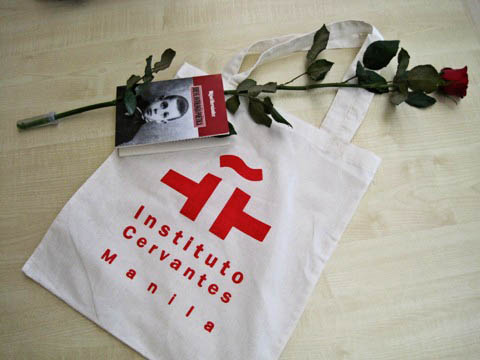
A rose for a book. The rose is the symbol of Saint George or Sant Jordi, the patron saint of Catalonia, whose feast day falls on April 23.
The practice dates back to 1926 in Barcelona, Catalonia when the first DÃa del Libro was celebrated on October 7, the supposed birth date of Miguel de Cervantes, who wrote Don Quijote de La Mancha. Barcelona-based Valencian journalist and writer Vicente Clavel Andrés conceived the idea of celebrating of a day dedicated to the Spanish book to recognize the efforts of publishers to promote reading. (Barcelona, then and now, is the publishing capital of the Spanish-speaking world.) A few years later, in 1930, the DÃa del Libro was moved to April 23, the date of the death of Cervantes. But why the rose? April 23 happens to be the feast day as well of Saint George or Sant Jordi, the patron saint of Catalonia, whose symbol is the rose. Saint George famously slew a dragon to save the life of a princess; a red rose bloomed where the blood of the dragon fell and Saint George presented the rose to the princess. Thus, in Catalonia, on April 23, it was traditional for a man to present a rose to his beloved. And since 1926, a woman would likewise present a book to her loved one. Today, roses and books are given not just to lovers, but also to friends and family members. In 1995, almost 70 years after the first celebration of the DÃa del Libro, the United Nations Educational, Scientific and Cultural Organization (UNESCO) declared April 23 as the World Book and Copyright Day to promote reading, publishing and copyright practices. The date was chosen to honor writers who died or were born on April 23: Cervantes and William Shakespeare, who both died in 1616, as well as El Inca Garcilaso de la Vega, Vladimir Nabokov, William Wordsworth, and Joseph Pla, among others.
Mercadillo de libros 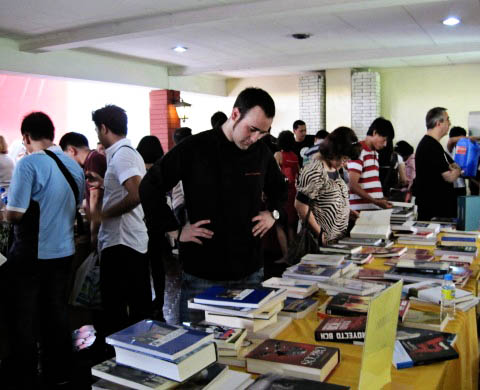
Mercadillo de libros. Books from major sellers were sold at deep discounts, some as low as P20.
In Manila, the DÃa del libro is always held on the Saturday closest to the 23rd so that the public can join the activities all day long. This year, the nearest Saturday fell on the 24th. At the Instituto Cervantes de Manila, the official Spanish Government Language Center founded in 1991 to promote the Spanish language and the cultures of Spanish-speaking countries, the highlight of this year’s DÃa del Libro was the mercadillo de libros or the book fair at the patio. From 10 am to 6 pm, books were sold at a discount, some for as low as twenty pesos. And with each sale of a book came a rose – as long as supplies lasted. Participating booksellers included Fully Booked, Powerbooks, A Different Bookstore, Anvil Publishing, National Historical Institute, Vibal Publishing, La Solidaridad, Benito Legarda, Tradewinds, Goodwill Bookstore, Tawid Publications, Amb. Virgilio Reyes Jr., and the Real Academia Filipina. One of the bestselling books was Cine español: Una crónica visual by Spanish film historian Jesús GarcÃa de Dueñas. The book presents a chronological overview of Spanish cinema and iconic images from every epoch.
Spanish films and kundiman At the Salón de Actos, there were various activities for the guest before and after browsing for books. After lunch, guests viewed Una casa de locos, a movie about European university students in Barcelona directed by Cédric Klapisch. It features a brief appearance by French actress Audrey Tautou (of Amelie and Da Vinci Code) as the girlfriend of the main character Xavier. Originally entitled L’auberge espagnole, a large part of the film is a first-person narration in French by Xavier. When he meets his housemates, the dialogue shifts to Spanish, English, Catalan, Danish, German and Italian. Children had a rare opportunity to collaborate on a video for two days, from April 23 to April 24, when they joined the video workshop La maleta de Cervantes to come up with a video on one chapter of Don Quijote. Nicolas Melini and Amanda Robledo, who have traveled to different countries to work with other children on other chapters of the Quijote, conducted the workshop. The kundiman, love songs of the Philippine revolution dedicated to the motherland, was the topic of the lecture of Dean Raul Sunico of the UST Conservatory of Music. Spanning the period from 1872 to 1898, the featured kundimans were performed by the Coro Tomasino, in some songs with Dean Sunico. The first set featured anonymous compositions that were heard in the provinces of Nueva Ecija, Cavite, Laguna and Bulacan. The second set was a series of songs and poems composed by Jose Rizal, Andres Bonifacio, Julian Felipe and Julio Nakpil.
Bersong Europinoy In the afternoon, spectators at the Salón de Actos were treated to a surprise – a balagtasan or debate in verse with poets Vim Nadera, Michael Coroza and Teo Antonio (who happens to be the son of Emilio Mar Antonio, hari or king of the balagtasan during the ‘50s). Coroza and Antonio debated on who was responsible for the widespread corruption in the Philippines today: the leaders or the people. Since the topic was politics, the poets inevitably made frequent references to the upcoming elections in May. Vim Nadera moderated the debate.
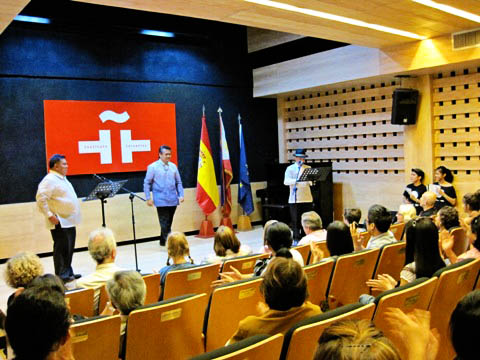
The balagtasan. From left to right, Michael Coroza, Vim Nadera and Teo Antonio in a jaunty black sombrero
Named for the Tagalog poet Francisco Balagtas, the first balagtasan took place in April 1924. The poetic debate is intended more for entertainment than for academic debate. Thus, the poets are expected to be witty and humorous, at times sarcastic, and yes, even theatrical. Big gestures, dramatic argumentation, debonair or colorful attire all have their place in the balagtasan. But the poets should never lose the logic of their reasoning. The surprise balagtasan was the culmination of Bersong Europinoy, a two-hour-long recital of poems in German, Czech, Flemish, Spanish, French, Romanian, Greek, Italian, Dutch, English and Filipino. Some of the Filipino poets who read their own works were Pete Lacaba, Marra PL. Lanot and Rayvi Sunico. Of course, what’s a Spanish festival without music and dancing? The DÃa del Libro in Manila ended with a Latin party, with music from the band Cubanila (combination of the words "Cuba" and "Manila") at the patio. –
YA, GMANews.TV Instituto Cervantes de Manila offers Spanish language classes and a series of free film screenings, art exhibits, lectures, concerts, book presentations and readings with Spanish and Latin American writers and dance and theater performances the whole year round. It is located at 855 T. M. Kalaw Street, Ermita, Manila near the UN LRT station. The author has attended the DÃa del Libro since it was first held in Manila in 2006. She and eight other students graduated from the 28-level Spanish language program last April 24, the first batch to do so in the Philippines. 

 GMA Brandtalk
 Tracking
 Archives


