There’s a Filipino saying about debts written in water, which is to say that that debts are never paid, as the waters can hold nothing. And then there’s a romance with the sea, premised on the waters flowing, where the sea is the site of letting go, of freedom, of calm. But in a country like ours, the sea also holds the narratives of tragedy, where debts are as long as the list of names that have been lost to its raging waters.
Pat Valera’s
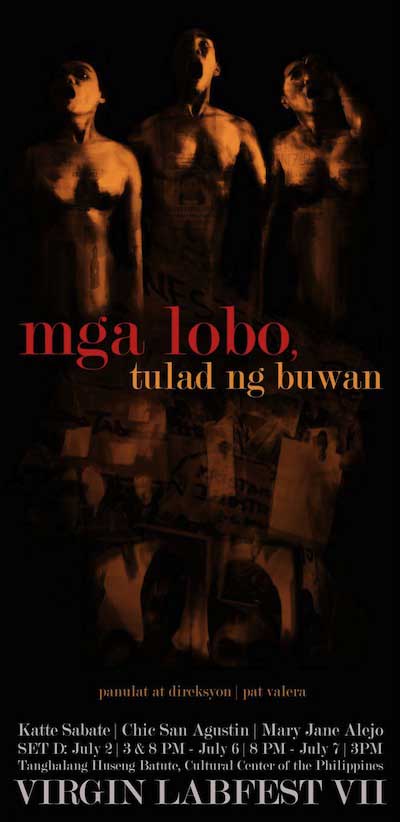
Mga Lobo Tulad ng Buwan is about this dark violent sea and the women left behind by its tragedies, reckoning with an aftermath that doesn’t seem to end because it’s ingrained not just in their memories, but in their bodies, in their hearts. The sounds of the sea, the women’s wails, the lullaby they sing are echoes of tragedy that we might never understand, that we will necessarily fail to speak of. But these three women, inextricably tied, tell their own story of agony and suffering, dulled by the passage of time, made stark by the act of forgetting. The mother, the pregnant lover, and the daughter reckon with this harrowing struggle together. In a friendship borne of loss, a common refusal to remember and forget, they are faced with the decision to either get caught in the tides of the waters or resist it with all their might. In the lives of those left behind, the waters will always be violent. It will always stand for what has been lost, what it has eaten alive. For these three women, it’s about the roles the sea took from them as well, roles that unravel in their memory banks: the daughter (Chic San Agustin) remembers her mother, the mother (Mary Jane Alejo) remembers her daughter, the pregnant girl (Katte Sabate) remembers her lover. These memories run alongside their stories about those who were once like them, but have since been blinded by the promise of a bright future, those who easily let go of memory, those who move on soon enough. The three women have been left behind by the people who lived, too. At this point these women are being sustained only by memory, unstable as that is, always questionable, necessarily subjective. There is a refusal to forget as there is a refusal to remember. This is their version of limbo: between moving forward and staying behind, between what’s lost and what remains, between what could’ve been and what is. It is limbo that’s about bitterness and agony, the kinds that only the woman must know to feel to the pit of their stomachs. It is limbo that’s about everything they’ve lost to the sea including the aspects of themselves that have been taken by the dead. That this limbo means an amount of insanity in these women is telling not just of their crisis, but of ours. Where we are unable to imagine this reckoning to be true, where we as a nation will easily forget if not refuse to acknowledge their existence. In these women are the insanities we cannot even fathom, as it is borne of grief that’s tied to their selves, and seems to be at the core of their beings. Yes, it can only be as highly charged as this, must only be as heavily emotional, owing not to the subject matter of death, but to the fact of grief and grieving that
Mga Lobo Tulad ng Buwan deals with. That it dares to navigate this void that is silenced, and force it onto the center of a stage is the gift of Valera himself. That this agony is made real, but more importantly deemed rational is what’s extraordinary here. The three actresses become a crucial part of this experience, especially given the instances of their individual reminiscences. San Agustin’s retelling of a daughter’s memories of her mother easily turns into a reckoning about her own faults, and on stage is a beautiful portrayal of bitterness turned vehemence. Alejo as the mother who reminisces about her daughter at the
perya, looking up at the lights, at the balloons, at the skies, was engaging in its rendering of pain that was tangible and true. It is Sabate though who shines a little brighter than the other two, with a childlike innocence that doesn’t get lost in the narrative of despair and pain, even when it is she who decides to ultimately be left behind. It is also in
Mga Lobo Tulad ng Buwan that the gift of a sparse stage becomes beautiful. This set was nothing but paper, a sea of it on the stage floor, an unstable platform made of it. From here rose the three women straddling a paper thin line between the rational and the insane, between grieving and anger, between the aspects of themselves that have died and the ones that live. The pieces of paper that make up the sea on that stage stand for every person killed by the waters. Here, and for once, the debts are clearly listed down. The payback remains unforeseen. -
YA, GMA News Mga Lobo Tulad ng Buwan by Pat Valera was part of the Virgin Labfest 7 at the Cultural Center of the Philippines. 

 GMA Brandtalk
 Tracking
 Archives