Ceramics can be scary for clumsy people like myself. The word itself sounds fragile and delicate, a warning to stay away from these breakable objects. Thus, it was with great caution that I looked at the Korean Cultural Center's first year anniversary exhibit called "Living Ceramics: The Modern Touch of Korean Heritage."
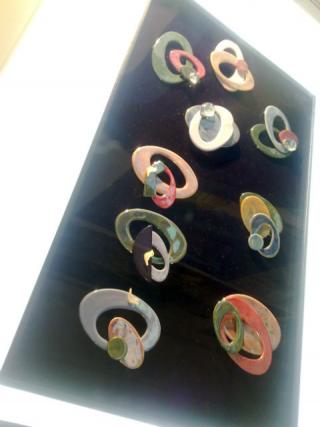
Eun hye Lee's Rhythm of the Season
Unlike in museums, where ceramics are safely tucked away behind glass panels, the Korean exhibit featured ceramics on display tables, with nothing to protect the dainty items from getting knocked over. This made me nervous, but as I looked closely at the various objects, I realized I was lucky to be able to see them up close. I didn't dare touch anything, but I could imagine how the smooth porcelain would feel. The exhibit featured ceramics designed by Korean artists Sy young Kim, Eun joo Lee, Sin hyun Cho, Ji-young Moon, Pan ki Kim, Bok ja Won, Sang man Kim, Jae kyung Lee, Hye young Cheon, Boo sun Kim, Shin bong Kang, Eun hye Lee, Se lim Yu, Youn jeong Seo, and Hee sook Ko. From Boo sun Kim's fashion jewelry to Ji-young Moon's unadorned porcelain jars, each piece in the exhibit held my gaze. Something about the ceramics made me stay a bit longer, admiring how the pieces were formed. Despite being shaped and polished by the artists, the ceramics had a charming roughness, reminding the viewer of nature. This was, after all, the exhibit's theme. Displayed against a backdrop of earth, wind, water and fire, the ceramics showcased Korean heritage. Sy young Kim's reproduction of Korea's black porcelain "allows the viewer to reevaluate the history of Korean black pottery and the artistic value of ceramic technology through the black porcelain work soaked with the natural colors deep black and rainbow. This black porcelain is an attempt at modern transformation in harmony with the color of Korean food," according to exhibit notes from The Korea Ceramic Foundation.
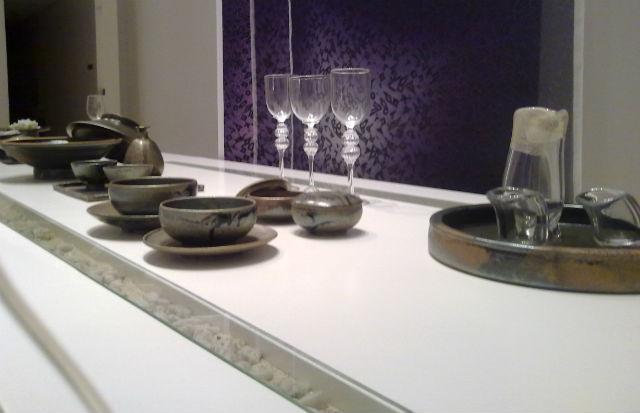
Sy young Kim's Black Glaze with Tableware
In Pan ki Kim's modern reinterpretation of the tradition of Korean celadon, he "juxtaposes pure celadon colors with iron glaze and silk thread, which underscores the transformation of it, reflecting the flow of time through color contradictions of the internal and external colors of celadon," the notes explained. Transparent oil glaze contrasts with self-nitrided white porcelain in Hee sook Ko's pure white ceramics, which combine industrialized pottery with handicraft work. Meanwhile, Jau jyung Lee works with the theme of "Eumgwang," (sound and light), using glass works to capture light, sound and memory. "The goal is to show the movements, the light, brightness and formation through the composition of the transparent glass," the notes said. One piece that's impossible to miss is the Moon Jar, not just because it's very large, but also because there's something almost hypnotic about its imperfectly round white porcelain.
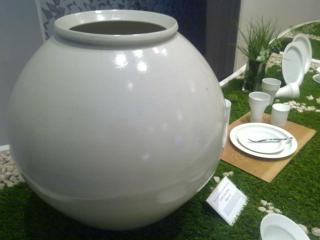
The Moon Jar is impossible to miss.
In Korea's traditional crafts, the moon symbolizes royal authority, the daily lives of Koreans, and Korean beauty, according to the Korean Ceramic Foundation. "As a simple and free expression of Korean beauty, the white porcelain Moon Jar contains the core of Korean emotions as well as the faith of the ancient East and West," the exhibit notes said. Sin hyun Cho's playful and colorful designs brought an unexpected burst of color to the exhibit, but the candy swirls were still subtle, complementing the simple designs. Se lim Yu's ceramics featured pretty blue and white traditional patterns, which were typical motifs during the Joseon Dynasty, which ruled over the Korean Peninsula for over 500 years. At the exhibit, visitors can watch a series of photos from artists who participated in the Gyeonggi International CeraMIX Biennale 2011. Different techniques in ceramics art are shown, including the use of a baby octopus to create designs with paint. According to the Korean Cultural Center, this is a method of Koreans for getting in touch with nature, along with the use of natural dyes. While the exhibit was not very large, each piece carried a part of nature with it. Admiring the ceramics, it was easy to imagine the nature that inspired the artists: the full moon, a smooth pebble, a flowing river, or a glowing fire against an inky midnight sky. –
YA, GMA News "Living Ceramics: The Modern Touch of Korean Heritage" runs from July 14 to October 12 at the Korean Cultural Center, 2nd Floor Mancor Corporate Center, 32nd Street Fort Bonifacio, Taguig City. For more information, call 555 1711. 

 GMA Brandtalk
 Tracking
 Archives


