

 GMA Brandtalk
 Tracking
 Archives

ADVERTISEMENT
Filtered By: Lifestyle
Lifestyle
Moon Cake Festival: good vibes, sweet bites when the moon is at its brightest
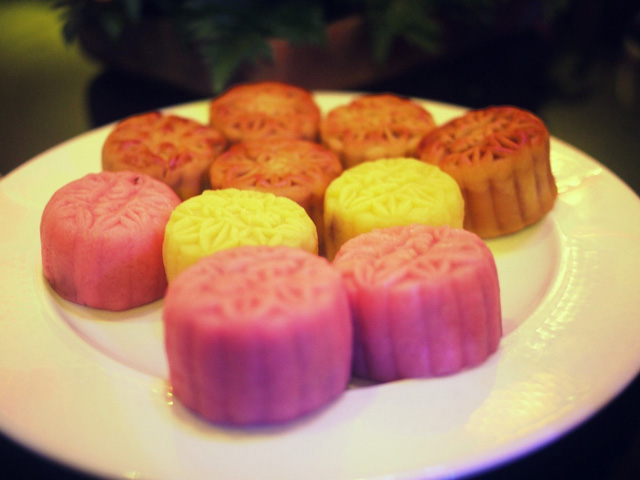
Moon cakes are meant to be eaten with loved ones during the Mid-Autumn Festival.
The moon has got to be the most effervescent element in the face of the universe.
Poets have written about its beauty and mystery, scientists have drawn conclusions on its phases and its effects on the earth. Deities have been worshipped, legends told, and myths passed on from generation to the next. It’s the favorite writer’s metaphor, a “regular” in horror flicks, especially where werewolves are concerned.
There may be a gamut of stories and beliefs about the moon, but if you live in the Philippines, where a lot of Chinese-Filipinos reside, chances are you’ve had a bite of the sweet, soft moon cakes and have heard of the moon cake festival.
Moon cakes are traditionally eaten with loved ones during the Chinese Mid-Autumn Festival, the second most important holiday for the Chinese after the Lunar New Year. It is celebrated during the 15th day of the eighth month of the lunar calendar, when the moon is believed to be brightest.
It is a time for bonding with family, welcoming the moon, and ushering in good vibes, wealth and harmony in the middle of the year. I say, what better way to take a look at the past six months and revitalize your goals for the remaining months!
Last September 29, I myself partook in the festivities at Mandarin Oriental Manila, where, together with members of the Chinese-Filipino community and surprisingly, a lot of Filipinos, we welcomed the moon with pageantry and style.
As Chinese-sounding as my surname is, I was not familiar at all with the paai shan ritual and the moon cake game pua tiong chiu.
But that night, I ended up going home with a box packed with hopia and my heart filled with positive vibes. It took a lot to restrain myself from singing the beloved Chinese classic “The Moon Represents My Heart” all the way home.
The Goddess’ radiance
I may be familiar with the ping yin and English translation of the song but my spare knowledge of Mandarin wasn’t enough to catch what international geomancer Master Joseph Chau was rapidly saying during the paai shan ritual.
Afterward he translated, “We are here gathered to pay respects to Chang’e.”
Legend has it Chang’e was the wife of Houyi, a heroic king in China. When Jade, the Emperor of Heaven, gives her husband the pill of immortality to safe-keep, Chang’ e accidentally swallows the pill and becomes immortal. She then chooses to live on the moon, the closest place on earth, where she can watch over her husband.
The incense sticks still burning, Master Chau asked us to utter our names, birth dates and our wishes, as he prayed to the Goddess of the Moon to bless us with positive chi and good luck.
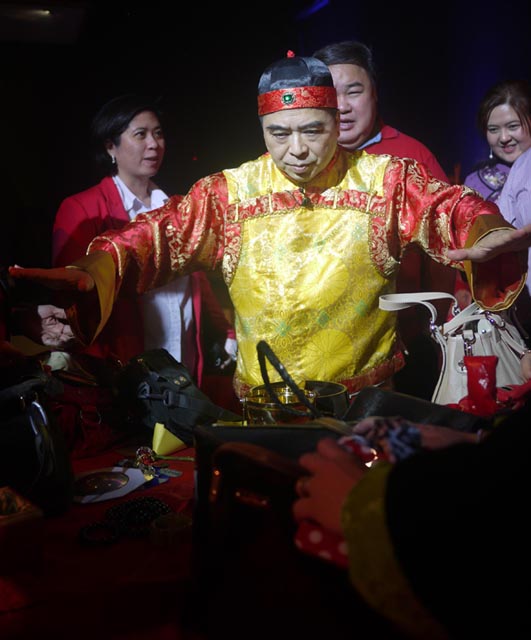
Master Joseph Chau prayed to the Goddess of the Moon to bless us.
“We pray for your radiance to shine upon everyone here,” Master Chau said.
Each of us was handed a colorful lit paper lantern for the lantern ceremony, which is one of the cultural customs practiced during the Mid-Autumn Festival. He then went around and blessed us with water, as we repeatedly chanted a Chinese phrase I do not remember.
My favorite part was when we were asked to approach his table and bring the things we want blessed. I was debating whether I should bring my camera and my phone, or my wallet, my camera, and my notebook.
“Why don’t you bring your whole bag,” my seatmate suggested. Her name was Yongkee, a Filipina, who fashions herself a mid-autumn moon and feng shui devotee.
“Kulto na namin ‘to e,” she said with a laugh, gesturing at our table, where her mom, sister, former officemate and his family were seated. She shared they attend the festivities yearly.
“Does it work,” I asked.
“So far, yes,” she answered.
So I brought my whole bag, opened it wide, and placed it on the middle of the table. Master Chau definitely could not miss it.
Sumptious lauriat
The dinner proceeded much like the ceremony did: simple and prompt, minus the frills.
How can a Mid-Autumn Moon Festival be complete without family and loved ones partaking in traditional Chinese cuisine?
Sweet and crunchy Peking duck roll, steamed shrimp dumplings dipped in mouthwatering chili sauce, steamed live garoupa, with the meat of the fish falling off the bones, my favorite vegetable pak choy steamed with oyster sauce and paired with a mushroom and shrimp mousse ball—good food that sat positively in my stomach.
But what earned the “oohs and aahs” of the festival participants was the dainty dessert platter, which included empress’ ginseng tea, the black sesame ice cream tart (I loved its grainy texture, like crushed cookies!!), and the traditional festival homemade moon cake.
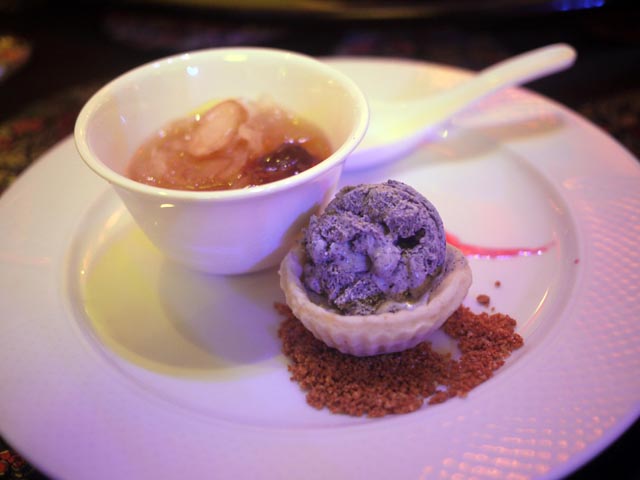
Empress' ginseng tea and black sesame ice cream tart
The dinner was graced with performances by the Chiang Kai Shek cultural ensemble. And what do you know, they actually performed “The Moon Represents My Heart”!
And as a perfect way to wrap up the night festivities, the guests were led upstairs in the MO lounge, where we played pua tiong chiu, or a moon cake game, known to Chinese Filipinos as hopia game.
I was rushing to go home, but somehow I stayed rooted to the table, wanting to bag the grand prize – the biggest hopia the size of a buffet plate.
Now, I’ve never won anything in raffles, but I got good runs rolling the dice, and I ended up taking home a box filled with hopia.
It was already 12 midnight when we walked out of the hotel. I couldn’t see the moon from where I was standing, but my brush with feng shui and positive chi was enough to make me believe the Moon Goddess was smiling above. –KG, GMA News

