

 GMA Brandtalk
 Tracking
 Archives

ADVERTISEMENT
Filtered By: Lifestyle
Lifestyle
Heart and soul: A taste of 'Forte@40'
Please, please don’t start dancing.
The thought crosses the mind as the volume is adjusted on the cellphone. The little communication device doubles as a portable music player as it’s made by an electronic company that made its name with music players. Matched with earphones up to the playback challenge, the music surrounds and conquers.
The Dum Dum Girls’ “Bedroom Eyes” plays a little louder, overpowering the numbing drone of passing vehicles along N. Domingo Street in Quezon City and the weekend’s early afternoon heat. The galloping 60’s girl-group, pop-glitter is infectious; the “jerk” and the “swim” pop into mind.
However, self-control and fear of looking like a lunatic stuff down the urge to get on down the road.
The listening experience ends as a new one is about to begin. The Lyric Piano offices come in sight, where the Piano Teachers' Guild of the Philippines (PTGP) are about to have a small concert. It’s a hint of what to look forward to in their “Forte@40” concert at the Cultural Center of the Philippines, scheduled for November 18. 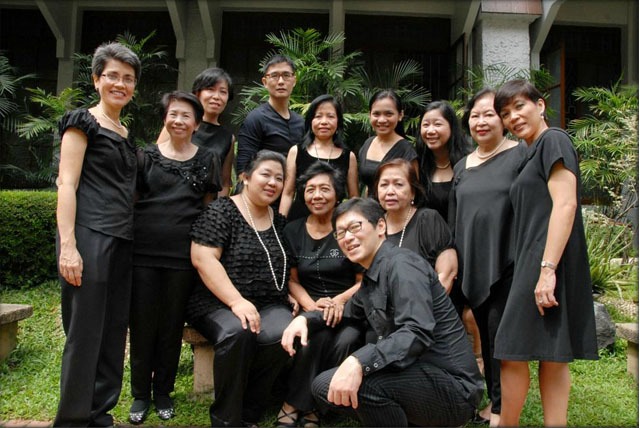
The officers and board members of the Piano Teachers' Guild of the Philippines pose for a souvenir shot as they prepare for 'Forte@40.'
But how classical piano pieces can wipe out the memory of the Dum Dum Girls’ retro-pop-on-acid fun is incomprehensible.
Inside the Lyric Hall, it’s a bit cramped as four baby grand pianos lord it over the room. There’s a bit of formal talk, including slightly heavy-handed instructions on how to write the story. But eventually it’s explained that the “Forte@40” concert celebrates the PTGP’s 40th anniversary by staging a concert involving over 300 pianists with ages ranging from eight to 80.
But most startling of all, 40 pianos will be crammed onto the CCP’s Main Theater stage as the grand finale of the concert is the premier of “Mga Gintong Pamana” by Augusto Espino. It was commissioned by the PTGP and features all 40 pianos played together by 80 pianists, two to an instrument. The piece is a grand tribute to great Filipino composers, most of whom need no first names: Abelardo, Santiago, Buencamino, San Pedro, Kasilag, Molina, just to half-name a few.
A mass piano concert this large has never been done in the Philippines. And the only other mass-piano concert that came to everyone’s mind was in London in May 2011, where around 100 young British pianists performed with 50 pianos at the Royal Festival Hall.
According to Anthony Y. Say, head of the University of Santo Tomas Conservatory of Music’s piano department and PTGP president, they rehearse the mass piano piece 20 musicians at a time. Lyric Hall can only accommodate so many pianists.
Say added that the November show should last about an hour and a half, with 10 numbers. Including the “Pamana,” the genres of music to be performed cover everything from Baroque to 20th Century to Filipino pop. 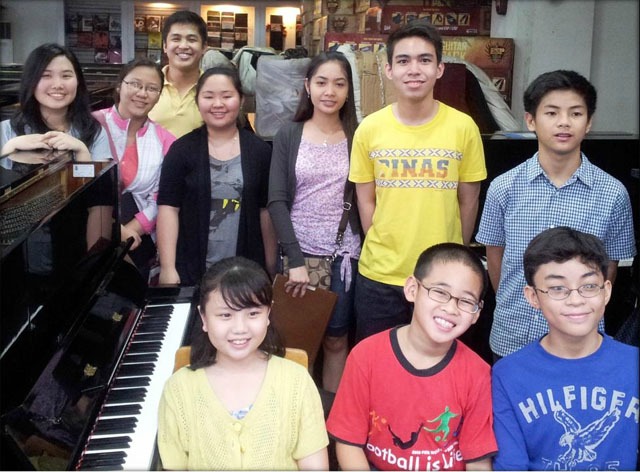
Young pianists will perform 'Harry potter Fantasy and Super Mario Capriccio based on a theme by Koji Kondo' by K. Bautista.
PTGP’s Say was kind enough to explain to a Dum Dum addled brain that 20th Century doesn’t necessarily mean familiarity to the common. It is avant-garde, where the piano playing doesn’t begin and end with the fingers. Rather, elbows, wrists come into play.
Say points to one of his former students, Kabaitan Bautista, who arranged two pieces for the big concert, one of which is the intriguing “Contagion on a theme by Nirvana” which will have 20 pianists on 20 pianos.
Pressed, Bautista did play a few bars of his material. It was a series of fluttering sounds, tingly and quick. A glance shows that his hands are moving up and down scales, quick and light, but purposeful. It’s not structured in the familiar musical form, but rather it is music stripped down to its bare purpose—its emotion triggered by sound.
But the afternoon’s program, and more proof in Forte@40’s pudding, is where the five musical numbers were performed by mostly young people.
The Grand Perpetual Motion by Michael Cox was performed by Denise Faith See, Lorenzo Medel, Aldrich Liao, and Sharon Jasminez on four different pianos. It was striking that they were so young. But it didn’t matter as they played with skill and aplomb, not only within their own talents and instruments, but coordinated as a group as well.
Furthermore, four pianos all together are not at all cacophonic. The size of the CCP’s Main Theater should handily accept the sound of 40 pianos.
And it only got younger.
When it got time for Valse Noble by Cornelius Gurlitt, Hansel Ang, Clarissa Li, and Yvonne Jael Ang scooched together onto one piano. They played the waltz with a feel for the music, it wasn’t just a mechanical bashing out. There were moments of pianissimo building to fortissimos. And they did it all six hands together.
Hansel was good enough to explain where his skill and passion came from. It came from years of exposure and practice, beginning when he was three years old until today, when he’s nine.
Also, he seems to come to the piano by default as that’s the only instrument his father plays. Haydn is his favorite composer. Not Bach, not Mozart, not Beethoven. “Haydn!” he insisted.
Be that as it may, he provides an encore—Aram Khachaturian’s “Sabre Dance.” With rapid staccatos, it takes precision and control to play this piece. It’s not the type of piano piece that you play at a whim on a weekend afternoon just because a roomful of people asked a nine-year-old to do so. Wait a minute.
Three numbers later, Mozart and Ryan Cayabyab’s music have all left their mark in the psyche. Leaving Lyric, it’s the kind of experience you want to have after any type of show. It lingers, echoes in the memory. You’re caught in that moment and you want more.
Walking in the reverse direction, the headphones are fished out. Wasn’t there a collection of Beethoven piano sonatas on file in the phone? –KG/YA, GMA News Photos courtesy of Piano Teachers' Guild of the Philippines

