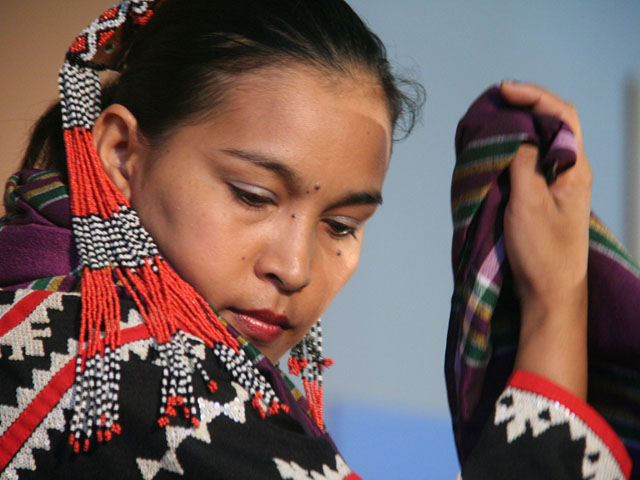
Performances of different indigenous groups entertained audiences at various areas in Bulacan's capitol, the venue for Dayaw 2012.
Surrounded by students under a cool and airy nipa hut, Lola Esleta Fuego happily entertained questions about the province’s iconic headdress, the
vakul. She came all the way from Batanes; her own
vakul, though, had been woven on the spot at Bulacan’s provincial capitol. “Hindi ko na maalala kung kailan ako nagsimulang gumawa niyan,” said the Ivatan with a quick smile before going back to work. Together with around 500 delegates from close to 40 indigenous groups coming from various parts of the Philippines, Lola Estela came to Bulacan to share her culture with visitors at the “
Dayaw 2012: Indigenous People’s Festival.” Spearheaded by the National Commission of Culture and the Arts (NCCA), the three-day gathering was not just a mere display of tribes, said chairman Felipe De Leon Jr. It was also an opportunity to learn and explore the “forgotten” characteristics of the Filipino. “The aim of this gathering is for our indigenous peoples to teach the nation their great heritage of cultural identity,” said De Leon during the festival’s opening on Tuesday. Metro Manila inhabitants like himself, he observed, have suffered from “collective amnesia” and must rediscover distinct traits such as a unique brand of creativity that has been diluted by foreign occupation in the past. “When it comes to everyday creativity, our indigenous peoples are at the top, and we should recover this kind of creativity,” said De Leon.
Traditional art as livelihood For indigenous communities that are among the country's lower income groups, De Leon said the Dayaw festival was a venue for cultural industries to be discovered. “We are trying to identify the masters of traditional art in this country…so not only can they continue producing their works but [also to] help them sell [their products],” said the NCCA chairman.
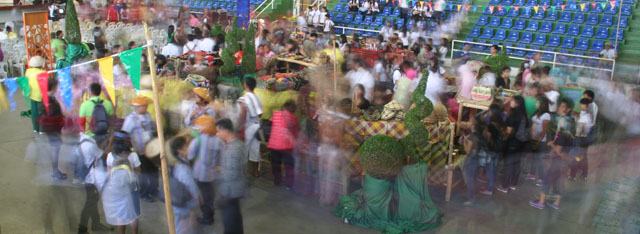
Dayaw's tiangge put the spotlight on cultural industries, with hopes of exposing indigenous products to more consumers.
In a forum, tourism consultant Chen Mencias explained how creating tourist attractions has been envisioned as a method of poverty alleviation, especially for indigenous peoples (IPs). However, she warned the audience that tourism itself is also a threat, since it subjects groups to the risk of getting treated as a cultural commodity. For example, Mencias shared how cultural immersions have limited some IPs to costume-wearing and photo-modelling stints for a measly fee of Php 20 per shot. “Where is the dignity in that?” Mencias rhetorically asked the audience of students and IP leaders. In an interview, she said that such a situation “is the fault of everyone” since “there is no intention to do it differently.” “We’re promoting the same kind of practice na picture-picture-an lang sila but no one is really going out of their way to really put it all together and have an honest-to-goodness product, integrating IPs and the natural environment. That has to be done,” Mencias told GMA News Online.
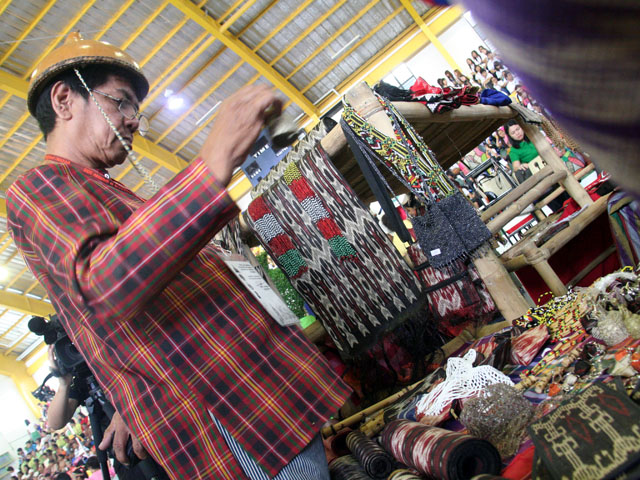
A man checks a T'boli-made brass bell, one of the wares for sale at Dayaw Festival's tiangge which features products from various provinces.
Shielding ethnic groups and their immediate environment from exploitation and corruption should be any tourism plan’s priority, she added, in order to preserve and promote culture and for IPs to rightfully reap its benefits. Citing Pine and Gilmore's Progression of Value
framework in the forum, she said that providing tourists with an extraordinary experience is the best service that can be offered without destroying people, place, and culture. “Tourism, by nature, talagang nakakasira,” reminded Mencias.
Educating generations Dayaw 2012 became a field trip for students from nearby schools as they watched cultural performances of various groups. Some even tried their hand at recreating the handicrafts. Nico Corregidor, an education major at Bulacan State University (BSU), was busy trying the local art of Puni (leaf fronds folding) with his friends, learning from an owner who has made a business out of the craft. “Nagka-interes [din] ako sa pabalat ni Lola Luz Ocampo,” he said, recalling how the 90-year-old woman could make intricate cut-out designs on paper that served as sweets wrappers.
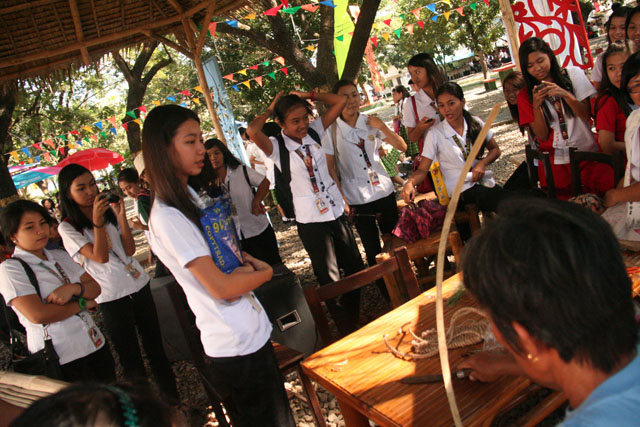
Young people have much to learn from Dayaw, as the festival invites everyone to look back in history and appreciate colorful yet forgotten cultures that collectively define the Filipino.
Gigi Garcia, who was teaching Puni to the students, said that while craft makers can be found anywhere in the Philippines where buko trees thrive, “kine-claim ng Bulacan, dito lang may nagtuturo.” For BSU teacher Raymond Carlos, who brought his tourism students to the festival, Dayaw can expose the younger Filipino generation to cultures that thrive beyond a student’s usual scope of perspective. “The schools and communities, kapag nagsasanib-pwersa kasi, parang mas lalong lumalawak ang kaalaman ng mga estudyante natin sa kultura natin,” said the Asian cuisine teacher. Mike Abad, head of the Iranon-Maguindanao-Maranao cluster, called Dayaw a form of peace for all Filipinos, whether they belong to any indigenous community or not. “Sa panahong ito, (may) pagkakaisa kung saan ang katutubong sayaw at awitin ay napapakinggan ng halos buong Pilipinas,” Abad told GMA News Online. He said the younger generation should remember that “doon tayo nagsimula sa pagiging etniko hanggang sa naging modernized. Kailangan nating lingunin ang pinagdaanan ng ating mga ninuno.” But beyond the usual frills of any festival, Dayaw reassured ethnic groups that they are not alone in the struggle to preserve traditional Filipino culture. “Akala namin ay mawawala ang kultura, kami lang ang nagmamahal,” Datu Roger Limbolong, a Tigwahano native from Bukidnon, told GMA News Online. “Napapagod ka [sa pagsali sa Dayaw], totoo, pero nawawala dahil nakikita mo ang mga tao na pinapahalagahan ang kultura.”
–KDM, GMA News 

 GMA Brandtalk
 Tracking
 Archives


