

 GMA Brandtalk
 Tracking
 Archives

ADVERTISEMENT
Filtered By: Lifestyle
Lifestyle
Faith, movement and airiness at the 2013 Metrobank Art and Design competition
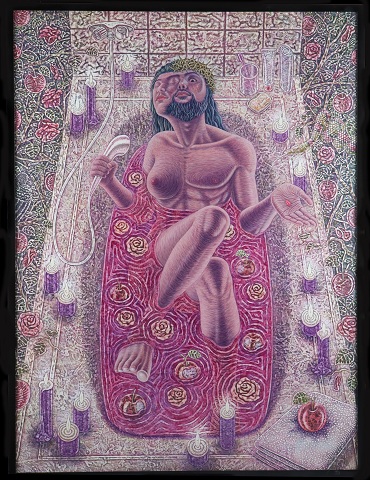
Alvin D. Florentino's "Nilay-Nilay". Photo courtesy of MADE
Florentino's “Nilay-Nilay” is a split-human, half-man and half-woman, cleansing itself in a tub of bitten apples and red roses. A challenging look haunts the Christ-half of the figure's face, while its womanly side relishes the apparent cleanliness the wash brings.
“Intercession”, Pajarito's abstract piece, drives to connect the interlocking series of reds, greens, and whites slicking the surface of the painting by the use of a singular, solid figure – the “divine.”
These two pieces were among the prize-winning artworks recognized during the 2013 Metrobank Art & Design Excellence (MADE) competition. MADE, which has been around since 1984, seeks to recognize the best of the Philippines' artistic talents.
Florentino explained “Nilay-Nilay”'s theme, which comes from the yearly Visita Iglesia pilgrimages Filipinos make every Holy Week.
“Pinupuntahan po natin yung iba't-ibang church... Isang beses lang yun [sa isang taon]. Tingin ko, 'di naman kawalan sa atin na kahit papano magbawas tayo ng kasalanan kahit man lang sa ganoong panahon,” he said.
Meanwhile, Pajarito pointed out that his painting's focal point, the solid figure, is the church, surrounded by people who interconnect in a wide web, yet always ending up in this center, waiting for a mediator to connect them with a meaning beyond their reach.
“Para sa akin, yung human at divine, hindi talaga tayo maka-connect sa divine, kasi human lang tayo, kaya meron tayong may namamagitan sa atin, parang mediator,” he said.
Vindication
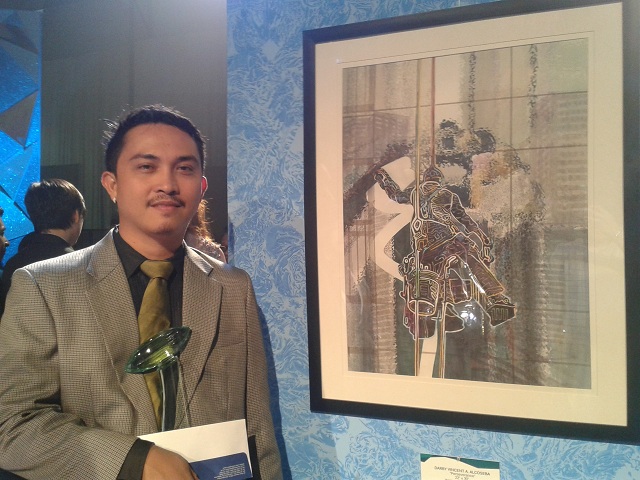
Darby Vincent Alcoseba and his work, "Perseverance." Photo by Rie Takumi
He chose a window cleaner as his subject, contrasting his happiness with the job, despite of the danger, with the people within the windows he cleans, who are hollow despite the economic and physical safety they enjoy.
Alcoseba was pleased that his work earned him a MADE award, which he considers to be his most prestigious win to date. Impressive, as the fourth-generation artist admitted he didn't even want to paint at first.
“Sa totoo lang, iniiwasan kong maging artist.... I decided [to take] Computer Engineering para umiwas sa painting, pero hindi ko alam na painting na pala ang magmo-move sa akin sa kung ano ako,” said Alcoseba, who paid his tuition with profits from selling his paintings.
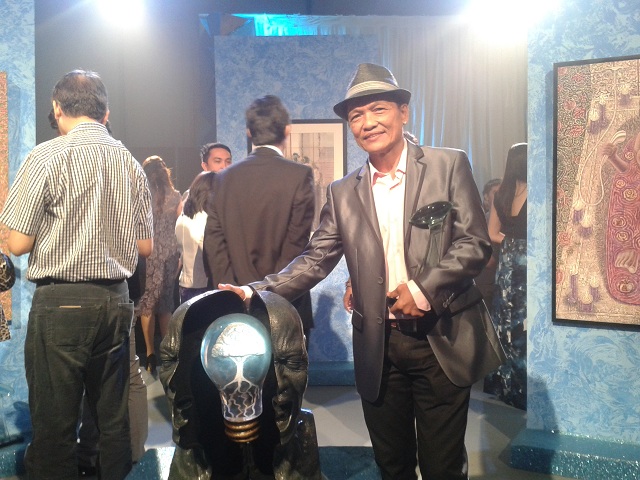
Sculptor Merlito V. Gepte poses with his winning entry, "Bulalas." Rie Takumi
A 59-year-old sculptor, Merlito V. Gepte, considers his win a boon from God for his lifetime dedication to the arts. “Bulalas” shows a bust of a man screaming, with the bust opening up to a light bulb which contains a sprightly tree.
“Kung makita mo yung bumbilya, yung bumbilya that is idea or knowledge, diba? At meron siyang puno sa loob, na malago, mas mahaba yung ugat, na maganda yung kanyang pagyabong,” he explained.
He said the piece came from his own life, his own primal scream - a proclamation that he will not lose hope.
“Yun yung sinasabi kong pag-asa; na kahit na matanda ka na o lugmok ka na, 'wag kang susuko, kasi may pag-asa. Kaya gusto kong isigaw 'yan, dahil karanasan ko 'yan eh,” he said.
Interior design and architecture

“Kung makita mo yung bumbilya, yung bumbilya that is idea or knowledge, diba? At meron siyang puno sa loob, na malago, mas mahaba yung ugat, na maganda yung kanyang pagyabong,” he explained.
He said the piece came from his own life, his own primal scream - a proclamation that he will not lose hope.
“Yun yung sinasabi kong pag-asa; na kahit na matanda ka na o lugmok ka na, 'wag kang susuko, kasi may pag-asa. Kaya gusto kong isigaw 'yan, dahil karanasan ko 'yan eh,” he said.
Interior design and architecture
The architects behind "Agos" and their winning design. Rie Takumi
Participants in the interior design and architectural design part of the competition were confronted by the daunting task of conceiving functional, innovative, and sustainable developments which would invigorate famous public spaces.
The Cultural Center of the Philippines played the figurehead for the design problem that participating architects needed to solve with their entries. A team composed of architects Jason Romeo Abustan, Anne Lorraine Caban, and Jonathan Sadorra endeavored to recreate the successful work that renowned architect Frank Gehry did with Bilbao, Spain.
 “In Spain, the urban decay in the area, in the city, Frank Gehry designed a structure that aims to uplift the area. Basically, the idea is for the CCP area... to be uplifted to a better area. That's a solution for the existing environmental and current development of this area,” said Abustan.
“Through 'Agos', we make things move like water for travelers and bypassers... [to be] moved by the cultural and historical essence of the Philippines,” said Sandorra.
Caban said said they made sure to incorporate their design into the existing CCP complex, composing a structure that simulates fluidity and undulating grace.
Anne Astrid Sangil created “Habi”, a re-imagining of the Manila Doctor's Hospital's public spaces. “I want to showcase the best in the Philippines, that's why I wanted to focus on something very Filipino... That's why I wanted to use the concept of weaving- not just literally weaving things, but the idea of mixing different things in the Philippines, like the culture, natural resources, climate, and of course, the people,” said Sangil.
The weaving motif of her entry removes the sterility and claustrophobic spaces hospitals have without compromising its efficiency and cleanliness. By adding light through mirrors, and replacing concrete and carpet with fibers and textiles, a “maaliwalas” effect is achieved. — DVM, GMA News
The Cultural Center of the Philippines played the figurehead for the design problem that participating architects needed to solve with their entries. A team composed of architects Jason Romeo Abustan, Anne Lorraine Caban, and Jonathan Sadorra endeavored to recreate the successful work that renowned architect Frank Gehry did with Bilbao, Spain.
"Agos," the award-winning design concept for CCP. MADE
“Through 'Agos', we make things move like water for travelers and bypassers... [to be] moved by the cultural and historical essence of the Philippines,” said Sandorra.
Caban said said they made sure to incorporate their design into the existing CCP complex, composing a structure that simulates fluidity and undulating grace.
Anne Astrid Sangil created “Habi”, a re-imagining of the Manila Doctor's Hospital's public spaces. “I want to showcase the best in the Philippines, that's why I wanted to focus on something very Filipino... That's why I wanted to use the concept of weaving- not just literally weaving things, but the idea of mixing different things in the Philippines, like the culture, natural resources, climate, and of course, the people,” said Sangil.
The weaving motif of her entry removes the sterility and claustrophobic spaces hospitals have without compromising its efficiency and cleanliness. By adding light through mirrors, and replacing concrete and carpet with fibers and textiles, a “maaliwalas” effect is achieved. — DVM, GMA News

