

 GMA Brandtalk
 Tracking
 Archives

ADVERTISEMENT
Filtered By: Lifestyle
Lifestyle
Ang Lee: 'My entire life is a film school, I never stop learning'
For the first non-white and the first Asian to win the Academy Award for Best Director (twice), 59-year-old Ang Lee is a soft-spoken, modest man, his face pleasant, his humor self-deprecating.
Though sharply dressed in a coat and tie, his bearing is that of someone at ease in his own skin.
Though sharply dressed in a coat and tie, his bearing is that of someone at ease in his own skin.
After he was awarded this year’s Lino Brocka Award from Cinemanila by director Tikoy Aguiluz at the end of the “A Salute to Ang Lee” at SM Aura’s IMAX theater on November 28, he put his palms together and bowed to applause from an audience of diplomats, press, indie filmmakers, and film students.
“My entire life is a film school—I never stop learning,” revealed the Taiwan-born director at the Q&A that followed a special screening of his critically and commercially successful “Life of Pi,” based on the 2001 Yann Martel novel of the same name.
He jokingly stated that he never quit making movies because he does not want to retire unsuccessful and because his microbiologist wife, Jane Lin, would kick him out of the house if he did.
“I think, for as long as I have the stamina to make movies, I still want to make them,” he said. “I still want to make movies, I don’t know what keeps me up. I feel like I’m the slave, not the master of filmmaking.”
“A Salute to Ang Lee” was arranged by The Taipei Economic and Cultural Office in the Philippines. It was Lee’s first time visiting the Philippines, and he said he was “looking forward to becoming friendly with you all.”

Director Ang Lee receives the Lino Brocka Award.
Ang Lee, indie flicks, and a love of movies
Lee was born to mainland Chinese parents in Taiwan. After an education at the National Taiwan College of Arts in 1975, he moved to the US and graduated with a theater degree at the University of Illinois, where he met his wife, and an MFA in film production at New York University.
He prefers making films to actually writing them, stating that the latter is “very lonely and painful” while the former allows him to work with other people.
He prefers making films to actually writing them, stating that the latter is “very lonely and painful” while the former allows him to work with other people.
“So, once I’m established…I don’t have to write anymore,” he said, smiling, adding that he does work very closely with the writers, especially those of the books he’s adapted for film. That said, he refuses to be a translator for a book.
He added working with people isn’t always fun. “Making movies is fun but sometimes, dealing with people is not fun. It reminds you of a reality; this world has gravity—no matter how much you fly, like ‘Crouching Tiger, Hidden Dragon,’ you still have to land and deal with people. And the more experience I have, the more I can see where people come from. You can get really irritated.”
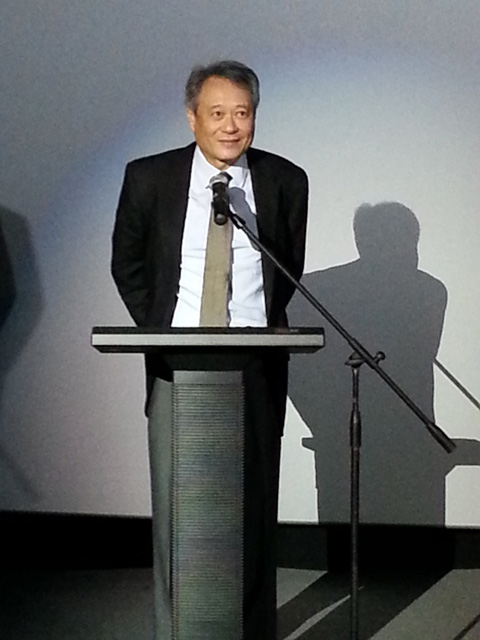
"Making movies is fun but, sometimes, dealing with people is not fun. It reminds you of a reality."
He stated that his first few films were mainstream and “slapstick” as one media personage put it, but it was clear that he had a soft spot for indie films, having made quite a few himself.
“I think a movie is spiritual. As long as you do your best. I don’t want to set boundaries, I don’t want to have a style,” he said.
He tends to think of even his most expensive commercial films—such as the 2003 flop “The Hulk” starring Eric Bana, which actually made him think of retiring—as arthouse films and that some of his actual arthouse films like “The Wedding Banquet” more commercial in terms of film language.
“It’s no different from when I made my student films. I just try to make it work,” he said, also stating that he did not like to be categorized as a filmmaker.
“It’s no different from when I made my student films. I just try to make it work,” he said, also stating that he did not like to be categorized as a filmmaker.
“Someone said when you talk about independents, you have to be wacky or…austere so you can go to film festivals, so that you get a notation from film critics. I never really do that. I just express myself doing what I think I’m doing my best, find my audience, and somehow it works out for me.”
Lee explained that his feeling like an outsider in both Taiwan and in America and not feeling absolutely culturally rooted in either helps him get to the subtext, to what the movie is all about, faster.
Being an outsider makes him more diligent with his research and doesn’t allow him to assume that he knows about the cultural milieu in which he is filming—which makes him an astute student of human nature and its complexities.
Being an outsider makes him more diligent with his research and doesn’t allow him to assume that he knows about the cultural milieu in which he is filming—which makes him an astute student of human nature and its complexities.
The self-professed “I-make-one-movie-at-a-time kind of guy” cited how many Indians felt a sense of ownership toward “Life of Pi” that makes him feel proud of his work.
When asked if he really goes out on a limb to film fantastic or magical realist movies, Lee answered that he tries “not to think about it. If I understand it, I probably won’t make it.” He stated that he makes whatever strikes him.
“Through pretense, you catch the truth. I think that’s the deeper level of whether you’re making an artistic film or a slapstick or a guilty pleasure or a very violent action film, what have you. I grew up in Taiwan, what do I have in common with a gay cowboy in Wyoming? But I read the short story and I cried.”
“At the end of the day, a movie is inspiration, it’s not about statement. It’s not about ‘I know this thing, I made a statement, I made a movie, you watch’—it’s really about inspiration. It’s a provocation. I think you make it enough so that people can make the movie in their head. I can never make a movie that’s as good as how people imagine,” he said.

"You just have to be patient and little by little find where your audience is."
Advice for Asian filmmakers
Lee also said the landscape is changing to be inclusive of non-American filmmakers.
“I think the times are better now. There are different ways to express yourself. You don’t have to conquer, you don’t have to overcome. You don’t have to, like, figure out your problem and the whole world will turn into Disney World,” shared Lee, getting a few laughs from the audience.
“You don’t have to follow the rules. You can show the saddest ending plus feel emotional—and okay, it’s kind of lukewarm in America, but you find your audience. You can survive.”
That said, he did say that an aspiring filmmaker has to know the film language of Hollywood and America in general. “There’s a certain cultural label, a way of thinking, operating. You could work against it, but you just can’t ignore it,” he explained.
“So, for those of you who are interested in bigger filmmaking and more mainstream movies and who want to break into Hollywood, you have to know film language and you have to know how to deal with it. You don’t want to a be a slave to it for the rest of your career.”
Often asked by the Western press whether he was free to do what he wanted when making movies in China, he said: “I tell you what, I get irritated. You know, the most un-free place to make movies is America—not politically, of course, but American film, particularly Hollywood, is an establishment."
He continued, "It’s not only financially, it’s film language—how things operate, ideology, all that has to function a certain way. Movie after movie, I try to break away, but I always have to negotiate with it.”
He also said that, “You have to know your craft to either adapt or negotiate to make a difference. You have to know your stuff. Don’t look down on them or you don’t have a chance. You have to deal with them, confront them.”
And above all: “You just have to be patient and little by little find where your audience is. And I think, there are more chances of making movies.” — JDS, GMA News

