

 GMA Brandtalk
 Tracking
 Archives

ADVERTISEMENT
Filtered By: Lifestyle
Lifestyle
Days in the Faith Underground: Inside the devotion to the Black Nazarene
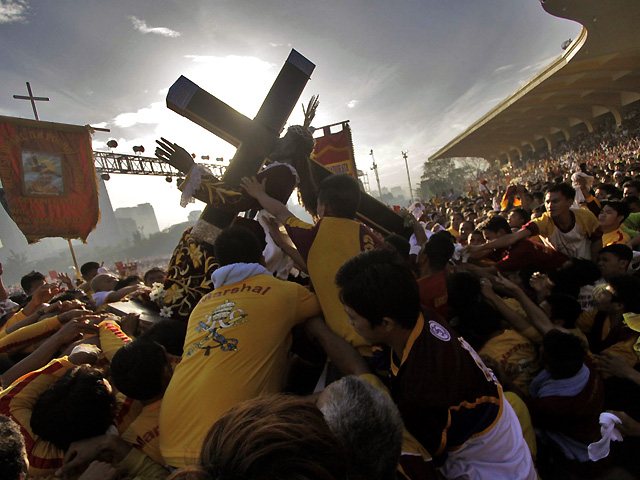
Thousands swarm around the Senyor, as the image is known, during the Traslacion, as seen in this photo from January 2012. Danny Pata
Reprinted from the book “Report from the Abyss”
Anybody who’s spent five minutes in a mosh pit knows the violence of chaos theory in action. You dive in and no formula can tell where, or if, you come up. In a country where anything can be backed by “You and what army?” there’s no better illustration of the crowd as pure body politic than the Traslacion of the Black Nazarene.
I don’t care who you are. If it’s your first time (especially if it’s your first time) you have not beheld anything as astounding as the Feast. Held every January 9, the Traslacion procession marks one of the three occasions when the seven-foot image is brought out and paraded around the Quiapo district. Both processions refer to the transfer of the image to the Minor Basilica. As early as 3 AM, devotees start trickling into Plaza Miranda waiting for the procession to start at 2 PM. By around 10 AM, the body count is 250,000 and growing, and the traffic is in a fantastic snarl. Security, if you can imagine it, is a nightmare.
* * *
“You get the hang of it,” shrugs Desiderio Salvador.
Salvador used to be the president of the Comite de Festejos. He organized the monstrous affair for 16 years running. Salvador and his partners always try to impose a semblance of control during the event. It is futile. So what they do is set up an uber-planner’s dream of paramedic teams, coordination with the local police detachment, the bomb squad, the mayor’s marshals, about 20 roving security guards, and an army of church volunteers.
Salvador used to be one of the young men in the crowd. Now, in his late 50s, Salvador only participates through the Comite.
“Their faith is strong because all of one’s wishes, one’s petitions are granted by the Senyor,” Salvador explains the crowd’s zeal.
The image’s complete title is Nuestro Padre Jesus Nazareno. But to Salvador, and others like him, Senyor is the fond name they use to refer to their patron. Like a reverent nick you would give to a beloved elder or close friend.
“Everyone has a personal reason to be here,” Salvador gestures to encompass the anxious crowd.
Faith, after all, is still a private affair. Even if you can’t drop a pin on Feast day, the heart of the practice isn’t joining the crowd; it’s the yearning for a benevolent force bigger than yourself. The Senyor fills this religious hunger like a boundless fount.
* * *
The Senyor is the personification of suffering. He is the patron of the bloody but unbowed, the ragged man-on-the-street, the perpetual underdog. Whoever you are, whatever you’ve done, the Senyor knows you thoroughly, understands you thoroughly.
The Senyor knows how it feels to work a 10-hour grind frying French fries and burgers, he knows how it is to clean windows for a living dangling 20 storeys up without a safety platform, how to subsist on minimum wage with seven mouths to feed, how to sit for months at a picket line and be uncertain of the future, to serve out a wrongfully accused sentence in a maximum security prison, to watch a daughter afflicted with a fatal disease die slowly and painfully because treatment is not an option, to sleep on cold asphalt with boxes for blankets, to begin in poverty and end in poverty, to be bereft of all hope.
To this despair the Senyor says: I AM hope.
“Religion is something that you live, after all, not something that you thought about one afternoon and fancied,” affirms Teresita Obusan, Ph. D. For seven years now, Obusan has been immersing herself in the world of Quiapo in a bid to study the district as a microcosm of Philippine culture. She is quick to point out that the devotion to the Senyor doesn’t fit the definition of a cult. A cult, unlike the unambiguous display at the Feast, usually seeks to hide its practices, its worship and doctrines.
Still, why such a vicious show of it? Obusan posits that the devotion to the Senyor is a faith of basics, stripped of everything but the essential: it is concerned less with a good afterlife than it is in receiving assistance now, while one is alive. When this help arrives, it elicits a visceral reaction common to those who experience the gifts of the Senyor for the first time: the cathartic sobbing shared by new devotees. So while going to heaven or hell may be at the back of every good Catholic’s mind, it is the secret, underground desire for divine intervention that this faith unearths.
Sure, it would be great if you can promise a family that their toddler with a brain tumor will go to heaven, but any parent will tell you that they’d prefer a few more years spent with their kid than a guaranteed ticket to paradise. Fortunately, the Senyor rarely fails to deliver.
“This is a god whom they understand as somebody who died for them exclusively. So they love, and must love fervently, somebody who is willing to undertake such a sacrifice for them,” Obusan rationalizes and holds out her palm. “To the masses, there is no other way to reciprocate.”
* * *
The Feast is only one of the ways to do this, though. Others, women mostly, fulfill their panata by praying to the images enshrined at a small chapel (dubbed aptly, the Sanctuario) at the back of the church every Friday (especially every first Friday of the month, thus the catchphrase “Biyernes sa Quiapo”). The start of many vows is a quaint but common story.
The Senyor comes to you in a dream and he calmly, casually asks you to pay him a visit at Quiapo. It all starts from there.
Gigi Camballa is the administrator of the Quiapo parish office. For her, stories of the miraculous have become commonplace since she stepped up to the position four years ago. Paraplegics would arrive in crutches and leave walking and ex-convicts would clasp their hands in prayer and give thanks for an early release. Such marvels aren’t unusual, but the visitation through dreams is still the most frequent miracle.
* * *
The truth is the Black Nazarene isn’t an indigenous conception. The original Black Nazarene was a real cult in Mexico with its own legendary story. A Mexican sculptor fashioned our image of the Black Nazarene and sent it here, arriving on an Acapulco-Manila galleon in 1606. It was then enshrined in Intramuros and then transferred later to Quiapo.
The Nazareno’s resiliency and fortitude add to its mystique. It has survived numerous fires and quakes. But the story that devotees like to tell is how the image survived, unscathed, while the whole of Quiapo burned down around the Senyor’s ears in a hail of bombs and bullets in World War II’s Battle for the Liberation of Manila. Scholars have a simpler explanation: the image in Quiapo today is not the original. Wood and aluminum isn’t very hardy. True enough, the image devotees bring out on January 9 and Good Friday is a fairly new one, with only the head of the original attached to it to stand in as proxy. But on Feast day, nobody cares about this irrelevant subject.
The intensity of the procession itself defies interpretation. A little past noon, the Bishop and priests stand on a balcony above the parish office and anoint the congregation with holy water while everybody sings “Cordero ng Dios” in a slow, solemn tone. Different shirts denote allegiances to different organizations, estandartes that proclaim these group names are repaired and fixed and then drift back ready into the crowd like war banners.
They came from everywhere, even overseas. I even saw a Japanese tourist couple standing underneath the balcony, euphorically crying their eyes out like bona fide devotees as the Bishop showered them with holy water. At a tad past 12PM the barefoot crowd grows apprehensive as the January sun raises the humidity to oven point. By 1:30, they’re ready to ignite.
When the church gates finally open, you can hear the collision as the crowd and the carroza rush to meet each other. Then, everyone in the sea of multitudes raises their hands, waves their white towels and shouts, “Viva! Viva El Senyor!” It is the voice of legion given a palpable, jubilant singularity. This sound rises. And rises and rises.
Blink and you might miss the Senyor’s movement. Children are raised on shoulders or put on higher ground for them to catch a glimpse. People jostle and are crushed, towels are thrown up to the small cluster of marshals atop the carroza, who dutifully wipe them on the image’s face or hand then throw them back down. All this while trying to keep thousands of people from swarming the Senyor. As the carroza fades out of view into Villalobos Street, Desiderio Salvador smiles wanly, exhaustedly at another year accomplished.
“The only thing we want,” he confesses, “is for tradition to be maintained.”
Salvador’s concern is understandable. What he calls the “preservation of the Feast’s continuity” can easily fracture due to any number of issues, from faulty planning, to petty infighting among the 20 plus organizations involved. Both and more are vital to preserving the devotion’s fragile trinity: the surrender to belief, the panata, and the procession. Among them, the last is deemed most important because the procession blesses you and gives a sense of affirmation and closure to the first two. At the end of the day it makes you just glad to be alive. This is the ambition and glory of its faith.
“Though the Nazarene procession may have a foreseeable end,” declares Obusan, “the primal and moving spirit behind it will continue forever.”
Postscript
In 2013 a count of nine million people came to the annual January 9 Feast of the Nazarene, with more than 500,000 devotees going barefoot. Organizers have since diverted the main event of the procession to Quirino Grandstand at Luneta Park. Plaza Miranda has become too small to hold the devotees.
Karl R. De Mesa is the author of the non-fiction collection “Report from the Abyss” (Visprint) and the co-editor of the anthology “Demons of the New Year” (UP Press). Both are available in print and ebook formats.
Anybody who’s spent five minutes in a mosh pit knows the violence of chaos theory in action. You dive in and no formula can tell where, or if, you come up. In a country where anything can be backed by “You and what army?” there’s no better illustration of the crowd as pure body politic than the Traslacion of the Black Nazarene.
I don’t care who you are. If it’s your first time (especially if it’s your first time) you have not beheld anything as astounding as the Feast. Held every January 9, the Traslacion procession marks one of the three occasions when the seven-foot image is brought out and paraded around the Quiapo district. Both processions refer to the transfer of the image to the Minor Basilica. As early as 3 AM, devotees start trickling into Plaza Miranda waiting for the procession to start at 2 PM. By around 10 AM, the body count is 250,000 and growing, and the traffic is in a fantastic snarl. Security, if you can imagine it, is a nightmare.
* * *
“You get the hang of it,” shrugs Desiderio Salvador.
Salvador used to be the president of the Comite de Festejos. He organized the monstrous affair for 16 years running. Salvador and his partners always try to impose a semblance of control during the event. It is futile. So what they do is set up an uber-planner’s dream of paramedic teams, coordination with the local police detachment, the bomb squad, the mayor’s marshals, about 20 roving security guards, and an army of church volunteers.
Salvador used to be one of the young men in the crowd. Now, in his late 50s, Salvador only participates through the Comite.
“Their faith is strong because all of one’s wishes, one’s petitions are granted by the Senyor,” Salvador explains the crowd’s zeal.
The image’s complete title is Nuestro Padre Jesus Nazareno. But to Salvador, and others like him, Senyor is the fond name they use to refer to their patron. Like a reverent nick you would give to a beloved elder or close friend.
“Everyone has a personal reason to be here,” Salvador gestures to encompass the anxious crowd.
Faith, after all, is still a private affair. Even if you can’t drop a pin on Feast day, the heart of the practice isn’t joining the crowd; it’s the yearning for a benevolent force bigger than yourself. The Senyor fills this religious hunger like a boundless fount.
* * *
The Senyor is the personification of suffering. He is the patron of the bloody but unbowed, the ragged man-on-the-street, the perpetual underdog. Whoever you are, whatever you’ve done, the Senyor knows you thoroughly, understands you thoroughly.
The Senyor knows how it feels to work a 10-hour grind frying French fries and burgers, he knows how it is to clean windows for a living dangling 20 storeys up without a safety platform, how to subsist on minimum wage with seven mouths to feed, how to sit for months at a picket line and be uncertain of the future, to serve out a wrongfully accused sentence in a maximum security prison, to watch a daughter afflicted with a fatal disease die slowly and painfully because treatment is not an option, to sleep on cold asphalt with boxes for blankets, to begin in poverty and end in poverty, to be bereft of all hope.
To this despair the Senyor says: I AM hope.
“Religion is something that you live, after all, not something that you thought about one afternoon and fancied,” affirms Teresita Obusan, Ph. D. For seven years now, Obusan has been immersing herself in the world of Quiapo in a bid to study the district as a microcosm of Philippine culture. She is quick to point out that the devotion to the Senyor doesn’t fit the definition of a cult. A cult, unlike the unambiguous display at the Feast, usually seeks to hide its practices, its worship and doctrines.
Still, why such a vicious show of it? Obusan posits that the devotion to the Senyor is a faith of basics, stripped of everything but the essential: it is concerned less with a good afterlife than it is in receiving assistance now, while one is alive. When this help arrives, it elicits a visceral reaction common to those who experience the gifts of the Senyor for the first time: the cathartic sobbing shared by new devotees. So while going to heaven or hell may be at the back of every good Catholic’s mind, it is the secret, underground desire for divine intervention that this faith unearths.
Sure, it would be great if you can promise a family that their toddler with a brain tumor will go to heaven, but any parent will tell you that they’d prefer a few more years spent with their kid than a guaranteed ticket to paradise. Fortunately, the Senyor rarely fails to deliver.
“This is a god whom they understand as somebody who died for them exclusively. So they love, and must love fervently, somebody who is willing to undertake such a sacrifice for them,” Obusan rationalizes and holds out her palm. “To the masses, there is no other way to reciprocate.”
* * *
The Feast is only one of the ways to do this, though. Others, women mostly, fulfill their panata by praying to the images enshrined at a small chapel (dubbed aptly, the Sanctuario) at the back of the church every Friday (especially every first Friday of the month, thus the catchphrase “Biyernes sa Quiapo”). The start of many vows is a quaint but common story.
The Senyor comes to you in a dream and he calmly, casually asks you to pay him a visit at Quiapo. It all starts from there.
Gigi Camballa is the administrator of the Quiapo parish office. For her, stories of the miraculous have become commonplace since she stepped up to the position four years ago. Paraplegics would arrive in crutches and leave walking and ex-convicts would clasp their hands in prayer and give thanks for an early release. Such marvels aren’t unusual, but the visitation through dreams is still the most frequent miracle.
* * *
The truth is the Black Nazarene isn’t an indigenous conception. The original Black Nazarene was a real cult in Mexico with its own legendary story. A Mexican sculptor fashioned our image of the Black Nazarene and sent it here, arriving on an Acapulco-Manila galleon in 1606. It was then enshrined in Intramuros and then transferred later to Quiapo.
The Nazareno’s resiliency and fortitude add to its mystique. It has survived numerous fires and quakes. But the story that devotees like to tell is how the image survived, unscathed, while the whole of Quiapo burned down around the Senyor’s ears in a hail of bombs and bullets in World War II’s Battle for the Liberation of Manila. Scholars have a simpler explanation: the image in Quiapo today is not the original. Wood and aluminum isn’t very hardy. True enough, the image devotees bring out on January 9 and Good Friday is a fairly new one, with only the head of the original attached to it to stand in as proxy. But on Feast day, nobody cares about this irrelevant subject.
The intensity of the procession itself defies interpretation. A little past noon, the Bishop and priests stand on a balcony above the parish office and anoint the congregation with holy water while everybody sings “Cordero ng Dios” in a slow, solemn tone. Different shirts denote allegiances to different organizations, estandartes that proclaim these group names are repaired and fixed and then drift back ready into the crowd like war banners.
They came from everywhere, even overseas. I even saw a Japanese tourist couple standing underneath the balcony, euphorically crying their eyes out like bona fide devotees as the Bishop showered them with holy water. At a tad past 12PM the barefoot crowd grows apprehensive as the January sun raises the humidity to oven point. By 1:30, they’re ready to ignite.
When the church gates finally open, you can hear the collision as the crowd and the carroza rush to meet each other. Then, everyone in the sea of multitudes raises their hands, waves their white towels and shouts, “Viva! Viva El Senyor!” It is the voice of legion given a palpable, jubilant singularity. This sound rises. And rises and rises.
Blink and you might miss the Senyor’s movement. Children are raised on shoulders or put on higher ground for them to catch a glimpse. People jostle and are crushed, towels are thrown up to the small cluster of marshals atop the carroza, who dutifully wipe them on the image’s face or hand then throw them back down. All this while trying to keep thousands of people from swarming the Senyor. As the carroza fades out of view into Villalobos Street, Desiderio Salvador smiles wanly, exhaustedly at another year accomplished.
“The only thing we want,” he confesses, “is for tradition to be maintained.”
Salvador’s concern is understandable. What he calls the “preservation of the Feast’s continuity” can easily fracture due to any number of issues, from faulty planning, to petty infighting among the 20 plus organizations involved. Both and more are vital to preserving the devotion’s fragile trinity: the surrender to belief, the panata, and the procession. Among them, the last is deemed most important because the procession blesses you and gives a sense of affirmation and closure to the first two. At the end of the day it makes you just glad to be alive. This is the ambition and glory of its faith.
“Though the Nazarene procession may have a foreseeable end,” declares Obusan, “the primal and moving spirit behind it will continue forever.”
Postscript
In 2013 a count of nine million people came to the annual January 9 Feast of the Nazarene, with more than 500,000 devotees going barefoot. Organizers have since diverted the main event of the procession to Quirino Grandstand at Luneta Park. Plaza Miranda has become too small to hold the devotees.
Karl R. De Mesa is the author of the non-fiction collection “Report from the Abyss” (Visprint) and the co-editor of the anthology “Demons of the New Year” (UP Press). Both are available in print and ebook formats.

