

 GMA Brandtalk
 Tracking
 Archives

ADVERTISEMENT
Filtered By: Lifestyle
Lifestyle
Fake off at the Bla-Bla Archaeological Complex at the UP Vargas Museum
For many, the museum experience is intertwined with the academic, museums being a typical destination for school field trips. The exhibits we viewed supplemented what was taught in our history classes, providing tangible evidence of the past. Initiated thus, our young minds were eager to accept the artifacts displayed in museums as authentic, and the narrative exhibits present as unbiased fact.
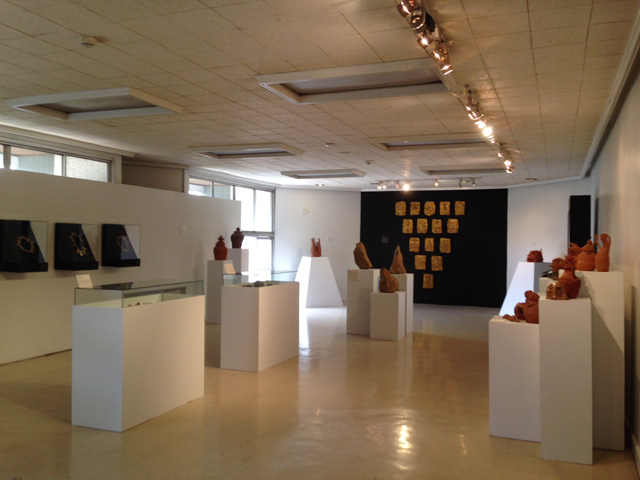
Bla-bla Archaeological Complex mimics typical museum displays.
But an ongoing exhibit at the UP Diliman’s Vargas Museum encourages visitors to take a closer look at how national narratives are presented by cultural institutions.
Cian Dayrit’s Bla-bla Archaeological Complex unearths questions of historicity and identity, and underscores the fine line between fact and fake.
Fabricating history
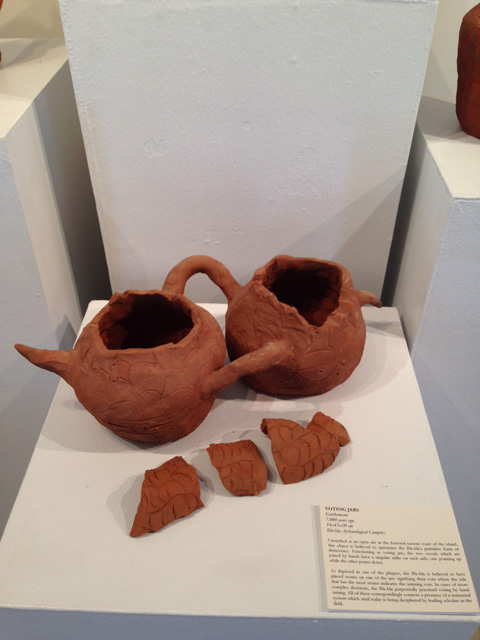
The "found" artifacts demonstrate include clay voting jars and gold plaques depicting historic events in Bla-bla society.
Bla-bla Archaeological Complex conforms to the display protocols one expects of an archaeological exhibit; indeed, if one took a panoramic shot of the exhibit space and showed it to a bystander, s/he could very well mistake it as a collection of pre-colonial artifacts belonging to a government-run museum.
The exhibit is introduced by a curatorial statement on mythmaking and society, and includes a timeline that situates Bla-bla Island culture within verifiable Philippine geo-historical events.
Artifacts are grouped according to function and presented to full advantage, their labels enumerating provenance, dimensions, and make.
It doesn’t take a history scholar or museum studies expert to realize that the raison d’etre of pre-colonial exhibits, such as those that may be viewed at the National Museum, is to demonstrate the presence of organized society and civilized behavior before the Spanish invaded and shaped our racial consciousness to their liking.
Certified anthropologists and archaeologists rely on found material, of course, but the Bla-bla Archaeological Complex is a complete fabrication, and the artifacts approximated are indicative of what Dayrit wants to present as the landmarks of civilization: ritual and religion, government, technology, historical records, and trash.
Much ado about meaning
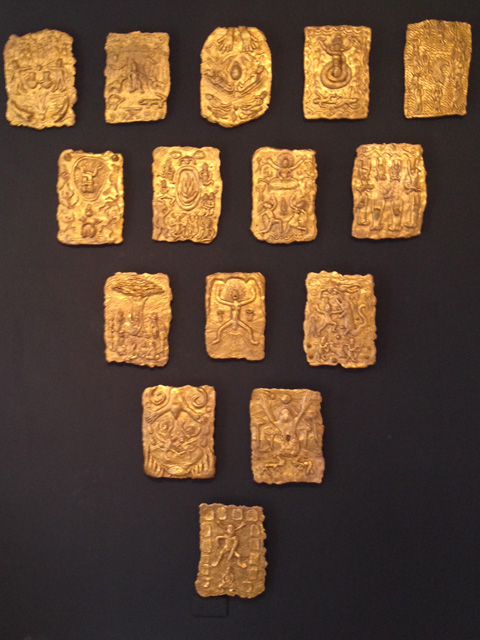
The "found" artifacts demonstrate include clay voting jars and gold plaques depicting historic events in Bla-bla society.
The exhibit provides an origins story for Artefact X: it is the Colossus of Bla-bla, the zenith of Bla-bla culture’s artistic-religious achievement.
But all this is just window dressing; it is the underlying narrative that bears further inspection. Without it, Bla-bla’s ceramic jars are just ceramic jars.
And here the conceit falters, its language inconsistent. Sometimes it reads like satire—Bla-bla’s primitive democracy prefers a show of hands for resolving critical matters, despite the presence of voting jars, which are used for more mundane decision-making.
Sometimes, it makes a statement about social norms: it is age (and the wisdom that goes with it) that determines prestige, not affluence. Sometimes, it is merely a facsimile of serviceable museum copy: dry, informative, straightforward language. And sometimes it makes no sense at all.
One can stretch the limits of interpretation and read this incoherence as a manifestation of the implosion of imposed national narratives, but one gets the sense that Dayrit was aiming for a scholarly tone and just did not have the facility for it.
Anywhere else, an exhibit like Bla-Bla Archaeological Complex would be nothing more than a mildly successful intellectual exercise on the conceit of taxonomy, on the function of the museum as a state apparatus. But when one recollects our notorious predilection for inventing history (the falsification of the Code of Kalantiyaw comes to mind), revising history (Bagong Lipunan and its imposition of Maharlika as a national identity), or sheer indifference to history, the exhibit (and the questions it raises) acquires the patina of relevance.
There is a sense of urgency, a call for critical thinking, an admonition to examine material evidence and question narratives imposed by institutions with the power to direct the course of history.
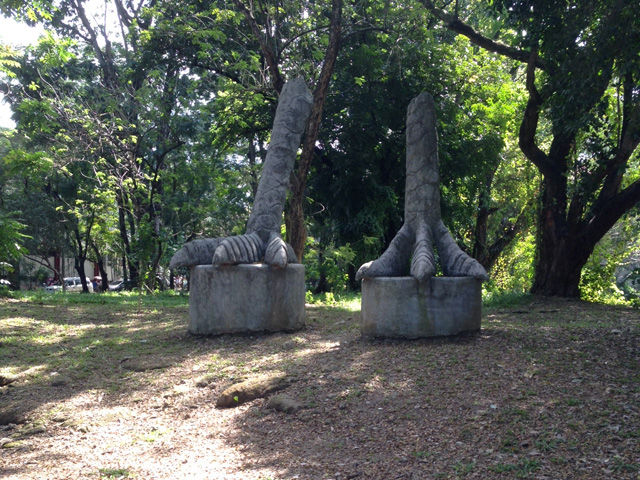
Cian Dayrit's Artefact X, now known as the Colossus of Bla-bla.
Bla-Bla Archaeological Complex will run until the 8th of February 2014. Southwing and 3rd Floor Galleries, Vargas Museum, UP Diliman. For more information, visit their website. — VC, GMA News

