

 GMA Brandtalk
 Tracking
 Archives

ADVERTISEMENT
Filtered By: Lifestyle
Lifestyle
More than ‘annyeong’: The 2014 Korean Speech Contest at KCC
Part of "Beyond Hallyuwave," a series on Filipinos' fascination with Korean culture beyond KPop and Koreanovelas.
Most Pinoys already grow up speaking more than one language—it's usually the case that from a young age we learn to speak the language of the region or hometown our family is from; the Tagalog-based national language known as Filipino; and English. Some also take up the language of our past colonizers, the Spanish. In this age of globalization and with many of our countrymen and women working overseas, we are also picking up other foreign languages to learn. And with the rise of Hallyuwave and the increasing number of Koreans in the Philippines, many young Filipinos are now interested in learning Hangul, or Korean.
Some learn just enough to say "I love you" to their Kpop idols when they visit. Others take it further: more than just understanding the basics, they study to master the language in order to be able to communicate to their Korean friends what our country and our culture are truly like.
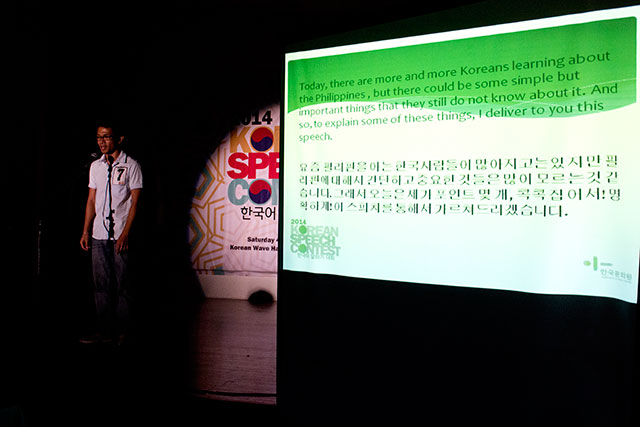
The Korean Cultural Center (KCC) put the spotlight on eight of these Filipino language enthusiasts at the 2014 Korean Speech Contest on April 5. The contestants were asked to choose a topic among four, including Korean food, travel, and what the two countries can learn from each other. Each speech had to be not longer than five minutes. The Korean judges also conducted interviews with the contestants in pure Hangul.
Being bilingual
Opening the event were KCC interns May Jornales and Choo Seun-Keuk, clad in colorful hanbok (traditional Korean clothing), translating each other's sentences. As the first finalist Maria Christina Sismundo went up, her supporters waved banners in Hangul. For the benefit of those in the audience who did not speak Hangul, a translation of each contestant's speech was projected next to them while they spoke.
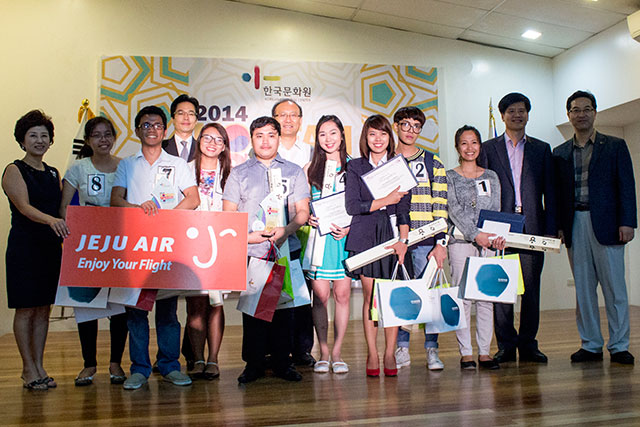
Coming out on top was Marco Angulo, won the grand prize—a trip to Korea. His piece, titled “What Philippines?” describes common misconceptions Koreans have about the Philippines. When asked, he said he chose to learn Korean because it is easier to learn than other Asian languages and because there are many Koreans in the country, giving him enough resources to study it. Angulo prepared himself for the contest by reviewing his Korean and asking for help from his Korean friends. According to him, the most difficult aspect of the competition was compressing all his thoughts into a five-minute time frame.
First runner-up Fermo Suson interpreted the topic differently, pointing our the differences between Korean and Filipino cultures, such as the contrast between the notorious "Filipino time" and the "Ppalli-Ppalli" (fast-fast) attitude of the Koreans.
Learning languages
Want to learn Korean? By embracing foreign languages, we are introducing ourselves and our culture to the world one word at a time. With many Koreans doing business and studying in the country, this might be the perfect time to learn Hangul.
The Korean Cultural Center of the Philippines offers Korean language classes ranging from beginner to intermediate level every semester. The annual TOPIK exams are also held at the center for those who want to test their Korean skills. For more information, check out the KCC's official website or its official Facebook page. Who knows, you might be the next winner of their next Korean Speech Contest. — BM, GMA News

