

 GMA Brandtalk
 Tracking
 Archives

ADVERTISEMENT
Filtered By: Lifestyle
Lifestyle
Two countries on canvas at the KCC Contemporary Art Exchange Exhibit
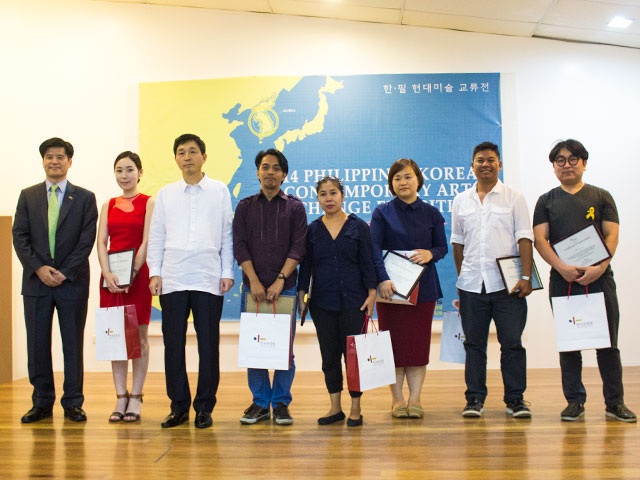
Celebrating the friendship between South Korea and the Philippines are officials and artists from the two countries. From left: KCC Director Oh Choong-Suk, Kim Min-Kyung, Korean Ambassador Lee Hyuk, Leslie De Chavez, Geraldine Javier, journalist Seo Jung-Im, Manny Montelibano, and Joo Dae-Hee..
My professor in Fine Arts once said, “An artwork is a reflection of the artist’s soul.” A piece can convey more than a thousand words, and before the first stroke touches the canvas, a lot of thought has been put to it. I haven’t held my brush in a long time, and seeing an exhibit—like the Philippine-Korean Contemporary Art Exchange Exhibition—brings me nostalgia of my colorful days in art school.
The exhibit was launched last Friday, May 30, at the Korean Cultural Center. Five artists from the two countries joined to showcase their works in celebration of the 65th anniversary of the bilateral relationship between South Korea and the Philippines
Different on the surface, same in the core
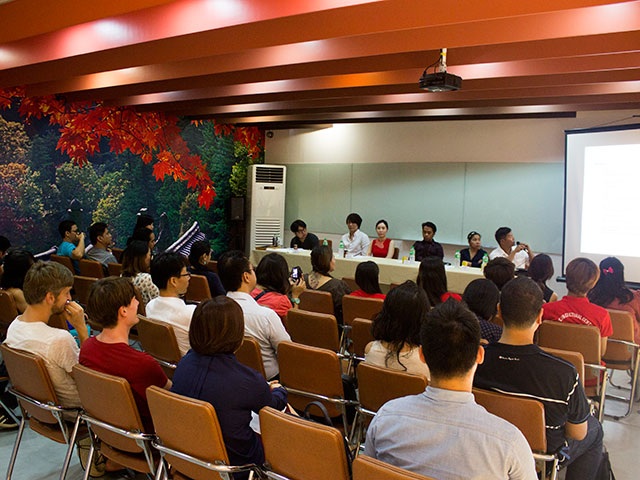
The Korean and Filipino artists talked about their inspiration and creative process.
The session began with filmographer Manny Montelibano describing his inspiration for his two pieces, “Pamunit” ("fishing" in Hiligaynon) and “Panilag” ("to observe"), which in single channel video and sound splice together scenes that show that mundane day to day life can be so much more than just killing time.
Meanwhile, everyday objects such as leaves, threads, and cloth are the medium of interest for another Filipino artist, Geraldine Javier. While some artworks can be too self-indulgent or grand, objects like these can be used to make a simpler masterpiece. “Filipino artists can be limited by what materials they can afford,” she said. Javier’s installation art, “Bliss,” uses a mix of organic materials blended with daily objects to create an intricate large piece that almost takes up a quarter of the exhibit hall.
For Leslie De Chavez, a slight shift in local politics can greatly impact the daily lives of Filipinos. His oil painting, “Front Acts,” shows a dark representation of how politics, religion, and consumerism have shaped our daily lives into a quagmire of despair.
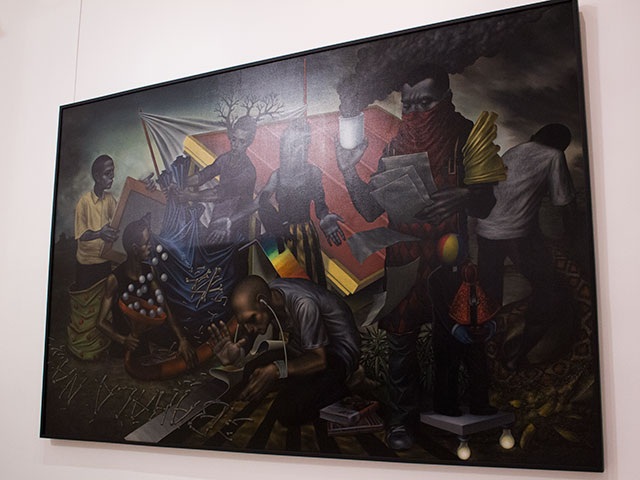
Leslie De Chavez’s 'Front Acts' (oil on canvas) shows a slum area, the result of a broken system.
Joo’s “Please” (a series of four giant paintings of infants in coffin-shaped frames) and “The crying, cover with a smile” (portraits of children) are grim reminders of how Korean families are shaping their children’s future to be constrained and imprisoned by the expectations of society.
Kim Min-Kyung’s “Camouflage Selves” series focuses on Korea’s obsession with physical appearance, with some Koreans changing themselves completely to conform to a perceived ideal appearance, disregarding what they can offer beyond looks.
Camaraderie over a bowl of bibimbap
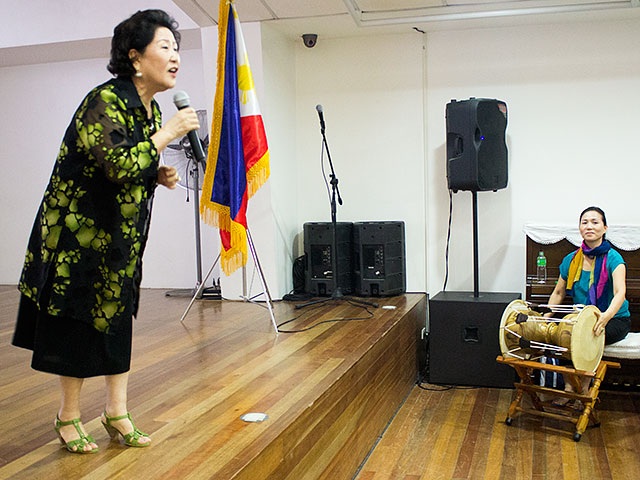
A drummer and a singer performed the traditional 'Pansori' (Korean opera) while the guests enjoyed their bibimbap.
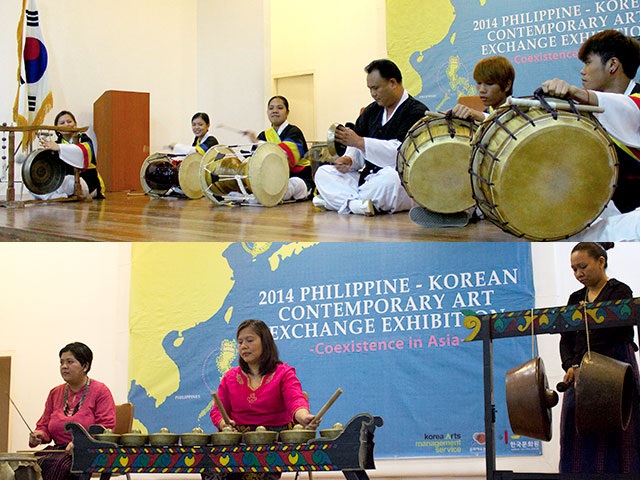
The beat of two countries: samulnori from Korea (above) and our local kulintang (below)
After the meal, distinguished guests took the stage to give their message to the creatives in the room.
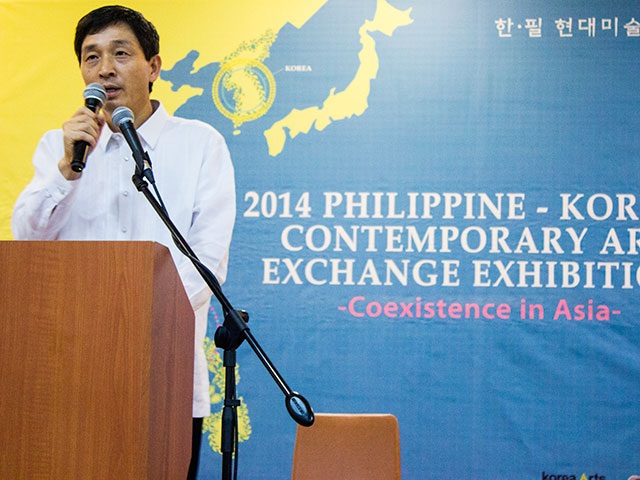
'The most important thing is to have a creative mind in order to succeed,' said Ambassador Lee Hyuk.
But it is not all hopelessness and gloom for Filipino artists. De Chavez points out that local artists can get support as much as Korean artists, through collectors and different local groups. However, “The difference between Korean and Filipino support is that the Koreans are more organized with their [programs],” he said.
At the end of the day, each piece depicts more than the artists’ soul and expression, but rather the soul of the two societies. The two countries are very different economically, but the artworks show how our similarities intertwine: the genuine concern and care for our countries and their future. — BM, GMA News
The 2014 Philippine-Korean Contemporary Art Exchange Exhibition is on exhibit at the Korean Cultural Center at Bonifacio Global City until July 26.
South Korea offers various and artists residency programs, available at the Seoul Artspace Geumcheon website.

