

 GMA Brandtalk
 Tracking
 Archives

ADVERTISEMENT
Filtered By: Lifestyle
Lifestyle
Heritage photographer Ferrante Ferranti talks of composing art with light
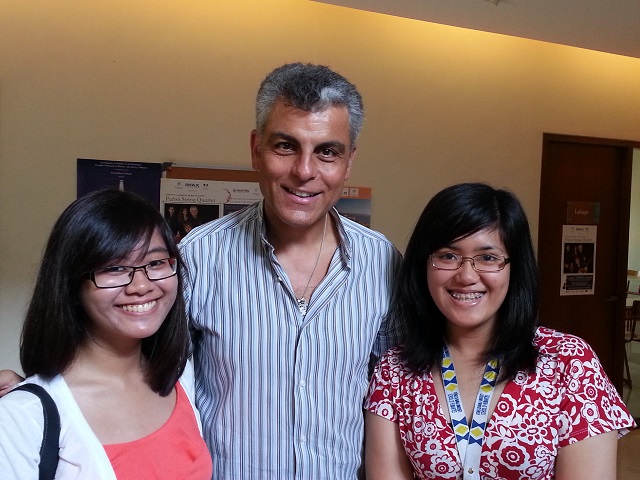
Ferrante Ferranti with the author (right) and her sister.
In his latest adventure, Ferranti was to spend June in the Ilocos region and Cebu to take photos of Spanish-era churches which are under the protection of the UNESCO. But before he set off, he shared his experiences and doled out sound technical advice in a talk titled “Photographing Heritage” at the Alliance Francaise de Manille.
“A good photo expresses exactly what you were looking for when you came [to that place],” was one pearl of wisdom Ferranti shared.
He also laid down five pointers for taking a good photo:
- A photographer needs a sensible experience of everything
- The photo has to exist in your mind [before you take it]
- Take time to build your vision
- A camera is just a medium to arrive at your vision
- Be concentrated on your own line
“Each one has his own imagination, his own world, and is just looking for the tools to express it,” Ferranti explained.
He also prefers cameras that make the least amount of noise as possible, as noise really disturbs his subject. “Be as discreet as possible,” he told GMA News Online. “Technique is really important, and you have to know your instrument very well. But once you know technique, you then have to forget it. You have to go further.”
Ferranti also takes photos both in color and in black and white, depending on the mood he wants to evoke. “Colors are like a language—you have to think in those colors,” he said. “Colors bring the subject into reality, but black and white photos need more imagination [from the viewer].”
Patience and spirit
Ferranti was first enamored by drawings and illustrations. At the age of 18, his family took him to the beach, at the edge of which he stood for hours with the family camera waiting for a wave to break over the shore.
“Could you do a drawing of that? No,” he said, smiling at the memory. “A photographer has to be there to take in all the elements right away.” And that was when he knew he wanted to be one.
Ferranti does research on the history of his subject both before he gets there and after he takes a photo, though he prefers reading documents to looking at existing photos. “If I discover a version of someone else’s reality [in a photograph], I will be conditioned,” he said. “I want to be as open as possible [when I go somewhere new].”
That said, he does not plan his shots ahead of time. “You choose a destination,” he said. “And when you arrive, anything can happen.”
It is no surprise, then, that he is hardly ever disturbed by someone walking into a shot he’s already laid out. He has also been known to wait a long time for something random to fly within range of his camera before taking the shot; one example was a bird flying over a hill with a hole in the middle, which took all of forty five minutes.
When asked how he knows the time is right for the photo to be taken, he said, “You feel it immediately. Photographers compose, write with light—that’s the meaning behind the word ‘photography.’ You wait for the real good moment when the light is good for you.”
What actually does disturb him, however, is a crowd of people all waiting to take a photo of the same thing, like what happened at a temple in Cambodia. In taking photos with landmarks, he said, it is better to superimpose the landmark in the background as opposed to making yourself the subject of the picture.
“Never put more than one person in a photo,” he advised. “Every photo is done with symbols, but no one has the same keys for reading.”
He added, “Sometimes, you don’t need people in the photo; but you need an element that links people to the photo—and that is their energy, their presence.”
This, he said, is what he hopes to capture whenever he takes a photo. “I hope to capture spirit, to keep the spirit of the place… normally, you can’t see this, but you can feel it strongly,” he said. “Maybe the person in the photo can feel this also. I believe you feel to receive something in return.”
When you feel right
Ferranti also had several bits of advice for aspiring photographers, although this advice appears to be applicable to all aspiring artists.
“Photos are also a physical experience,” he explained. “Your whole body is involved in it, so you must know what you will do. Feel the good, just the energy. You have to know what is good for you.”
“If you feel right, someone can enter your imagination,” he added. “If you express what is good, you can touch many people.”
He concluded, “Creating art is a challenge because you have to go very deeply [inside yourself] to find the energy to express on the outside.” — DVM/BM, GMA News

