

 GMA Brandtalk
 Tracking
 Archives

ADVERTISEMENT
Filtered By: Lifestyle
Lifestyle
Art review: The subaltern’s sly civility in ‘Complicated’
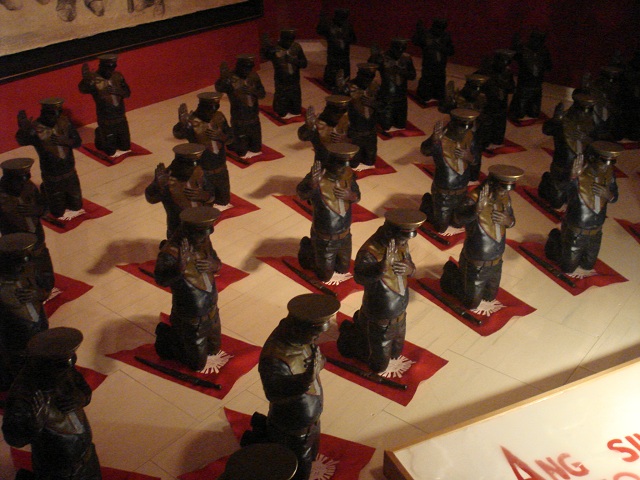
Detail of 'Litanya ng talumpu't dalawang sumasampalataya' by Leslie de Chavez
Curators Ethel Villafranca and Ricky Francisco allowed a number of works from the museum collection to "converse," so to speak, with commissioned works from contemporary artists Mike Adrao, Leslie de Chavez and Ea Torrado. The curators organized their works—reflections of three contemporary artists who reckoned the Philippines’ long and storied colonial past in relation to the complications of identity politics and the issues these occasion—alongside the museum's extensive collection of art works related to the notion of nationhood and motherland by 18th and 20th century modern canonical artists as Juan Luna, Felix Resureccion Hidalgo, Ang Kiukok, BenCab, Vicente Manansala and Brenda Fajardo.
Among the three guest artists, the one who most fleshed out this problematique was Leslie de Chavez. Take his shrewd mixed media installation “I Just Can’t Stop Loving You”—five identical statues of the infamous prince of pop Michael Jackson. Each icon holds a hose towards itself as water gushes out as if to perform its own ritual of self-absolution. Here, the artist implicates one of America’s most popular musical icon as a signifier of postcolonial power, in a performative moment of seemingly cleansing itself of its purported excesses and sins.
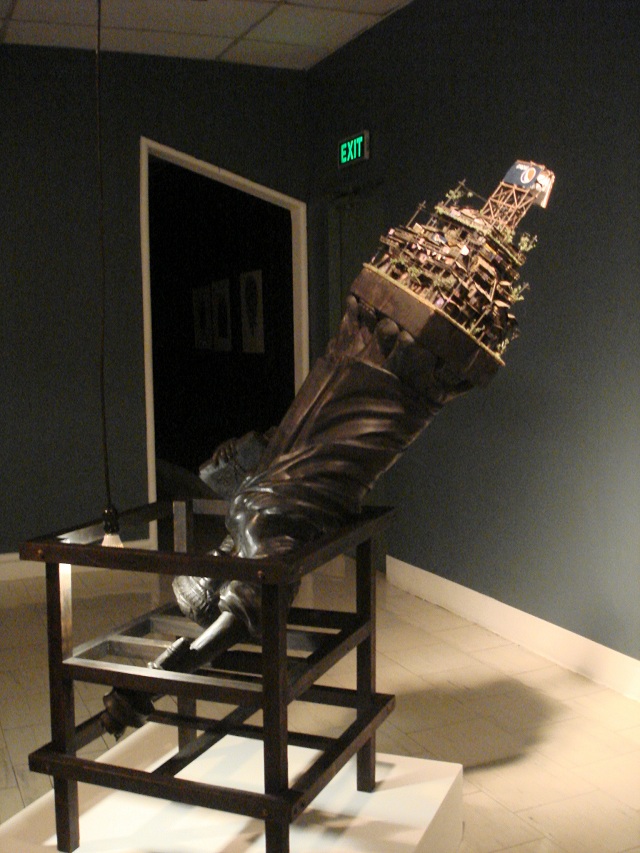
De Chavez's 'State of your Liberty'
His other work, a sculptural installation called “State of your Liberty,” is an upended Statue of Liberty, and on its top side is a miniature terraced shantytown redolent of Metro Manila’s urban squalor.
In another section of the exhibit, de Chavez’s installation “Litanya ng tatlumpu’t dalawang sumasampalataya” (Litany of thirty-two believers) joins Benedicto Cabrera’s charcoal and chalk painting “Soldiers”. De Chavez tackled the Tagalog movement Lapiang Malaya with 32 figures depicted with their right hands raised as if reciting a creed, while in front of them is a fragment of red text from the credo of this supposed fanatical nationalist crusade that thrived from the 50s to 60s: "Ang sino man na may gusto sa pagiging alipin ay sumama sa Americano/Ang may gusto ng calayaan ay sumama sa Tagalog."
For his part, Adrao employs charcoal on paper in his works, which are placed in the central exhibition area. Adrao’s works comprise a series of elegant and arresting black and white illustrations, “Infectious” and “Pillars,” featuring layered images of the Tagalog anting-anting with the dollar sign; a chalice with a termite; maps with the traditional alibata, and other surrealist but ornately skilled compositions that refer to images of colonial power against local and traditional Philippine iconography.
Meantime, in the section composed of works depicting the trope of woman and motherland, one can find contemporary dance artist Torrado's video installation “Sisa.” The six-minute dance film is a solo work that juxtaposes Rizal’s tragic heroine with the modern-day issue of desaparacidos. Torrado enacts the titular role in a film noir aesthetic, showing her in a desperate search for her lost sons, as names of the modern disappeared are recited by a vocal and sound collage background.
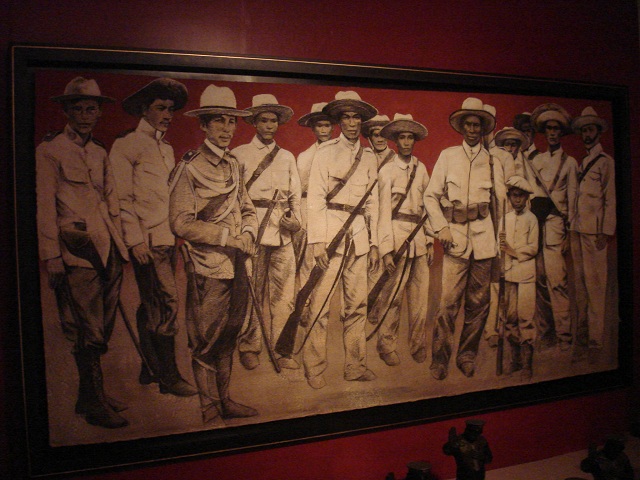
Benedicto Cabrera's 'Soldiers'
As Edward Said once proferred how Western artists and scholars, through their works, make “the Orient speak, describe the Orient, render its mysteries plain for and to the West”, so it is also mainly the male “mestizo” intellectuals and artists who have been given liberties to define the feminized colony for the benefit of a male “mestizo” culturati and audience. Which is certainly not to say that Torrado and Fajardo’s works are less than their male counterparts, for in fact, they deserve further introspection from viewers who wish to inquire into the tensions and complexities of gender discourse that their works might offer contemporary viewers.
Finally, as postcolonial theorist Gayatri Spivak once asked, "How should the subaltern speak?"
“Complicated” is one such attempt to recoup the multiplicity of subaltern voices, and the disparate ways in which Bhabha’s “sly civility” might continue to be redefined and engaged. — BM, GMA News
“Complicated” runs at the Lopez Museum and Library in Manila until August 2. Call 635 9545 for information.

