

 GMA Brandtalk
 Tracking
 Archives

ADVERTISEMENT
Filtered By: Lifestyle
Lifestyle
Emblems of the sacred self in the ‘Loob’ exhibit
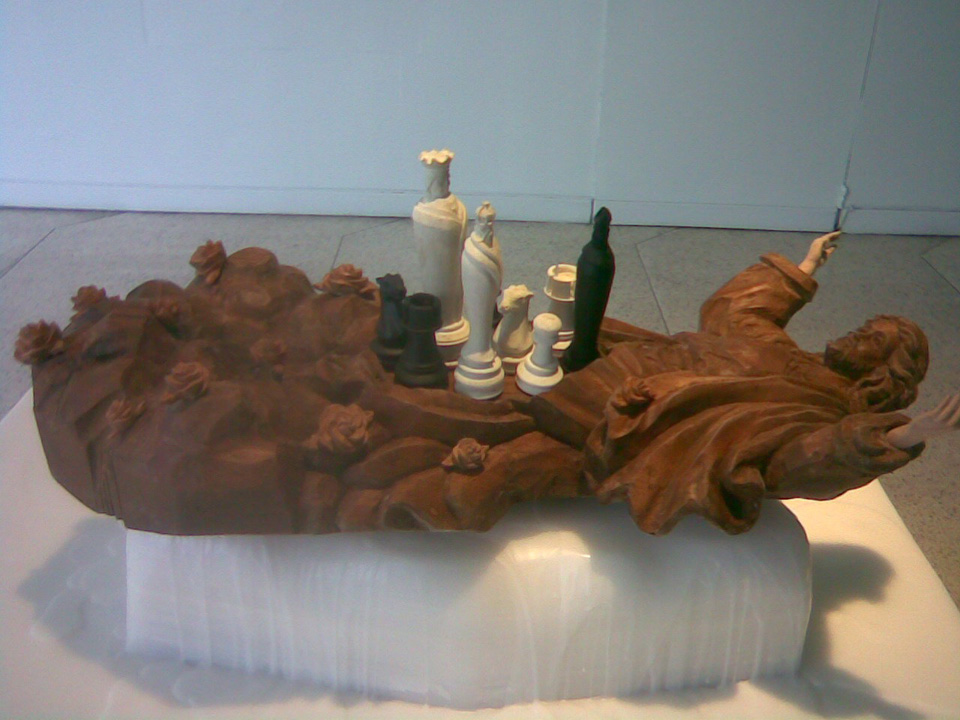
"Sagradong Pwesto: Pinaggsugalan." Wooden sculpture and wax by Habulan.
“Loob” presupposes a looking inwards to an inner self, a momentary journey away from its extraneous other, the labas.
In this current two-man exhibit by Renato Habulan and Alfred Esquillo at the Vargas Museum, “Loob” is a sustained meditation resulting from these artists’ peregrinations into the inner sanctums of Catholic folk devotion, particularly in Quiapo, Manila, where the Black Nazarene is the central icon of veneration for the local folk.
The first floor of the Vargas Museum was sprinkled with emblems that revealed this locus of spirituality, filling it with re-interpretations of familiar objects and practices surrounding Nazarene piety and the search for the sacred being that it occasions.
In Habulan’s “Tagpo” series, framed in heavy dark wood was a black and white painting in oil on canvas. It is a scene of a lady kneeling to kiss the ground, while beside her is a mimicry of the Nazarene, bereft of his opulent crown and gown, merely clothed in white sheets. Devotee and icon seem to be surrounded by people, whose feet encircle them, quiet witnesses to this slice of devotional drama.
Then there is the “Potensiya” series by Esquillo that deftly makes use of the shape of the potencia, the ray of light rendered as the crown of the Nazarene. “Potensiya” 1 and 2 are two massive works using oil on pelon and pinya barong, lightly bordered with floral embroidery as the three panels that comprise each work are reminiscent of the Trinitarian Catholic theology. “Potensiya 1” centers on a nude female with hands outstretched, while above her is a pair of hands brought together to form the dove symbol. Clouds billow from above where the Nazarene potencia shines through. “Potensiya 2” is of a half naked penitent man in jeans, his back towards the viewer, as a large pair of hands meet above him to form a dove, as the potencia similarly juts out from the sky.
Meantime, “Potensiya” 3, 4 and 5 are smaller than the first two, using surrealist imagery to portray the mysteries of religious faith: one contains the sculptured and iconic pierced hand of the crucified Christ, bleeding with blood-colored roses that are delicately held by another hand emerging from below the frame. Another from this series shows the omniscient dove-like hands reaching out from above its frame as the word “sampalataya,” vernacular for “faith”, is written in all caps in the middle, while a smaller pair of sculptured hands, clasped in prayer, emerges from below the composition.
Habulan’s “Sagradong Puwesto: Pinagsugalan” is a wooden sculpture of the resurrected Christ, lying down on a bed of white candle wax; below his belly stands a grouping of chess pieces. Right here we are led to contemplate on one of the ironic realities of life: the presence of both the profane and the sacrosanct, clues to the often nefarious activities of betting games within the same vicinity where ardent adoration to the transcendent also takes place.
The “Takatak” series by Habulan contains the same wry wit, as the artist approximates the takatak, the wooden encasement created and used by vendors to display their wares. Habulan’s version of the takatak contains imitations of bottles of herbal potions that are popularly sold in Quiapo, which are believed to have healing effects. These come hand in hand with the anting-anting or amulets that promise protection and safety to their owners. Habulan conjures these juxtapositions in a background of white candle wax, reminiscent of the practice of pagtatawas, a process used by local healers using the drippings of lit candle on water in order to discern the presence of an offending spirit that is believed to have caused one’s illness.
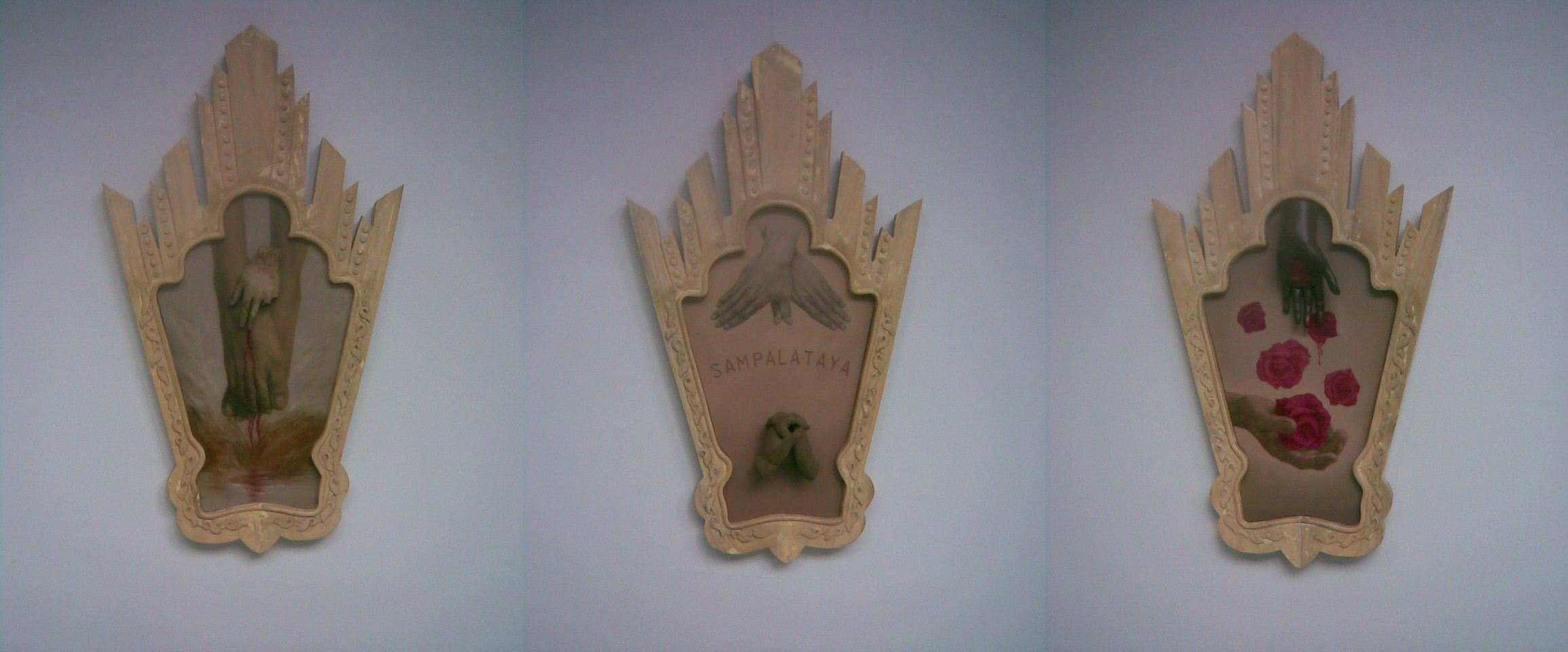
"Potensiya" 3, 4, and 5 by Esquillo.
Esquillo, Habulan’s former student, matches up to his erstwhile mentor’s skilled manipulation of form with equal perceptiveness and a sensitivity to theme and material. In “Penitente,” he turns a wheelchair into a tricycle with a penitent’s iconic whip, referencing the penitensya, the local Lenten religious practice of self-flagellation, performed by men who sacrificingly whip themselves under the sweltering heat of the midday sun.
Meantime, his “Lakbay Panata” series is composed of five wooden sculptures on wheels, miniatures of the carroza that carry saints around town during customary street processions to mark feast days. Instead of saints, Esquillo’s carrozas contain the disembodied corporeal fragments that reveal Christ’s sufferance: his head crowned with thorns, his heart bleeding in thorns, his crucified feet, his wounded hands. Side by side these are the various other devotional effects that we commonly see in Filipino household altars: handkerchiefs printed with prayers, sampaguita garlands, rosaries, golden lucky charms from Binondo, and small Buddha icons. This amalgam of icons awakens in us the notion of hybridity in Philippine culture, our islands being the crossroads of various cultural beliefs and faith systems. To take one example from our folk food, that we have halo-halo as one of our famous local deserts is not accidental, but is also akin to the variegated cultural mixtures seemingly embedded in our quotidian awareness as a people and nation.
This same notion of cultural heterogeneity is imprinted in Habulan’s own “Lakbay Panata” series, nine tall staff-like totems that draw from an ensemble of disparate religio-cultural imageries: the Sto. Nino or the Filipinized Christ-child, the Cordilleran bulul, the boatman from the Manunggul jar, the winged horse of the apocalypse, the biblical serpent of Eden.
Finally, the two artists’ collaborative diptych-documentary is a video in two parts, namely, “Mga Hinirang” (Chosen People) and “Dibusyon” (Devotion), which are raw cuts from the Quiapo Church and its vicinities on the Nazarene feast day, bringing alive the rituals of an undying devotion and the commitment of a people to a sense of the sacred that is inherently perceived in the loob, the inner being, and the sense of kapwa, of being with and joining others in a community.
In “Loob,” the viewers are witnesses to masses of people in a constant procession, bearing with them emblems of their faith in the spirit, in a non-material life force suffusing their life ways, in their ongoing journey to an inner sanctum where their values are deeply held. It is an enactment of that quintessential search for the ‘sacred inner self,’ repeatedly performing itself in a living tableaux, striving to find form and expression in the throbbing flux of our diverse human ways. — VC, GMA News
“Loob” runs at the UP Vargas Museum from July 22 until August 22.

