

 GMA Brandtalk
 Tracking
 Archives

Art review: Intercepting the powers-that-be in ‘Sa Ngalan ng Batas’
Visual artist Emmanuel “Manny” Garibay comes back with his characteristic expressionist fervor in his newest exhibit, “Sa Ngalan ng Batas” at the University of the Philippines' Vargas Museum.
Carrying the subtitle “Reflections of Philippine law, culture and society,” this one-man show manifests Garibay’s customary adroitness in fleshing out characterizations and caricatures that implicate the conundrums of the powers-that-be, as well as the manifest complications of state authority in our everyday lives.
All works were rendered in oil on canvas, as the artist reflects on the notion that “the legal is not necessarily ethical,” as the exhibit notes proffer. Here, Garibay allows us a glimpse of problematic characters and profiles that make up the bureaucratic set-up of Philippine social life.
In this exhibit, we also see the former CCP Thirteen Modern Artists Awardee tackling aspects of plebeian life, as he has always done, using vigorous figurations that depict people with a tinge of humor and warmth, drawing from his own rich experiences with everyday masses as a college activist in the state university.
In “Pasaway”, we see a basketball player as a pedestrian, nonchalantly crossing the street while texting on his cellphone, signifying the lack of discipline and attention among the public in following urban street protocols.
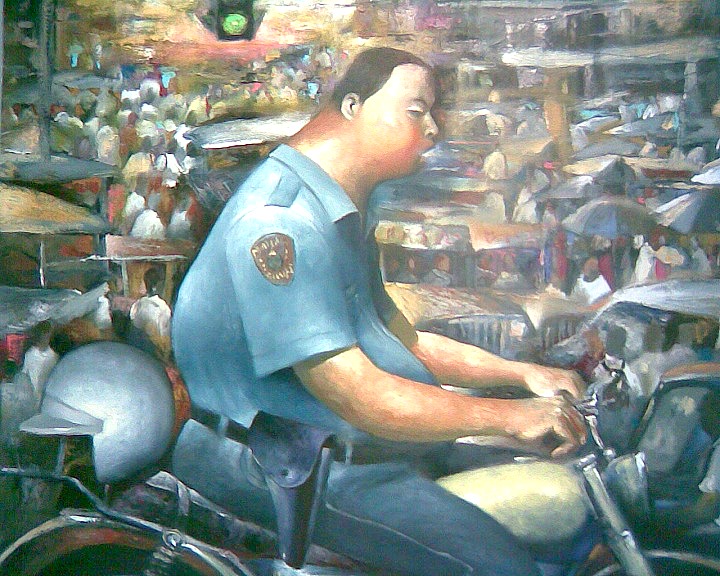
“Enforcer” portrays a blue-uniformed policeman straddling his motorcycle amidst the horror vacui mishmash of vehicles, people and market vendors that make up the daily bedlam of Manila’s urban chaos. The painting’s focus is on the lackadaisical profile of the slouching and big-bellied officer, an icon which reminds us of the attitude of normalcy and inattention with which we treat the pervasive lack of discipline among motorists and pedestrians in our diurnal comings and goings within the city’s concrete maze.
In “Pang-meryenda,” we see a barong-clad politician slinging his one arm around a female employee, as he slyly hands her an envelope. It is a scenario reminiscent of “envelopmental leadership,” where hush money is given out and palm-greasing is a common practice in return for special but illicit favors within the bureaucracy.
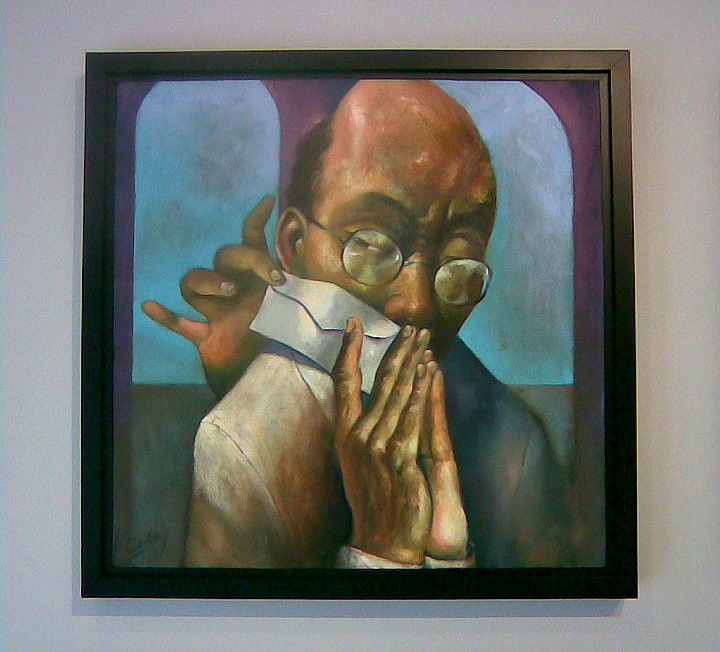
This same theme is also tackled in “Madasalin,” a surrealist work which foregrounds the profile of a bald and bespectacled official, whose hands are clasped together as if in prayer while a third hand appears from behind him, offering him a white envelope.
The work’s first panel is undeniably the iconic image of former President Joseph “Erap” Estrada, more known in his political sorties as “anak ng masa.” The former leader is giving a thumbs-up sign, even as a signboard hangs from his neck bearing the partially-revealed word “plunderer.”
Next to this image is an anonymous male face, disfigured as if beaten black and blue, while a sign ("snatser") is also hung around his neck.
The final panel is a profile of former President Gloria Macapagal-Arroyo, offering a winsome smile while a board similar to Erap’s is also hung around her neck.
Among the works in this exhibit, which mostly had anonymous, if not everyday figures, “Triptych” proves to be a blatant parody that serves to remind us to vividly remember the crimes committed by two of our erstwhile heads of state—who still hold elective positions within the present administration.
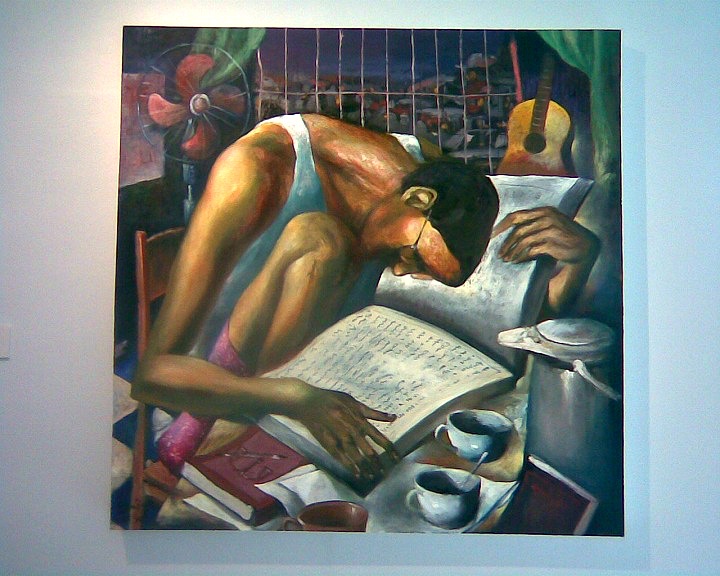
Seizing the notion and questioning the relevance of getting a legal education, “Abugasya” shows a law student, back hunched as his head is totally absorbed in law books. Coffee mugs and books surround his desk, while out the window is a view of the city enveloped in greys and reds that imply its darkness and squalor. The picture is symptomatic of how far removed the study of law is from one’s everyday realities, and how a legal education has often proved to be irrelevant and unresponsive in addressing the most basic social issues that surround us.
Behind him is the seal of his office, side by side the portrait of an older version of him, whom we may construe to be the politician’s own father. The problematic, but often accepted succession of power from grandfather to father to son, and the various linkages and systems that support the inheritance of elective positions of power within the family’s lineage, is here put to fore.
But more than laying bare the troublesome dearth of values of personas who are supposed to be the first to uphold law and order, Garibay re-tells for us in a new light the ongoing narratives of malfeasance that the public has been accustomed to. Garibay’s works are creative re-presentations of our realities that invite us to undertake with critical observation our own foundering, for the state’s failure eventually stems from the very dereliction of our own cultural and social values.
Finally, the personal remains political, Garibay seems to say, and as the consummate visual storyteller, the artist also draws us into a contemplation of our personal values that may hopefully lead us to more judicious choices and actions in our daily engagements, which make up our collective cultural and social ethos. — BM, GMA News
"Sa Ngalan ng Batas" is on exhibit at the UP Vargas Museum until November 4. For information, call 981-8500 loc 4024 and 0929-856-7909.

