

 GMA Brandtalk
 Tracking
 Archives

ADVERTISEMENT
Filtered By: Lifestyle
Lifestyle
Art review: Dainty eroticism and celestial destinies in Lina Llaguno-Ciani’s paintings

Artist Lina Llaguno-Ciani with two of her paintings: 'Family Portrait' (left) and 'Memoria Infinita 2', both acrylic and oil on canvas. Photos courtesy of Galeria Duemila
In the oil and acrylic painting “Magenta and Salty,” two frogs (one on top of the other) are perched on a big purple moon, while above them is a distant half-moon, like a celestial witness. Two dragon flies, two ladybugs and two turtles copulate on top of round objects in “Fly Me to the Moon.” “Nautilus Night” depicts a skeletal shell, its inner center is softened by a mysterious shape in stark blue. In “Full Moon,” a round shape opens up and attracts (or sets off) fire-flies, twinkling objects, and a boy on a string. “Watermelon” depicts a whole and green watermelon contrasted by a sliced watermelon with red flesh. The two differently shaped delectable images morph into heavenly bodies that mirror each other in outer space.
Angelic ties
Getting connected is central to Llaguno-Ciani’s surrealism, a contrast to the alienation, derision of man’s tragic fate, or rebellion against unacceptable historical, political, and social conditions often depicted by Western surrealists since the art movement began in Europe in the early 20th century. Llaguno-Ciani’s surreal paintings are like visions of what is extraordinary, gripping, and unreachable in life, a contrast between reality and dreams. Her visual nirvana reveals more the fulfillment or perfecting of her heart’s desire than escapism.
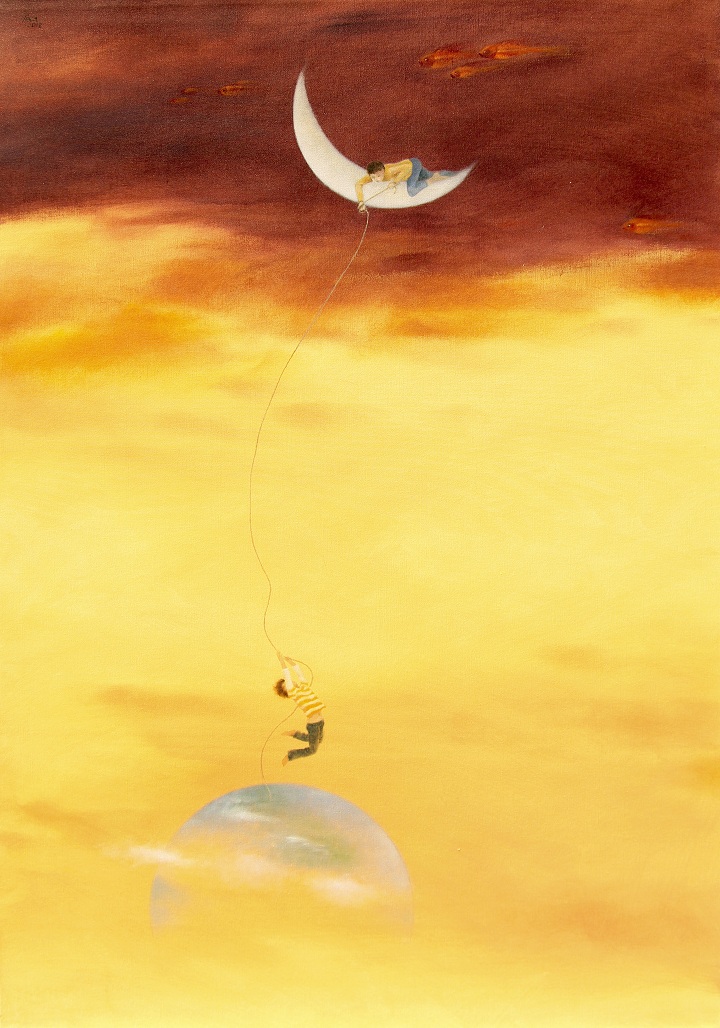
'Samsung Boy and Friend'
“Family Portrait” depicts a mother hen sitting on a giant egg-like object, beneath which dangles a minute egg suspended on a string that seems like a shadow from the top of the frame. Her relatives love this work about fragility, strength, and warmth.
Chit, the artist’s elder sister from New York, points out, “In 'Family Portrait', I can see our father Remigio with a pipe, our mother Magdalena hidden in the cloudy space, and my profile with a prominent nose.”
Jenny, a sister-in-law, shrieks when she recognizes her late husband Frankie from the
yellowish cloud. “I feel what I see from this seemingly faceless painting,” she attests, while poet Marne Kilates squints and says, “Aha, my friend Remigio Llaguno Jr. is there.”
The rest of the Llaguno siblings like Renee, David and Jessie are like mists in the warm fields of “Family Portrait,” waiting to be sensed by a discerning heart more than eyes that chase the artist’s monumental memories of vanishing loved ones.
Faces of babies unobtrusively float among velvet rose petals in “Five Roses,” a painting in acrylic and oil where sadness slowly creeps like an old aria from a distance – through a surreal image of a crocheted curtain with torn threads.
“When I paint I have a visual plan. But the hidden images in my paintings are not planned at all. They just suddenly appear. I allow it [this creative process]. I work on possibilities, on never-ending stories,” explains the artist.
Connectivity through remembered gestures that remain etched and eternal in the heart is the aura of Llaguno-Ciani’s two paintings about close ties. In “Samsung Boy and Friend,” a string connects two young figures riding on top of their moon-toys. In “Boy Riding a Flying Fish,” a young boy on a stilt-like structure hangs on to a pole with a caught fish.
Homes shaped by memories
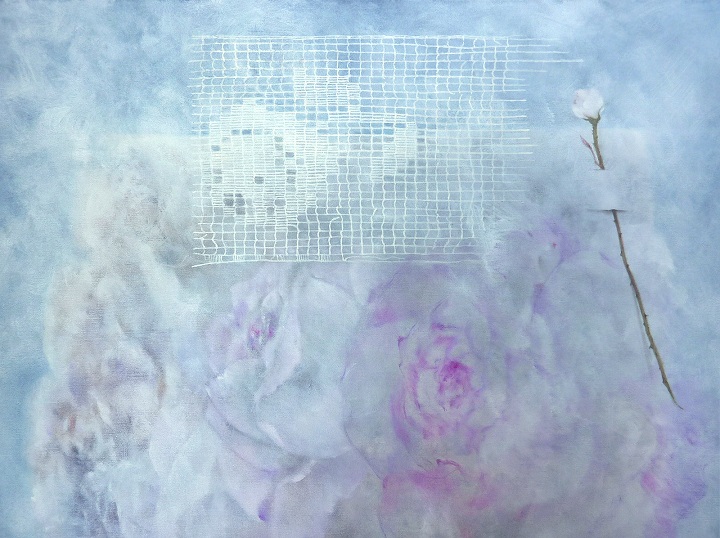
'Five Roses'
The artist has crafted a poetics for space in “Memoria Infinitum I,” a spirit-filled house with external walls that conjure internal spaces – they give shape, as if with a breath, to a woman, a mother and a child, including a silhouette from a door that watches over a young girl smelling a growing tree in the garden.
“Memoria Infinitum II” is a house with a window sill filled with egg-like shapes. A Madonna-like figure peeps out from a door. The external wall is overcome by a white withering tree and adorned by a tall green shoot that is magically nurtured, as in a fairy tale, by an egg-shaped surface above the earth.
Creeping sadness
In contrast to Llaguno-Ciani’s sense of visual quietude or Zen-like balance is her growing depiction of sadness, an early stage of alienation and isolation that she seems bent on avoiding for the longest time. In “Bouquet,” semblances of fresh white and violet flowers are not inside a vase; their stems are painfully plastered with ribbons on the wall. “Crimson Hour” depicts a big leaf in red, with dragonflies and worms. Beneath the overpowering image of existential decay is a distant (but constant) horizon and a small moon.
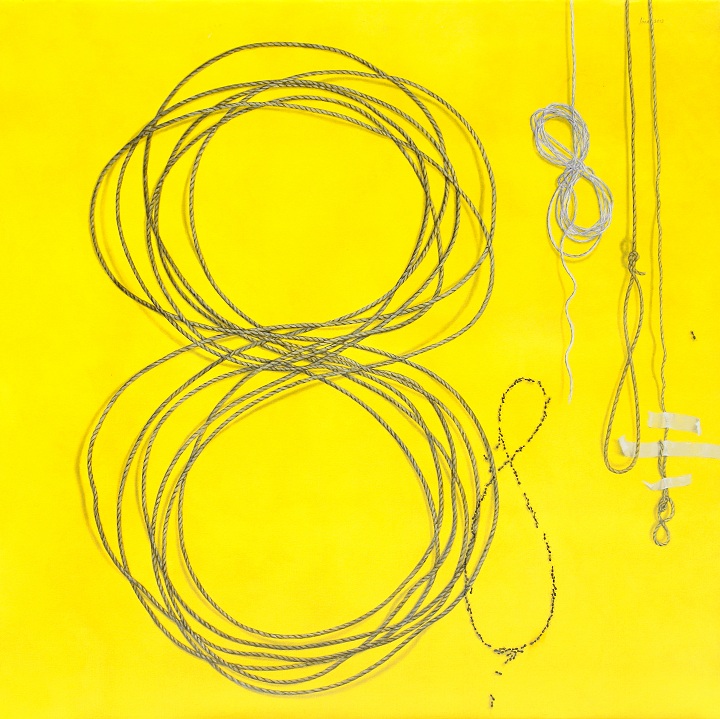
'Eight'
“As much as I dream in my art works, there is also anguish in my life,” the artist explains.
In a show at Pasay City’s Galeria Duemila in 2010, Llaguno-Ciani's depiction of nature’s wrath were like elegies for trees, butterflies, eggs, moths, and other gentle animals that were banished by Typhoon Durian (Reming) which caused fatal mudflows from the flanks of the Mayon Volcano in Albay in late 2006. Kilates, a family friend from Bicol, wrote 10 poems for the artworks.
A native of Daraga, Albay, Llaguno-Ciani graduated from the University of the Philippines College of Fine Arts in 1963. She worked as an art director for McCann-Erickson in Manila; studied at the Academia delle Belli Arti in Perugia, Italy; worked with Image Plan International in Milan and became a creative director for BBDO Italia in Rome. She is based in Trevignano, Romano, where she has a studio overlooking a lake. Her other studio is in Sogod, Bacacay, Albay. She and her estranged Italian husband have one daughter, Maya, 40, who is also based in Italy. “My husband and I were divorced 20 years ago. At the time, I was nurtured by my art and my daughter. I did not marry again,” says the artist. — BM, GMA News

