

 GMA Brandtalk
 Tracking
 Archives

Behind the filter: How The Sandbox Collective’s ‘No Filter’ got rolling
“It started out as an idea that the Sandbox team had late last year after Imaginarium,” says Toff de Venecia, the artistic director of the performing arts group Sandbox Collective. “[It was a] monologue series then called The Social Network where we asked the question: Is your social network your social net worth? Then it evolved into something else entirely.”
That "something else" is the new production “No Filter: Let’s Talk About Me,” a multimedia monologue series that deals with the representative struggles of a generation that grew up in the age of the Internet. It is scheduled to open at the RCBC Theater in Makati on July 25.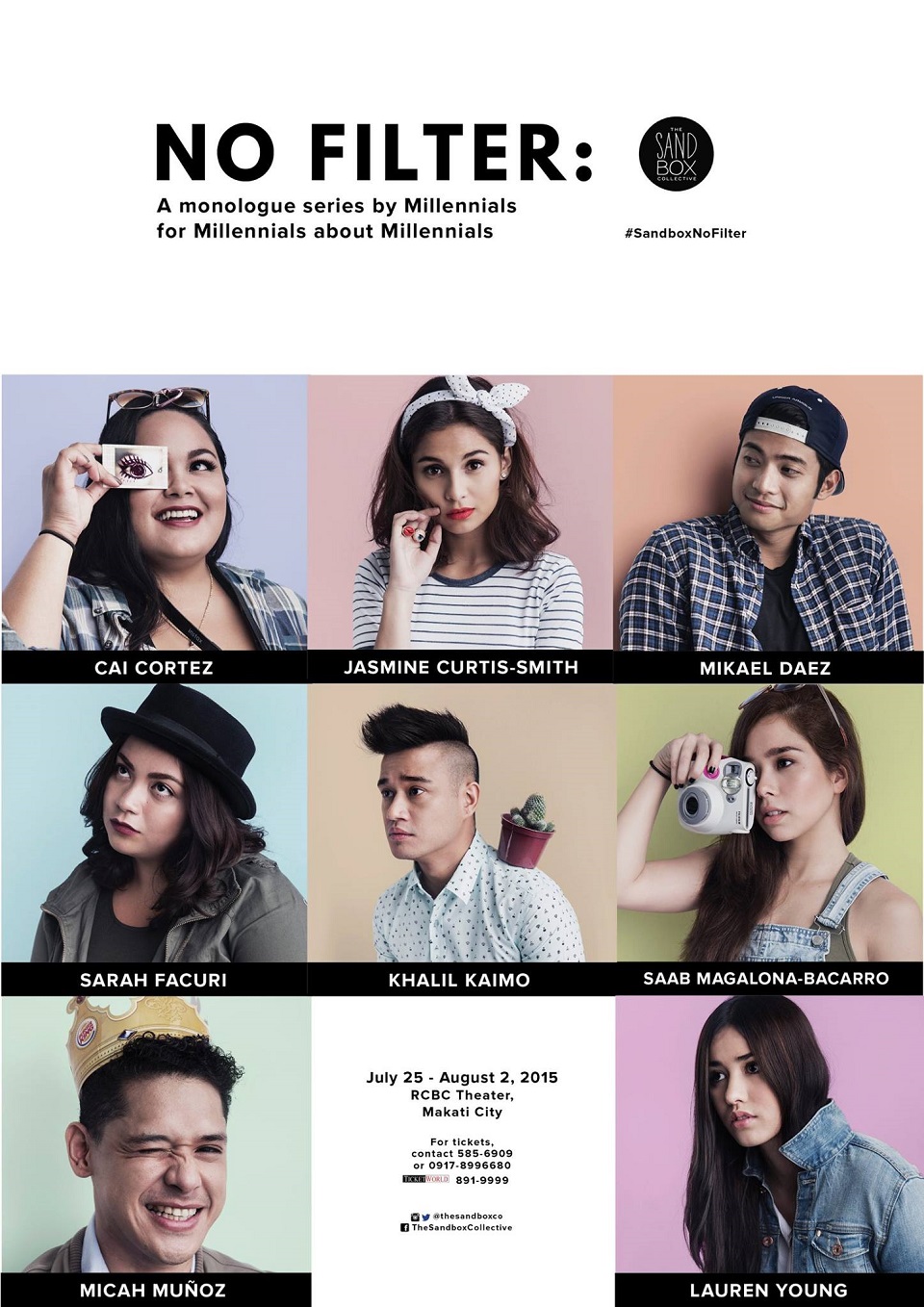 Some aspects of “No Filter” were already foreshadowed in some way during last October’s multi-arts festival. For instance, there was a spoken-word performance during the first night, and there was the appearance of #Y, whose Gawad Urian-nominated composer Jorge Wieneke (Similarobjects) would become "No Filter"'s sound designer.
Getting started
For this collaboration, de Venecia worked with two work colleagues, Wanggo Gallaga and Jam Pascual. He also credits his creative consultant Raymond Ang for getting the ball rolling: “We decided on essential topics that would provide us with good coverage of the millennial experience and then decided on writers who could exact from their personal experience and bring the show to life,” he said.
Gallaga recalls, “I was invited by Toff to work on a project with him for The Sandbox Collective as far back as March, I think, and then sometime in May, when that original project was moved to a later part of the year. He told me that he had an idea to put up an original play about millennials and he had asked me if I wanted to come aboard as a dramaturg.” A dramaturg is someone who assists in the development and staging of a theater production by being an adviser and often an internal critic.
The three, along with Ang, worked on identifying writers who would contribute original material. “We invited writers whose body of work we were familiar with, and who we believed to be intimately familiar with the millennial experience,” says Pascual, “I was contacting writers I knew about, writers I didn't know about but came to respect, writers whose work I'd been a fan of for a long time.”
Gallaga notes that sometimes the choice of writer would come from experiences they were considering for inclusion: “We'd have a monologue on ‘moving out,’ for example, and we'd think of any of our creative friends—or people we've heard about—who have had interesting stories about moving out and then we'd just call them and ask them if they want to collaborate.”
Among the writers they eventually chose were poets Petra Magno and Gian Lao, marine advocate Anna Oposa, magazine editor Anna Canlas, and musician B.P. Valenzuela. All in all, around 18 writers were invited to participate.
As works came in, the three creative team members would work on edits, pass them along to their collaborators, and rework them not only during the writing process but also during rehearsals, where they could get to hear how the actors—the cast includes fan favorites Mikael Daez, Jasmine Curtis-Smith, Saab Magalona-Bacarro and Lauren Young—would bring them to life.
The Millennial experience
One possible criticism I noted was whether these would represent only a particular voice of the millennial generation, considering that the writers I knew came from relatively affluent backgrounds. Gallaga calls it a fair critique but adds, “I think what has happened is that this play came about from all the articles that we keep reading about the millennial generation, so we were addressing those articles and trying to find the millennial voices that could speak on behalf of the millennials with [regard] to what is being said in [those] articles.”
However, they realized that there were voices which were not represented as the play developed, precisely because any criticisms of millennials in those articles did not apply to those voices, and the creative team is looking for a way to address that.
On the other hand, de Venecia notes that the play aims for a dialogue between experiences, not merely to “speak for a generation”: “The show isn’t trying to arrive at generalities, rather it awakens universalities through the work’s specificities," he said.
“The monologues always come from a raw and honest place—maybe the language or form is different. but the themes are certainly universal: the search for love, happiness, finding one’s passion or purpose in life, religion, and so many salient and resonant issues or themes that you would associate with the millennial experience.”
Such is the creative dynamic behind this developing production that Gallaga notes, “I am very happy to say that Toff doesn't consider the process finished when we open on July 25. We will be closely watching the audience and taking down notes and continue to refine the material in the coming months or years until the show is really ready.” Gallaga adds that the next step is to see how an audience would react to the work and how it would be further refined.
A lot could be said here, for example, about how “No Filter” fits in, or innovates, local theater’s history or tradition. The form is possibly unconventional compared to what the local theater scene has been offering. But what counts is that the process of telling a particular generation’s representative stories has found some new expression. Perhaps the test will be whether audiences are ready to hear those voices and talk back, continuing the dialogue. — BM, GMA News
"No Filter: Let's Talk About Me" runs from July 25 to August 2 at the RCBC Theater in Makati City. For more information on the play, visit the Sandbox Collective website or Facebook page.
Ren Aguila was the music curator for the Imaginarium festival.

