

 GMA Brandtalk
 Tracking
 Archives

ADVERTISEMENT
Filtered By: Lifestyle
Lifestyle
On the Rizal Monument and the Torre de Manila
About face, Rizal (Part 1)
This is the first part of an analysis of the Torre de Manila issue.
 How important is historical memory? How vital is remembrance to a nation’s sense of self-worth?
Of all the icons of Jose Rizal in parks throughout the country, his monument in Luneta—sculpted in 1908, named Stella Motto, Guiding Star—is first among equals. Five generations of Filipinos have honored this icon as the symbolic heart of the nation, with ritual visits from all over the country and the world.
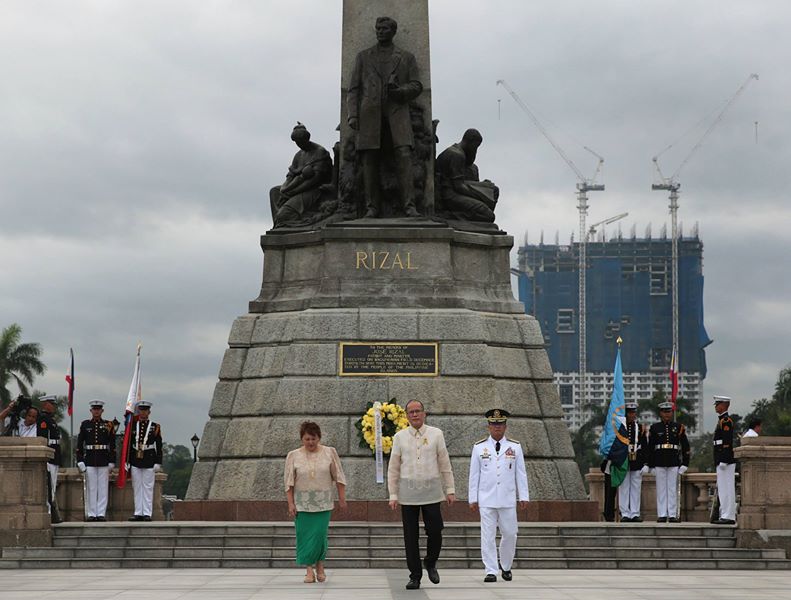
The Torre de Manila construction can be seen behind the Rizal Monument in this photo of President Benigno Aquino III laying a wreath at the monument in commemoration of Jose Rizal's 118th death anniversary on Dec. 30, 2014. Aquino is flanked by NHCP Chairperson Dr. Serena Diokno and then-Armed Forces Chief of Staff General Gregorio Pio Catapang. Official Gazette of the Republic of the Philippines
Of all the icons of Jose Rizal in parks throughout the country, his monument in Luneta—sculpted in 1908, named Stella Motto, Guiding Star—is first among equals. Five generations of Filipinos have honored this icon as the symbolic heart of the nation, with ritual visits from all over the country and the world.
To the lasting credit of heritage advocate Carlos Celdran, he was the first to sound alarm bells in June 2012, when the Manila City Council approved real estate giant DMCI’s plan to build the soaring Torre de Manila right behind Stella Motto. Celdran’s online petition demanded a halt to the construction. DMCI started building anyway.
The Manila City Council ordered construction to be suspended in November 2013, but reconsidered in January 2014.
The Manila City Council ordered construction to be suspended in November 2013, but reconsidered in January 2014.
By the time loud public outcry could no longer be ignored, the Torre was several storeys high and growing, looming over the very spot of Rizal’s martyrdom, where his bones now lie.
In September 2014, the Knights of Rizal filed a petition at the Supreme Court for the Torre's demolition.
In September 2014, the Knights of Rizal filed a petition at the Supreme Court for the Torre's demolition.
The National Commission on Culture and the Arts (NCCA), which was made an intervenor-respondent in the case, ordered the suspension of the construction in January.
The Supreme Court eventually granted the Knights of Rizal's petition, issuing a temporary restraining order on June 16.
The NHCP
In an editorial, “Unhistorical Commission,” the Inquirer put the blame for the construction squarely on Maria Serena I. Diokno, chair of the National Historical Commission of the Philippines (NHCP).
The Supreme Court eventually granted the Knights of Rizal's petition, issuing a temporary restraining order on June 16.
The NHCP
In an editorial, “Unhistorical Commission,” the Inquirer put the blame for the construction squarely on Maria Serena I. Diokno, chair of the National Historical Commission of the Philippines (NHCP).
Diokno flouted her own agency’s Guidelines on Monuments Honoring National Heroes laid down by the NCCA, the editorial said—strange, since the NHCP is one of this collegial body’s 15 Board members.
In a letter, Diokno had stated that the Torre “is outside the boundaries of Rizal Park and well to the rear of the Rizal National Monument, hence it cannot possibly obstruct the front view of the [Rizal monument]”, giving DMCI a way out.
However, the Guidelines say that the “vista points and visual corridors to monuments” should be “clear for unobstructed viewing.” Furthermore, the monument's setting is “not only limited to the exact area directly occupied by the monument; it extends to the surrounding areas.” To give prominence to the monument, “the immediate areas should be simple and unobstructed.”
Last month came a clownish suggestion from Manila’s 4th district representative, Amado Bagatsing: turn Rizal around 180 degrees instead of demolishing the Torre—a suggestion met with snickering radio and online commentary and laughter in his own House committee on Metro Manila development.
Laughter could not hide the gravity of the situation. Records of the sequence of events over the past three years bring to full view the state of competence in Manila City Hall and the NHCP under Diokno, where anti-Torre minions struggle for integrity.
The Manila City Council
A step-by-step review of media reports on how DMCI got its permit is revealing. A year after the permit was issued, Rappler reported that a Manila City Council investigation of City Buildings official Melvin Balagot, who issues permits for all construction projects in Manila, concluded there had been a conspiracy between Balagot and DMCI.
Last month came a clownish suggestion from Manila’s 4th district representative, Amado Bagatsing: turn Rizal around 180 degrees instead of demolishing the Torre—a suggestion met with snickering radio and online commentary and laughter in his own House committee on Metro Manila development.
The Manila City Council
A step-by-step review of media reports on how DMCI got its permit is revealing. A year after the permit was issued, Rappler reported that a Manila City Council investigation of City Buildings official Melvin Balagot, who issues permits for all construction projects in Manila, concluded there had been a conspiracy between Balagot and DMCI.
Neither Balagot nor DMCI bothered to show up at the Manila City Council hearings on the Torre. Construction continued, but so did objections in several Council resolutions.
The main objection was DMCI’s violation of a Manila City Ordinance No. 8119 provision that imposes a maximum floor-area ratio within a university cluster reserved for schools and government buildings in the city’s zoning map.
The maximum allowable floor-area ratio is 4; the Torre's floor-area ratio is 7.79. By law, the Torre should also have been allowed only 7 storeys; it was eventually allowed 46 storeys, plus two penthouse levels and a basement level.
House hearing
How construction resumed in January 2014 surfaced in a recounting of the chain of events at the House committee on Metro Manila development hearing in July.
House hearing
How construction resumed in January 2014 surfaced in a recounting of the chain of events at the House committee on Metro Manila development hearing in July.
At the hearing, a picture emerged of zoning regulations overturned by now incumbent Mayor Estrada.
Rappler reported that DMCI had asked Estrada for an exemption from the provisions of Manila’s land use plan and zoning regulations. The City Council ratified these exemptions in a resolution dated January 2014, overturning its own previous record of resistance.
Estrada consented so the city could pursue “development,” Councilor Joel Chua told the House hearing. "Pag pumutok 'yan, wala nang mag-iinvest sa Manila," he recalled, Manila Bulletin reported.
So the City Council "reconsidered their decision" in a resolution authored by Councilor Ernesto Isip, signed by Chua as presiding officer, citing exemptions given by the zoning board.
GMA News noted a telling detail: there was no list of which councilors voted for and against the resolution.
Ordinance 8310
GMA News noted a telling detail: there was no list of which councilors voted for and against the resolution.
Ordinance 8310
Another heated point surfaced over an earlier council ordinance vetoed by former Mayor Alfredo Lim.
Lim’s veto neutralized Ordinance 8310, authored by Councilor DJ Bagatsing, a son of Congressman Amado. This ordinance sought to prohibit structures “marring the line of sight of any historical or cultural site or monument,” which “diminish [their] dominance and dignity or aesthetically desecrate [their] frontal or natural perspective.”
Eloquently absent from the hearing, Estrada took to the media instead, blaming Lim for granting DMCI’s permit, and allowing it 49 storeys, from the originally approved 19 floors.
Lim replied that only the foundations of the building were constructed in his term, skipping the exemption City Hall gave to the floor-to-area ratio in its own city zoning. It was in Estrada’s term, he said, that the building shot up to at least 40 floors under the Manila City Council’s January 2014 resolution ratifying the exemption granted by the Manila Zoning Board of Adjustments and Appeal to DMCI.
More revelation at this hearing zeroed in on the NHCP. Councilor Bagatsing told Rappler that NHCP representatives Wilkie Delumen and Crisanto Lustre cited NCCA’s guidelines at the City Council hearing back on June 22, 2012. “Their position was clear,” Bagatsing said. “Torre de Manila violates NHCP guidelines on monuments honoring national heroes.”
The choice is clear. Demolish or drastically reduce the Torre’s height to finally comply with violated Manila zoning regulations, or allow it to become a permanent monument to Filipinos' bending the rules for the rich and powerful for the whole world to see.
Lim’s veto neutralized Ordinance 8310, authored by Councilor DJ Bagatsing, a son of Congressman Amado. This ordinance sought to prohibit structures “marring the line of sight of any historical or cultural site or monument,” which “diminish [their] dominance and dignity or aesthetically desecrate [their] frontal or natural perspective.”
Why did Lim veto this ordinance? Because he sat tight on the principle of primacy of the executive over the legislative branch of Manila City Hall instead of trying to persuade the Council to delete one requirement in this ordinance.
That requirement was for contractors to seek City Council clearance for vertical construction of buildings. "Bakit kailangang magmano sa [city council] ang developer bago magtayo? Ano ang motibo?” he asked.
The blame game
That requirement was for contractors to seek City Council clearance for vertical construction of buildings. "Bakit kailangang magmano sa [city council] ang developer bago magtayo? Ano ang motibo?” he asked.
The blame game
Eloquently absent from the hearing, Estrada took to the media instead, blaming Lim for granting DMCI’s permit, and allowing it 49 storeys, from the originally approved 19 floors.
Lim replied that only the foundations of the building were constructed in his term, skipping the exemption City Hall gave to the floor-to-area ratio in its own city zoning. It was in Estrada’s term, he said, that the building shot up to at least 40 floors under the Manila City Council’s January 2014 resolution ratifying the exemption granted by the Manila Zoning Board of Adjustments and Appeal to DMCI.
More revelation at this hearing zeroed in on the NHCP. Councilor Bagatsing told Rappler that NHCP representatives Wilkie Delumen and Crisanto Lustre cited NCCA’s guidelines at the City Council hearing back on June 22, 2012. “Their position was clear,” Bagatsing said. “Torre de Manila violates NHCP guidelines on monuments honoring national heroes.”
Barely six months later, to his surprise, the NHCP changed its tune in Serena Diokno’s letter to DMCI consultant Alfredo Andrade on Nov. 6, 2012.
She recommended “a City Hall ordinance designating a buffer zone around Rizal Park, prescribing guidelines building development” against recurrence of “a similar dilemma” in the future. But that buffer zone is already implied by the NCCA Guidelines, so what made Diokno reverse the NHCP's stand?
The resemblance between an official NHCP letter written to a hired consultant and Estrada’s approval of DMCI’s exemption from zoning regulations is striking.
Councilor Bagatsing sought clarification from NHCP executive director Ludovico Badoy, Rappler reported. Badoy told him outright that he was “for the Torre.” But wouldn’t it obstruct the vista of the Rizal Monument? Bagatsing persisted. “Bakit, sa gilid meron na,” Badoy replied, referring to the residential Eton Baypark Manila on the corner of Roxas Blvd and TM Kalaw Street.
Options
The citizens’ clamor is growing. More than 11,000 have signed Celdran’s petition for demolition by now, citing both “the sanctity of the sightline” and the Torre’s future load on Manila’s traffic from added overflow of vehicles and people, a nightmare that Manila’s traffic management is already unable to cope with.
Options
The citizens’ clamor is growing. More than 11,000 have signed Celdran’s petition for demolition by now, citing both “the sanctity of the sightline” and the Torre’s future load on Manila’s traffic from added overflow of vehicles and people, a nightmare that Manila’s traffic management is already unable to cope with.
The choice is clear. Demolish or drastically reduce the Torre’s height to finally comply with violated Manila zoning regulations, or allow it to become a permanent monument to Filipinos' bending the rules for the rich and powerful for the whole world to see.
The overall picture reveals law trying to catch up with shallow historical understanding, tayo-tayo politics and economic giants defying all in rampaging, indiscriminate real estate development. In the process, both intangible values in collective Filipino memory and tangible—now urgent— environmental straits are ignored to everyone’s peril.
Previous jarring changes in Manila’s most elegant historic landscape, the lone oasis in our traffic-choked capital went nearly unnoticed. To the moaning of heritage advocates, the NHCP also allowed the demolition of the 104-year-old Army-Navy Club and the 76-year-old Admiral Hotel on Roxas Boulevard designed by the future National Artist Hernando Ocampo.
The next installment will examine why, along with more instances of NHCP’s level of competence now spilling over to Fort Santiago, Rizal’s loveliest shrine in Dapitan, and Baguio’s turn-of-the century heritage architecture.
More Filipinos need to wake to the fatalist mediocrity of “Nandiyan na 'yan. Anong magagawa natin?” That would have shamed Jose Rizal over a century since he gave his life for our nation. — KG/BM, GMA News

