

 GMA Brandtalk
 Tracking
 Archives

About face, Rizal (Part 3)
Apart from the Rizal Monument in Luneta, other heritage structures hang in the balance under the shadow of the National Historical Commission of the Philippines (NHCP).
Quotes from a letter regarding the Torre de Manila from NHCP chair Serena Diokno and from Solicitor General Florin Hilbay's reply shed light on their levels of wisdom at counterpoint.
Dear Sol Gen Hilbay:
You informed us today that you will now argue that there is a legal basis to stop the construction of Torre. Allow me to state my objection to your new position.
You assured me that the NHCP is ‘cleared’ of any responsibility because you will explain, if asked, that the NHCP Board members are not constitutionalists. But the draft of your statement primarily cites not the Constitution but Sec. 25 of the Heritage Law as your legal basis. So if the basis of your prayer that the NHCP is discharged as respondent is gone, on what grounds, then, should we be discharged?
Make no mistake: the NHCP did not, does not like the Torre. But as a responsible government agency, it does not act on the grounds of personal preference but solely on the basis of the law, in this case the Heritage Law and the NHCP charter.
The implications of your new position go well beyond the NHCP’s position...immensely worse for the nation in terms of the rule of law, the right to the present generation to create its own heritage alongside that of earlier generations, and pending heritage cases...
Part of Hilbay's reply is below.
Dear Chair Maris,
I hope you take time to seriously reflect on your position insofar as it affects the jurisdiction of your office and its credibility in the community...I hope the NHCP will find the courage and reason to stand with us on this matter of grave importance. We are committed to moving forward, regardless.
The NHCP’s understanding of the Heritage Law already allowed the renewed construction of the Torre and the demolition of the 76-year-old Admiral Hotel.
Dambana ni Rizal
Few know that the NHCP had already wrought puzzling changes on Fort Santiago’s Dambana ni Rizal, renovated for the Centennial of the Philippine Revolution.
By virtue of Rizal’s imprisonment, trial and sentencing, Fort Santiago was judged by experts and scholars in conference with the National Centennial Commission (NCC) “the most important landmark of the Freedom Trail” of our 1898 revolution.
Neither scholarly effort nor expense (budget: P64 million) was spared to turn a virtual bodega of Rizaliana to an elegant memorial honoring Rizal’s sacrifice.
The NCC purposely chose the word “dambana” for a secular, not religious, shrine of Philippine emergence from a theocratic Spanish colony to a sovereign State.
This dambana reflected work by outstanding historians, Benedict Anderson and Vicente Rafael, and experts conversant in 19th century Spanish, French, German, English and Tagalog translating Rizal. Materials from the Industrial Revolution’s black iron and glass and the 19th-century ilustrado home’s stone and hardwood in his time were carefully chosen for virtuoso artisans to craft.
In the resulting serenity of austere surroundings a hero’s words echoed in Mi Ultimo Adios etched in Italian sandstone, more writings etched in black iron or sandblasted into glass, and an excerpt from “Portrait of Lolo Jose,” a book of clan memories by Rizal’s grandniece Asuncion Lopez-Bantug, in kamagong inlaid in narra. Fine taste had created the subliminal presence of the spirit that sparked our revolution.
The Freedom Trail’s second most important landmark is the Dambana ni Rizal in Dapitan, Zamboanga del Norte, in memory of our indio Renaissance man’s exile in deep reflection and practical service to the community.
The Dapitan shrine, an outdoor museum designed to blend with the natural landscape, was divided into Rizal’s own land (bought with lotto winnings!) following the gradients of a hilly forest floor as sacred space, and reclaimed area paved with all-weather material stone aggregates symbolizing community as civic space, with Rizal’s poems in own handwriting etched on steel plate plaques displayed outdoors.
“The Centennial Commission did a good job,” observes Trixie Cruz-Angeles, former NCCA commissioner for heritage conservation, now legal counsel. “Hindi lang natapos. The plaques of Rizal's poems descriptive of the place were completed, but never put up. I’m hoping the work will be completed according to the original vision.”
However, when Diokno’s NHCP opened a bidding to renovate the recently renovated Fort Santiago and Dapitan shrines, there was no reference to painstaking NCC consultations with historians, educators, statesmen, cultural and civil society leaders.
“The plan was approved by no less than five layers of the bureaucracy,” says Marian Pastor-Roces, chair of Tao Inc. the only Filipino corporation in professional museum development and curatorship contracted by NCC.
“The NHCP thought to replace the dambana concept with a student's educational center. By what fiat? How were the decisions arrived at? I don’t understand why the materiales fuertes (sandstone from Italy, which took nine months to arrive) is covered over by plastic. Kamagong inlay into narra has been covered over by cheap wood panels.” Result? The look of an outdated grade school history book.
“Can the public know the new curatorial plan?” Roces asks. “The Shrine in Fort Santiago is destroyed. Now the Rizal Shrine in Dapitan is about to be ‘modernized.’ Where are the consultations?”
In Baguio City
The Torre controversy dovetails with the furor in Baguio over plans to turn part of their last green space, Burnham Park, into a parking lot and “improve” their 105-year old City Hall.
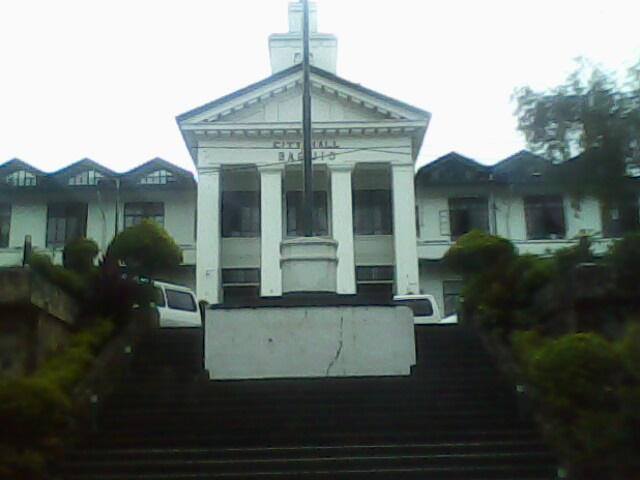
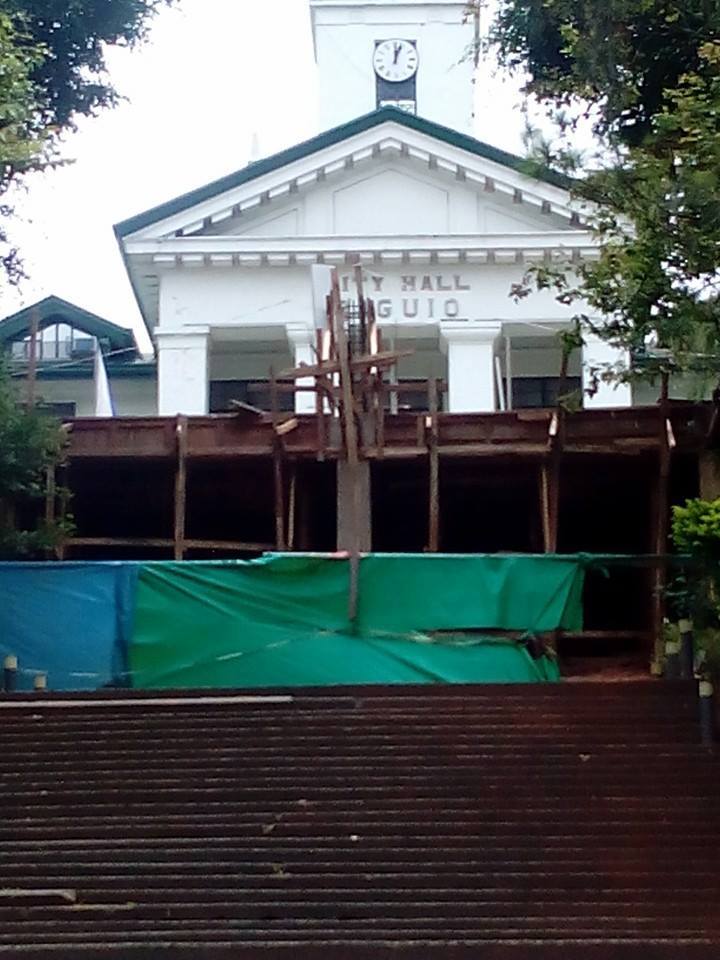

Alarmed Baguio heritage advocates had already written to the City Architect, the City Council and Mayor Mauricio Domogan, invoking the Heritage Law, to no avail.
Only in early May 2015, after months of protest in the local press and social media, did Diokno ask Domogan for a copy of their plans for City Hall, meanwhile enjoining him “not to undertake any development work or changes in the area until the Commission approves your plan.”
Two weeks later, advised by her architects after a brief ocular visit apparently spent only with the mayor’s team with no time for heritage advocates, Diokno wrote Domogan again, giving him the go-signal. It was Torre de Manila, Admiral Hotel, and Army-Navy Club all over again.
In desperation, heritage advocates finally wrote the NCCA, which responded quickly with a Cease and Desist Order. The local press, such as the Baguio Herald Express, reported City Hall’s objection to the NCCA CDO, confused by the lines of authority hardly clarified by the statement of an “NCCA analyst.”
Out in the open now were both local struggle over heritage issues and the NHCP’s lone-ranger power style vis-a-vis the NCCA’s higher collegial mandate.
All this uncertainty makes the Supreme Court’s word on the Torre a much-awaited verdict on where the last word on conserving heritage rightfully belongs. Meanwhile more heritage remains endangered by developers’ greed and Pinoy tayo-tayo. — BM, GMA News

