

 GMA Brandtalk
 Tracking
 Archives

Neil Gaiman’s ‘Trigger Warning’ takes no prisoners
Contrary to convention, the title of this collection is not taken from among those of the stories included. It is, Gaiman said, a nod to the increasingly common usage in the United States, such as in universities, of tagging certain books, films, and other forms of media as containing material that could be troubling to the reader or viewer.
Gaiman suggests, "What we read as adults should be read, I think, with no warnings or alerts beyond, perhaps: enter at your own risk. We need to find out what fiction is, what it means to us, an experience that is going to be unlike anyone else's experience of the story."
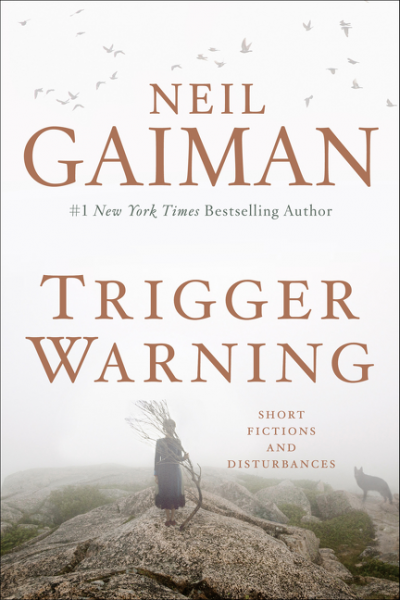
The two dozen works—19 stories, five poems—in this collection are guaranteed to give the reader an experience, for no other author has quite the same deft touch as Gaiman in spinning other-worlds that, disturbingly, seem to be only a hair's breadth away from reality.
The poems are “Making A Chair,” “My Last Landlady,” “Observing The Formalities,” “Witch Work,” and “In Relig Odhrain,” the last a reference to a Celtic tale.
For me, the standouts among the stories are:
"A Lunar Labyrinth": The narrator walks up a “gentle hill on a summer's evening” with a local guide, who shows him a maze constructed of hedges of rosemary—“for remembering.” And he remembers the people who have walked the labyrinth according to the phases of the moon, for desire, for healing, for good fortune. Yet there is a price to pay if the maze is not run correctly…
“The Thing About Cassandra”: Teenager Stuart Innes draws an imaginary girlfriend in his notebooks to avoid peer pressure. Twenty years later, she becomes a reality, and too much for him to handle.
“The Truth Is a Cave in the Black Mountains…”: A dwarf searches for a cave of gold for a king's campaign of conquest, but discovers a secret about his guide that leads to a change in both their fates.
“Orange”: This story employs an unconventional structure, and reminds me of the surreal stories of Donald Barthelme. It involves bubbles, neon-colored dyes, chocolate, and a most matter-of-fact family who take unusual events in stride.
“A Calendar of Tales”: This is twelve stories within a story. Each short tale is named for one of the months, each a gem of speculative fiction. Choose your favorites. Mine are "May," where mysterious messages are received—“WE APOLOGIZE OF THE INCONVENIENTS”—and "July", where an igloo of books is built, and washed away when its purpose is fulfilled.
Two of the stories are pastiches: "The Case of Death and Honey" places Sherlock Holmes in China, where he collects the honey of rare black bees for an important experiment; and "Nothing O'Clock" is a Doctor Who and Amy Pond adventure, where once again they save the day and thwart an evil-doing alien race with a squiggly whatsit and timey-wimey stuff.
"The Sleeper and the Spindle" revisits the tales of Snow White and Sleeping Beauty, and the result is a story that transcends both, with a courageous queen, axe-wielding dwarfs, and a tower entwined with roses.
"Black Dog" is a further adventure of Baldur “Shadow” Moon, a character from Gaiman's "American Gods" novel. Finding his way back to America, Shadow has made it as far as the Peak District in Derbyshire, where he is embroiled with a pair of lovers and a mysterious spectral hound on an uncanny hill. There he becomes an instrument of revenge, reparation, and atonement.
"Short story collections don't sell" is the wisdom that most publishing houses are said to go by nowadays. But short stories have their own value, a luminescence one can hold in the hand, like a firefly trapped in a jar; it is fiction bite-size but still larger than life, and no less short on the imagination and in the clarity of telling than the longer forms.
As Gaiman says in the introduction, “I grew up loving and respecting short stories. They seemed to me to be the purest and most perfect things people could make: not a word wasted in the best of them.”
These works, by turns upsetting, provocative, terrifying, and, yes, informative, are consistently lyrical and well-crafted. It takes an adroit mastery to make short stories gleam like jewels, and Neil Gaiman, indeed, is a master of this form, as this collection proves. Enter at your own risk. — BM, GMA News
Trigger Warning: Short Fictions and Disturbances by Neil Gaiman, 2015. 308 pages, mass market paperback. William Morrow, New York.

