

 GMA Brandtalk
 Tracking
 Archives

The burden of the oral: Recent works on Filipino heroes
In the past year and a half, local audiences saw two very successful theatrical productions and one digital film about the newly relevant subject of heroism.
Ang Huling Lagda ni Apolinario Mabini, written by Floy Quintos and directed by Dexter Santos, was staged at the Wilfrido Maria Guerrero Theater of the University of the Philippines Diliman by Dulaang UP for the whole month of October, 2014.
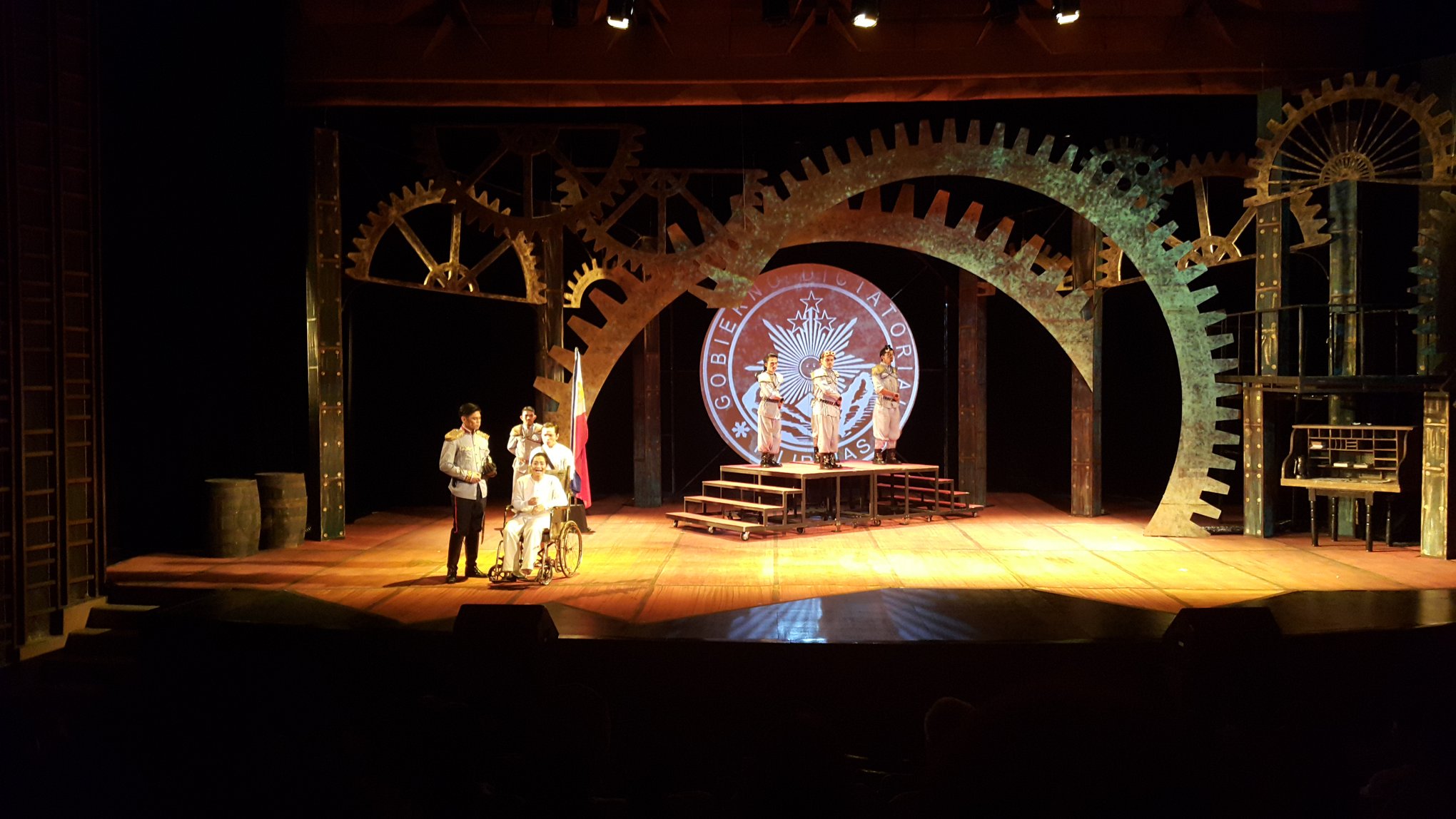
Mabining Mandirigma, directed by Chris Millado, and with a libretto by Dr. Nicanor G. Tiongson, ran for the whole month of July in 2015, at the Teatro Aurelio Tolentino of the Cultural Center of the Philippines.
And of course, produced by Artikulo Uno Productions, Jerrold Tarog’s Heneral Luna (from a script written by E. A. Rocha and Henry Hunt Francia), was released—and enjoyed immense commercial success—in September of the past year.
What unifies all three productions isn’t just their historical and nationalist interest. In their own ways they all powerfully dramatize the social effects of a residual and enduring oral consciousness, which is the cultural condition in which the heroic figures of Mabini and Luna—as well as of Jose Rizal and many others from that period—lived and loved.
As we may infer from these remarkably performative texts, the revolutionary struggle then—as well as, in many tangible ways, now—is, at bottom, a cognitive one: the ability to envision and champion the Filipino nation is premised on the existence of a firmly established textual mentality. This is synonymous with a kind of archival and profound literacy that allows—indeed, encourages—the collective achievement of categorical thought, upon which the adamancy of nationalist conviction must stand. The oral mind, by contrast, can only appreciate ideas that are close to the immediate and communal life world.
While accretive and copiously phrased, these ideas are far from categorical in that they transform even as they are repeated by their different speakers. This oral “negotiability of meaning” is what writing—the technologizing of the spoken word—precisely seeks to arrest, codifying memory and pinning it down to the enduring medium of its script.
“Nation-ness” is necessarily collectively imagined, and while orality has its own rich and entirely useful psychodynamics, as it has evolved into its modern form the nation is a grand and aspirational abstraction that requires of its members not only the ability but also the mental inclination or habit to apprehend—and remember—its capacious unity even in incongruous and disparate realities, whose occurrence it is meant to ultimately minimize and transform.
Needless to say, given the uneven and mostly superficial literacy that afflicts us today, we can only imagine the unique and extreme difficulty erudite and highly literate heroes like Rizal, Mabini, and Luna needed to endure, assailed and “martyred” as they variably were by the oral and provisional ways of an even more fractious and colonially subjugated population, whose illiteracy predisposed them away from the abstraction of democratic solidarity and toward the kind of familial, feudal, and/or regionalist loyalties that the national project is ideally meant to supersede.
As a fundamentally imaginative undertaking—that relies heavily on literate memory and the power of literary narration to bind and sublate disparate elements into a singular and discursively stable vision and form—the project of the Filipino nation is obviously an unfinished one.
Mabini’s final script
What’s good about teaching in UP Diliman—among so many wonderful things, like the verdant canopies with their exotic birds, the brilliant and passionate conversations at just about any corner of the sprawling campus, the living tradition of national service, and the brightest students—is that the University’s foremost theater company, Dulaang UP, semester after semester offers the most interesting and intelligent productions, that can certainly complement any number of the collegiate courses in literary, historical, communication, performance, and cultural studies, for they can occasion reflections (or even debates) on any of their routine lessons.
In Ang Huling Lagda ni Apolinario Mabini, playwright Floy Quintos pursues his well-known passion for musical theater and historical drama, and in collaboration with composer Krina Cayabyab, and under the superb direction of Dexter Santos, his wonderfully realized play proves to be entirely watchable and satisfying. This is true even if, now and then, the music and the singing don’t exactly produce the kind of felicitous sound that they should, owing perhaps to any number of reasons: logistical, acoustical, the mismatch between tessituras and the songs’ melodic ranges, the luck of the draw, etc.
One suspects, however, that imposing the musical form on this dramatic vision may not have been necessary, or desirable, inasmuch as the best scenes are really the non-musical ones, especially the central dramatic moment, when the American Governor General and the sublime paralytic meet and argue on the deck of the boat that is bringing the exiled “Brains of the Revolution” back to his homeland, accompanied by his devoted younger brother and the feisty general Artemio Ricarte. This encounter almost certainly took place, and its central facts very likely were the historical case. In these scenes, however, Quintos boldly exercises his artistic license to ennoble and illuminate this pivotal “event,” thereby gifting to the audience his own insight concerning the vital question of why, after valiantly resisting for so long, the old and infirm Mabini finally relented and signed the oath of allegiance to the United States, that had already effectively (and brutally) annexed his beloved and wobegone country, after all.
As Quintos would have it, Mabini right at that moment must have realized, with the aid of the fictionalized figure of the kindly Filipina nurse Salud, that the dream of an emancipated Filipino nation rightfully belonged to the future generations of his countrymen and -women, to whom he had already bequeathed the seed of his own life’s sacred scripture. This idea—that it was not his actions but rather his writings that would constitute his truest and most enduring contribution to the dream of nationhood—proves entirely fortuitous, not only because even Jose Rizal’s “greatness” itself is in a large part textual (novelistic, to be exact), but also because before it can be anything else, the Filipino nation must be a stable allegorical narrative, a powerfully enacted story with its set of cosmologizing symbols that can gather together the embodied and parlous differences of our country into the provisional and archipelagic unity that lies at the heart of this imagined community.
It’s additionally interesting that Quintos’ play renders the act of signing—of textual self-inscription—as the most important dramatic gesture, because it’s precisely the transition from the oral to the chirographic that defined the modern project of state-formation, both for the colonized subjects and their colonizers, especially in this part of the subjugated world.
Finally, UP’s resident historians will most likely appreciate this play differently from its artists, but that’s because their task is to demystify what the latter, by definition, must again and again summon forth: resonant, inspiring, and enduring stories or myths, which are really what writers (and artists in general) all aspire to achieve, disseminate, and leave behind.
In any case, just as one stands up to give the crew and cast (top-billed by the amazing Roeder Camanag and Poppert Bernadas, and of course, the splendid Banaue Miclat-Janssen) their hearty and well-deserved ovation—along with the rest of the house—one finds oneself remembering why exactly one required one’s young students in postcolonial discourse to see this extraordinary production: so that, on one hand, they may experience for themselves the nativism (in this fractious subject, a much-encountered and contentious notion) that still must inform and impel all our institutional attempts to reimagine and reclaim our past as a people; and on the other, that they may recognize this essentialist project’s affective viability, power, and “richness” when deployed in the arts, as well as its sad inadequacy and ruinous impoverishment as a form of historical analysis.
The writerly warrior
Chris Millado’s musical reminds us that the sublimity of Apolinario Mabini is the same thing as his heroism: like Jose Rizal, he lived the life of the mind, and wrote, committing himself to the categorical imperative of nationhood to an extent that his fellow revolutionaries (including even Emilio Aguinaldo himself) couldn’t. A scholar and lawyer by training, he provided the revolution and the First Philippine Republic their important pieces of scripture.
These texts were obviously less imaginative and more discursive than Rizal’s novels—which is probably why despite their significance they haven’t endured in the national memory—and yet we must remember that they exerted as much influence over the course of events as they possibly could, being precarious and preliminary moments of literacy in a decidedly preliterate world, still resolutely determined by orality’s systems of patronage which were all premised upon feudal and clientelist ties.
The capacity for abstraction and categorical thinking that underpinned the modern project of nationhood was a difficult thing to come by during this time, and therefore the national vision was something that very few could consistently devote themselves to (indeed, like Rizal, the eminently literate and text-minded Mabini held on for as long as he could).
While this play’s ornately worded libretto (by foremost scholar and playwright Nick Tiongson) may not, now and then, be in perfect sync with its restive and vivacious music, its project is accomplished remarkably enough: to trace contemporary nationalism to its anticolonial “foundational” moments, in whose light it is both confounded and affirmed. The problems of the First Philippine Republic, caught between one Western colonialism and the next, are arguably the problems of our own sad republic in the present time, and they to a large extent can be attributed to the persistent effects of a residual orality that has hampered categorical mentality and the formation of genuine national solidarity (across various social divides), and allowed feudal and clan-based oligarchies to hold sway.
The solution Millado’s play proffers would also appear to be the same one that Mabini, after witnessing and surviving the brutal war (that wiped out hundreds of thousands of Filipino lives), toward the end of his own life, himself intuited: the realization that once domination has turned hegemonic the object and ground of struggle becomes both ideological and cultural—a field of meanings and textual contestation that requires not the isolationism of counteridentification but rather the participatory and ironic moves of disidentification: a complicated task that both accepts and critiques the terms that power imposes upon those it simultaneously subjugates and enables.
Needless to say, as this production reminds us, this is a task that eschews “essentialism,” re-signifying “foreign” forms like steampunk into something relatable and local, and seeing such attributes as gender as mere social constructs (that, come to think of it, do not need to determine casting choices).
Of course, this task also makes it possible to understand anti-imperialism as a position that even those in/from the empire may in fact assume (as Americans like Mark Twain did, which this play memorably takes note of).
Finally, aside from the effective choreography and strong and powerful performances of the cast (headed by Ateneo alumna, Delphine Buencamino), Toym Imao’s production design deserves to be commended as well, for its arches of disarticulated clockwork parts—cogs and wheels and such—betoken the idea of history not only as chronology, but also as machinery and structure, the frame of overarching forces within which exercises of individual and collective agency must happen.
Given the constitutive role that textual consciousness and literacy played in the life of heroes like Mabini—and the roles they must continue to play in our own residually oral lives—just now I’m thinking that it would have perhaps been more interesting (and meaningful) if embossed upon these clockwork parts were lines or pieces of texts that Mabini had faithfully inscribed: an entire stage beribboned in the written words that could possibly save us still.
Death by gossip
As Jerrold Tarog’s film would have it, the beginning of the end of Antonio
Luna was when he was overheard issuing what was perceived as a “veiled threat”
on the life of Emilio Aguinaldo, right after he went all trigger-happy and took
pitiless aim at a poor vendor’s luckless chickens right outside a church. Soon
enough, this “tsimis” reached the ears of El Presidente, who by this time had
already become predisposed against his army’s testily macho and verbally
“coarse” chief commander.
Indeed, Luna’s single-mindedness about resisting the occupation had been rubbing against the grain of the First Republic’s cabinet, constituted as it significantly was of morally dubious and business-savvy ilustrados, who were all too willing to get into bed with the new colonizers if only to preserve their own pecuniary interests. Thus do we see the enormous difficulty faced by the eminently literate, continentally educated, poetry-loving, and madly uncompromising general, who could imagine the nascent and aborning nation in ways many in the downtrodden and touch-and-go world he lived in simply couldn’t, caught as this world inexorably was not only between the brutal imperatives of Western colonialisms, but also between an immemorial and many-tongued orality and a precarious and uneven literacy, that simply hadn’t stabilized into a discursively viable and “binding” cultural condition despite three centuries of Hispanic rule.
How interesting to see the ill-fated general writing and reading letters, therefore, and answering the questions of a fictional young patriot (allegorically named “Joven”) at a table laden with books, for these visually indicate and signify him as someone who is capable of practicing the kind of categorical mentality that, despite a mythically invested and abiding religiosity at least enabled him to intuit the abstract contours of the archipelagic whole, and imagine past the familial and regional loyalties that even the likes of Aguinaldo again and again found it difficult to transcend... Finally, how fascinating to see the figure of the general’s savaged body, done in as much by the bullets and knives of traitorous Caviteños as by the poison of a clannish, copious, and runaway orality, bearing his life’s final scripts, kept like his dream of a fully emancipated nation close to that fiery hero’s heart. Tarog’s final tribute to him is in fact the evocation of another script—this time a
painterly one, that of the masterpiece Spoliarium, inscribed by the equally famous brother Juan—into which he hauntingly consigns, in the viewer’s memory, this tragic hero’s final image. — BM, GMA News
Heneral Luna will be screening on February 3 and 4 at the Cine Adarna of the UP Film Institute of UP Diliman, and Mabining Mandirigma will be having a second run from February 19 to March 13 at the Tanghalang Aurelio Tolentino of the Cultural Center of the Philippines.

