

 GMA Brandtalk
 Tracking
 Archives

‘Schism’ knows what you hate about the theater...and people, too
The title card reads: "A STEAMPUNK ELECTRONIC DANCE MUSIC NATIONALIST DYSTOPIAN MULTI-MEDIA HALLUCINATION IN A POST-MODERN ADAPTATION OF MOLIERE'S MISANTHROPE."
Oh. Dear.
After taking a seat inside Pineapple Lab, I found myself preparing for the absolute worst. It's worth noting that "Schism" is directed by George de Jesus III, not this "Don Garcia"—which should have been a hint.
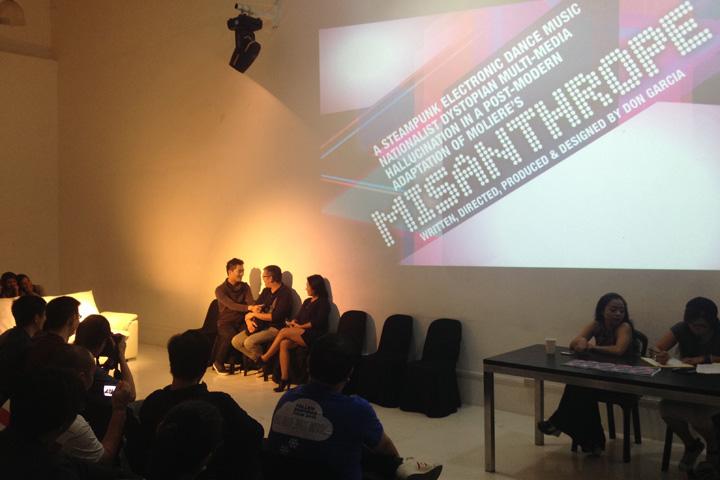
That buzzword though—"post-modern"—elicited an immediate reaction. If you've seen one of those, to put it mildly, "ambitious" projects before, an eye roll is almost instinctive.
It turns out, "Schism" is the show everyone should have watched in the Fringe Festival. It makes fun of all the things about art that turn people off.
Tuxqs Rutaquio and Angeli Bayani enter and say hi to some people to some people they recognize in the audience. Rutaquio then begins a soft tirade about the annoying platitudes people say after they watch a play—especially a play that's not particular great...or not even close to good.
"Schism" starts without any announcement, with the two actors casually beginning a conversation.
Rutaquio speaks as Alex, a playwright who is spending all of his energy keeping his lower and upper lip together—sealing his mouth, because per his friend Helen's (Bayani) advice, speaking one's mind causes some adverse effects.

Alex has seen this STEAMPUNK POST-MODERN ET CETERA adaptation by Don Garcia (Ron Alfonso) and his criticism of the play can be summarized in one word: "Panget."
Garcia, predictably, is offended. And what do offended people do? Go to Facebook, of course. There, he finds comfort—the Internet is vast and even pedophiles find pals there.
Regardless of the quality of the play within the play is (a snippet is performed—it seems terribly pretentious), Alex should have every right to express his thoughts. He seems, after all, sincere in his criticism. He even tried to keep it to himself, knowing Garcia might feel bad.
It was in fact Garcia who asked—nay, prodded. Alex's outburst, which happened in such close proximity to the audience, warrants applause. However, in the "Schism", he paid a dear price for daring to be honest.
Rutaquiao is convincing as Alex. The disdain for the kaplastikan and unnecessary chumming up to famous personalities is almost too real. On par with him is Jojo Rodriguez, whose performance as the perpetually smiling Jim is unnerving.

Handsome and appealing, Jim gets away with everything—charming his way into plays and lying himself into Alex's heart. Poor, poor Alex.
De Jesus ends Alex's ordeal the only way it could have—ripe with frustration as people willfully remain blind to their own flaws. As a writer, De Jesus succeeds in illustrating the worst in people without pointing a finger directly at the usual suspects, i.e., social media.
Moliere's "Misanthrope" existed before Facebook. People and their annoying traits existed before Twitter. De Jesus doesn't frame the Internet as the culprit. It's just another medium where hypocrisy is exposed. Theater is another and he wields its power successfully with "Schism." — BM, GMA News

