

 GMA Brandtalk
 Tracking
 Archives

Volunteers give new life to Tacloban library
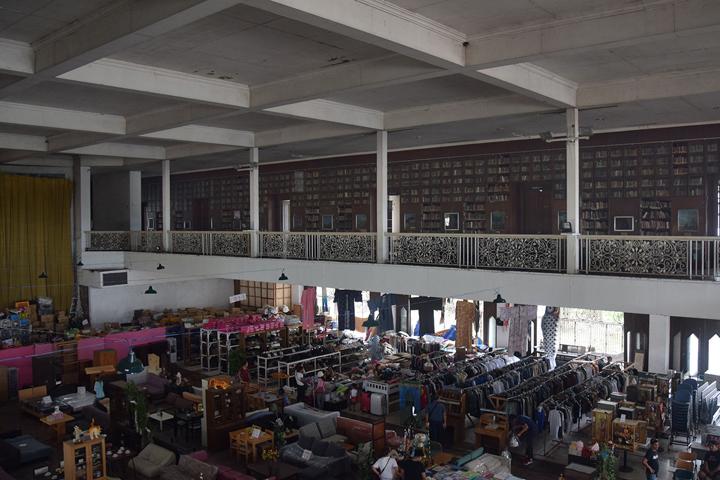
TACLOBAN CITY – The music blares just loud enough to catch the attention of passersby to a bazaar in a two-storey building that for almost 40 years has served as an important landmark of Tacloban.
The People’s Center and Library stands next to the more prominent Sto. Nino Shrine, the residence of the Marcos family in the city at the height of its power and a showcase of the opulence and extravagance of the Marcos era.
As dozens of shoppers scour for bargain at the bazaar below, four women are busy checking on the books one-by-one – removing the dusts that have accumulated for over 30 years that they were left unattended.
Books infected with termites are separated for treatment. “Some of the books are now heavily infected and beyond recovery,” says Jaclyn Noelle Saño, a 30-year-old law student.
Saño and two of her friends, Ypille Mia Tirse and Coreene Ann Cular, started their volunteer work at the library in January this year. Later, library science student Donnabelle Gay Fabicon joined them.
The four of them have already cleaned thousands of books, coming regularly either alone or as a group at least twice a week to clean the books.
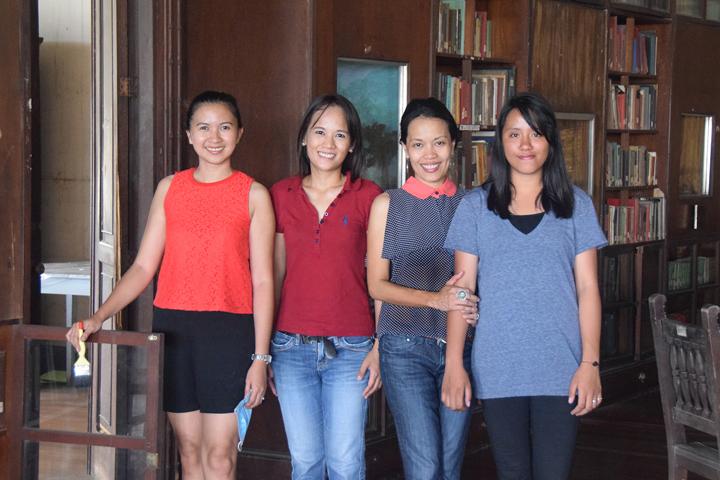
It was Tirse, a nurse for 30 years in the United States, who first brought up the idea of volunteering to clean up the library. She came home to Tacloban seven months after super typhoon Yolanda hit Eastern Visayas.
“I went around to places that I used to visit when I was younger to see the effects of typhoon Yolanda and one of which is this library,” she said. “I was shocked to see the condition of the library – books were in disarray and dusty and the place was really in a bad shape.”
She discussed this sad condition to her friends Saño and Cular and they decided to start a seemingly unending task. “The books that we cleaned in January need to be dusted again. We need to come up with a system to sustain what we have done,” says Tirse.
In March, Tirse posted an appeal for volunteers on the Facebook group “You Know You’re From Tacloban If…”
The response was tremendous. Student organizations, civic groups and individuals responded to the appeal and came armed with cleaning paraphernalia and paid the P20 fee for library card that is valid for six months. Some Taclobanons abroad pledged financial support to defray cost of cleaning materials, masks, and library fee.
As many as 100 students came daily last month to help clean the library. But as classes came to an end, the number slowly dwindled and now it seems that only the four of them are left.
“We need more volunteers now to help us,” says Tirse. She is encouraging students who don’t have much to do this summer to volunteer in sprucing up the dilapidated library.
Treasure trove
While bargain hunters are busy looking for “treasures” among the heap of second hand items from Japan at the bazaar, the library at the second floor is deserted most of the time. But for booklovers the stacks of books at the library are real treasures; many are rare copies and may no longer be available even in online bookstores.
“Most Leyteños do not realize how much a treasure we have here. This is a real treasure trove,” says Tirse.
The library has 14 big rooms filled with books on shelves 15 feet high. One room serves as the Leyte provincial library and is run by a licensed librarian paid by the provincial government. The rest are administered by the Presidential Commission on Good Government (PCGG), which administers the People’s Center and Library and the Sto. Nino Shrine, both sequestered properties.
The PCGG office occupies one room surrounded by books and manned by only one person, PCGG administrator Renor Dauag. He takes charge of both buildings, acts as the librarian, and takes charge of collecting the P20 library fee, which is set aside to buy floor wax.
Large volumes of books by renowned authors like Victor Hugo, Leo Tolstoy, Albert Camus, Franz Kafka, Anton Chekhov, and the like could be found in the library. There is also a large collection of what may be a complete work of French novelist Honoré de Balzac, whose writings influenced the likes of Emile Zola, Charles Dickens and Henry James.
There is hardbound compilation of Munsey’s Magazine that dates back from the late 1890s to early 1900s. Researchers on the evolution of anti-apartheid campaign in the United States will be interested in the compilation of the Journal of Negro History published from 1925-1942.
Despite the good available resources, there are very few people who come to visit the library.
Dauag said during regular classes only around 50 people come to read a month. He said students find it easier to just do their research on the internet.
But booklovers believe the rigors of doing the research on a library is still a lot better than relying on what is available online.
“There is always a question on the integrity of information that you get on the internet,” says library science student Fabicon. “Many of the materials available here are not in the internet.”
A battle for survival
The library is dim but well ventilated with fresh air from trees outside. It could be ideal for relaxed reading if not for the noise from the bazaar at the ground floor. PCGG has rented out the area to a second hand bazaar to cover the operation and administrative expense for both buildings.
“This is for our survival,” says Arpon. The P100,000 monthly rent plus minimal earnings from the library fees and entrance fee charged to visitors of Sto. Nino Shrine cover the salary of 21 staff working on rotation and maintenance operation.
There is no budget coming from the national government for their operation because litigation is still ongoing to determine the rightful owner of the place.
The Tacloban City government has once offered to fund some repairs at the shrine but was dissuaded by the Commission on Audit because doing so would get them liable for graft. —KG, GMA News

