

 GMA Brandtalk
 Tracking
 Archives

Desire and devotion: Sparks, glow in ‘Happiness is a Pearl’
Artist Playground's production design for Rody Vera’s script “Happiness is A Pearl” transformed the black box that is The Little Room Upstairs into a Japanese drinking pub.
Upon entering The Little Room Upstairs, which can sit maximum 30 guests for this production, one feels cramped, like a piece of jewelry shoved inside a cushioned small box meant for fineries.
The dark, provocative setting did wonders for the play, which is a journey and examination of love, lust, and longing, and the fears and horrors these competing passions lead to when allowed to gallop untrammeled, and in fatal fusion.
A habitue of any pub knows that drinking joints are peopled with warm bodies with fascinating or aching stories to tell. And these are the sparks and the glows in “Happiness is A Pearl,” the narratives of the lives of the three main characters told in an unusual style.
Directed by Paul Jake Paule, “Happiness is a Pearl” sets the Japanese drinking pub mood by opening with several singers rendering songs and performing onstage.
Then enter the three main characters garbed in kimonos and carrying Japanese lanterns, as if trying to find their way as they navigate the terrain of life. Bob Marley’s “No Woman, No Cry” plaintively plays in the background.
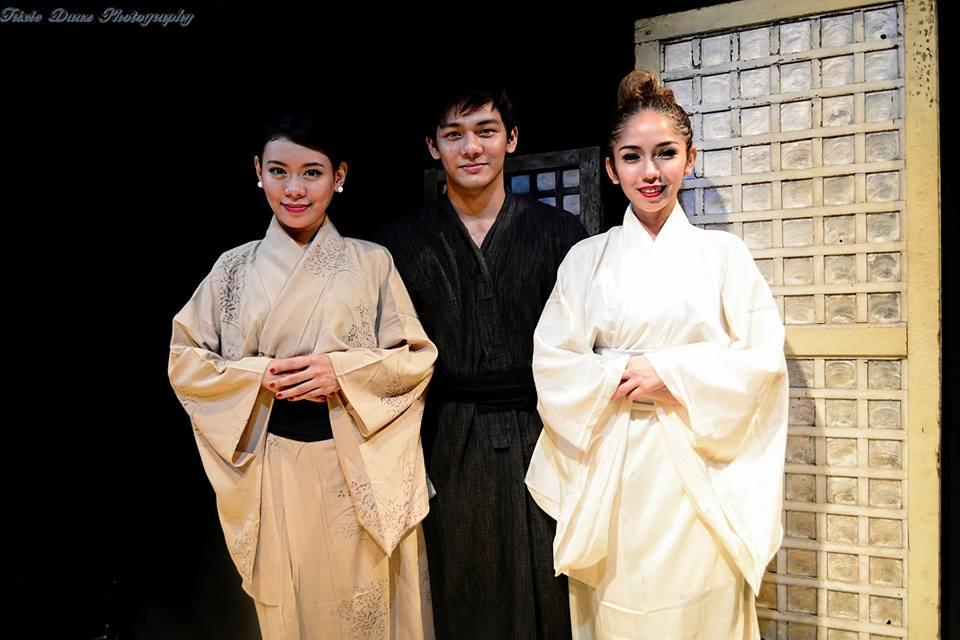
In an impressive staging with minimalist props, Paule deliberately employs devices found in a typical show at a seedy Japanese club, throwing in arresting tango numbers to push his story-telling until it spirals into its “bloody ending.”
In his maiden theater appearance, indie film actor Tomas Miranda eloquently masks his relatively meager acting resumé, which before this did not go beyond 30 words.
As Kenji, a Japanese boy-toy-host working in a pub, Miranda exhibits charisma and wit, and ably delivers his lines in a consistent Japanese accent—no mean feat.
Jerome Rosalin alternates with newcomer Miranda in the role.
Cath Go also displays her impressive acting skills in her role as Mari, a Japanese woman married to a rich Japanese businessman and who eventually becomes a prostitute. Her moving, agonizing descent and breakdown into a woman with a terrible obsession with a “pearl” in Kenji’s body is intensely absorbing.
Go alternates with Ruth Alferez and Camile Tiu in the role.
As Maria, a Filipina hostess working in Tokyo, Ira Ruzz manifests clarity in the darkened pub. She seizes with understatement the emotional ferment of a woman confronting the burden of supporting a family back in the Philippines and the heavy weight of her affections for Kenji.
Ruzz alternates with Sheila Espina and Mary Grace Saldo in the part.

Miranda, Go, and Ruzz should be commended also for convincingly performing several tango numbers on such a cramped stage—dances that provide the contrast between Mari's lust and Maria's love.
“Happiness is A Pearl” is a barbed and brilliant theater production on a small stage made magnificent by Paule, together with his artistic and production teams, as they cleverly show how ordinary mortals can be enticed with, and entangled in, the sticky, problematic space separating love and lust, desire and devotion.
This grim story of love and lust and obsession by playwright Vera is timeless and universal. And not for the faint-hearted. As most great stories are. — BM, GMA News
“Happiness is A Pearl” runs until July 3, with 3 p.m. and 7 p.m. shows, at the 1701 The Little Room Upstairs, Landsdale Towers, Mother Ignacia Avenue, Quezon City. For tickets and inquiries, visit Artist Playground's FB Page or contact 0926-9323179.)

