

 GMA Brandtalk
 Tracking
 Archives

Doro’s power of commendation
Amando Doronila was my first boss in journalism, back in the Manila Chronicle that he edited in the late 1980s. His front-page column, unambiguously branded “Analysis,” was the most lucid public explanation available on what was going on in the political world. When it was time for me to apply for a job in journalism, his newspaper was the only one I considered.
At first, I couldn’t get a job as a staff reporter, but Mr. Doronila (no one I knew called him Doro to his face) allowed me to contribute as a freelancer, getting paid a few hundred pesos per article. I reported on, among others, the disastrous effects of getting hit by a computer virus, which was then a new thing, and the burgeoning real estate boom on a tiny island with no electricity but had seductively soft, white sand, Boracay. Doro and his top lieutenant Vergel Santos gave me space and assigned copy editors with a light surgical touch.
Then I produced my first scoop, about Vietnamese refugees stranded on the high seas who resorted to cannibalism to stay alive before being rescued by Filipino fishermen. The refugees had first encountered a US Navy ship that didn’t rescue them, leading to the court martial of the ship captain. In his unexcitable manner, Doro read the printout of my draft closely, called the story “gripping” under his breath, put it on the front page, and offered me a regular job.
For the next three years, Doro enabled me to spend weeks in remote areas to bring home stories about communities hit by measles epidemics, villages caught in the insurgency crossfire, the last years of the U.S. military bases, and the unlikely rise of a rebel priest named Conrado Balweg. The Chronicle was where I met some of the most talented journalists of any era, many of them drawn too by the light cast by Doro: Sheila Coronel, Malou Mangahas, Paulynn Sicam, Lorna Kalaw Tirol, Manny Mogato, Ed Lingao, Eric S. Caruncho, Robles Alan, Johanna Son, Lito Zulueta, Thelma Sioson San Juan, Rolly Fernandez, and many others.
Drifting always around the newsroom was Amando Doronila, conferring with editors while slightly hunched over, with signature eye bags and a mumbling speaking style that conveyed a precise economy of words.
When a massive earthquake struck Luzon in 1990, I got out of my sick bed and volunteered to hike up to Baguio with a photographer after landslides closed all the roads.
After our coverage, when we were filing stories by landline from a telegram office on Session Road in between strong aftershocks, Doro wrote me a letter of commendation that he posted on the office bulletin board. It was the first commendation letter I ever got. It was just a paragraph with, as usual, precisely chosen words, but it left a mark that motivates me to this day.
When I finally felt I had to move on to another job, I met with Doro who read my resignation letter and then threw it back at me. Then he got up and went back to work. In that blunt, startling gesture, he let me know that he wanted me to stay. But he knew he couldn’t stop me from going.
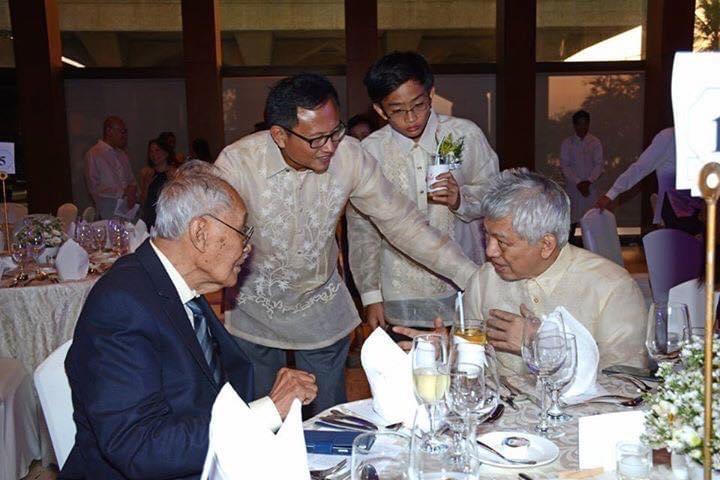
In 2016, I organized my ailing father’s 80th birthday party, three years before he would pass away. One of his requests was that I invite Doro, an old friend of his from his journalism days in the 1960s. I don’t think that Dad knew that I had also been close to Doro, who showed up alone and reconnected with my father, shown in the photo, with my son witnessing the encounter between my father and a father figure whom I can credit with fathering my career in journalism.
Soon after I found out that Doro too had passed away, at age 95, I reflected on the many things I learned from him. Not least was the value of a commendation or just a few kind words in a handwritten note, which I write often now for younger colleagues. The brief one Doro wrote more than 30 years ago was enough to tell a young journalist that he was on the right track and this was a profession worth a life’s devotion.
— LA, GMA Integrated News

