

 GMA Brandtalk
 Tracking
 Archives

Katya Angara’s artworks deal with women empowerment, death, and overcoming
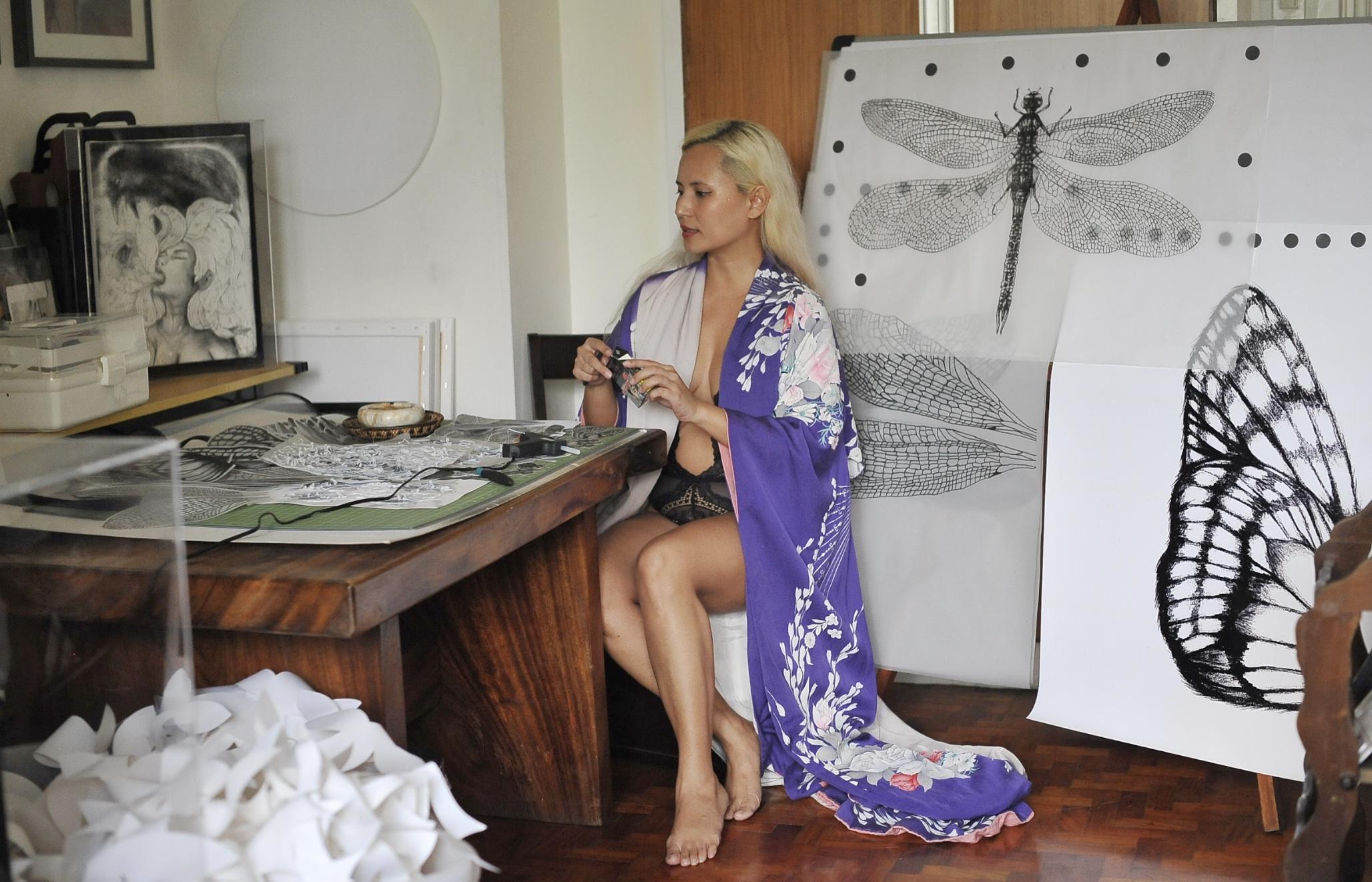
Artist Katerina “Katya” Angara depicts feminine sensuality both with ferocity and subtlety, also as life and death forces – with images she has plumbed from old cultures of Europe and Asia.
Like an archaeologist, Angara, 42, has resurrected in her canvases ancient energies, Bacchic and cosmic roots of women empowerment with mythical gods, goddesses, birds, insects, and their wings.
Her penchant for carbon-dated images seals her belief that women empowerment is as old as time or creation. It must be claimed as life’s provenance, and not asserted as a contemporary political awakening.
Women in art, as well as artworks dealing with death and overcoming life’s limits, brought about by her mental illness, are part of her exhibit, Dendrophilia, at the Crucible Gallery in SM Megamall.
Her unsold artworks are still in her studio in Makati, for discussions related to her plan to open soon a gallery named Counterflow with mentor-artist Jun Yee.
Women in Art
Angara’s “Lilith” depicts the Mesopotamian goddess naked, in close up, with two hands holding antlers that rise from her pubic area. “She is the original savage goddess, a representation of the darkness within,” says Angara.
The horns refer to Cernunnos, a Celtic and Gaelic Roman god of nature and wild things who also escorts souls to the other world.
Lilith’s prosthesis of power, the horns, makes her empowerment less intrinsic, weak, and drawn from someone who represents two divided forces: the earthy and the supernatural, critics say.
But combining Lilith and Cernunnos’ horns, Angara argues, is “connecting strongly the natural and savage roots (of a woman) with a (man’s) virile emblem of sexual emancipation.”
“Le Petit Mort (Little Death),” is a figurative and surreal charcoal drawing (on canvas) of a woman with a black bird on top of her head. Her face is surrounded by line drawings of flowers and petals. “They are the sexual organs of plants. The black bird represents flight or sexual freedom,” explains Angara, adding her title is the French slang for orgasm.
Angara tries to illuminate the sexuality of a woman, a visually challenging topic, which is often ignored by many feminist artists in the Philippines.
She talks about the “sexual spark” that unites, gives equality to, and resolves the differences of a man and a woman. Drawing a parallel to artistic creativity, Angara says, “Making art is a celebration of aliveness, an exploration of emotions and sensations. I love how creative orgasms and fleshly orgasms feel (the same) like little deaths.” Personally, she reveals, “My body is my temple, and sex is how I worship.”
Her “Provocatrix,” has a figurative and nearly scientific drawing of a scorpion, its pair of pincers, eight legs, segmented tail, and stinger, in black ink on thin photographic paper. The scorpion is perched on a thick black paper shaped like a leaf. At the bottom of the collage are white photographic paper cuttings with drawings of butterfly wings in black ink.
For Angara, the scorpion’s 435 million years of existence, otherworldly power, and venom are fitting metaphors for unadulterated power for women. The arachnid in her canvas is like the beginning of a dual-life form of a woman with enhanced powers. “She is the artist. She disturbs the peace. Her personal language is both cryptic and revelatory. Her sign is Scorpio. She is the provocatrix; the enigma; the mystic; the seductress; the sensualist; the dark one,” says Angara.
“Geisha” is an abstract rendition of Japan’s age-old entertainer. Its black canvas is filled with transparent paper cuttings with dragonfly wings drawn in black ink. In the middle of these wings are three white paper cuttings shaped like plates, whose edges are cut and curled. They are arranged vertically, like the dragonfly’s exoskeleton. The third part has touches of red, small and immovable, but it dominates the tone of the whole collage.
Angara’s abstract geisha is absent and present; alluring and platonic; hidden and enhanced; inscrutable and expressive; near and unreachable. Her intertwined physical construct and essence makes her always in “another secret world, only of beauty,” says Angara. The geisha who embodies both the material and immaterial is like a supernatural portrait of women empowerment.
Power of feminine psyche
According to Angara, “I choose to boldly emphasize the power of the feminine psyche in my artworks.”
“We women distinguish ourselves with supernatural roles, as if (we are) delivering a message from the depths of the cosmos through the narratives of our own bodies,” she explains, adding, “We are babaylans, witches, seers and summoners. Women are made for the complexities of the spiritual (and the) immaterial realm. This demands a great price from us: we bleed to bear children, we suffer for beauty, we become diminished in patriarchal societies.”
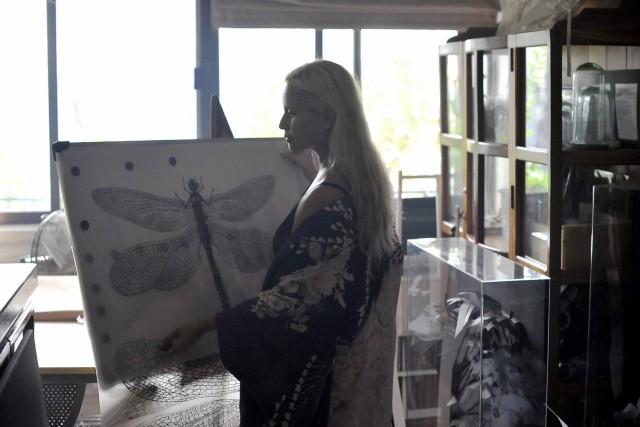
Her aim, of course, is similar with the objectives of all other Filipina feminists: “to show resistance to the ultra-conservative and macho aspects of our society enforcing traditional mother, wife, homemaker roles upon women.”
Angara recalls seeing Agnes Arellano’s version of “The Fates, the Maiden, the Mother, and the Crone,” at Manila’s Met Museum, when she was young. “Each sculpture had its own beauty and sensuousness that I didn’t fully understand then, but now I do,” narrates Angara, adding, “I desire to evoke the same unapologetic sensuality (of Arellano’s memorable work) in my art.”
Death in art
Angara’s pre-occupation with death in art has resulted in artworks that try to capture the separation of body and soul.
“Necromancer,” Angara’s circular paper collage with 16-inch diameter, has a figurative drawing of a skull, in black ink on thin photographic paper. It sits on a leaf-shaped black paper, a second layer. Its black canvas is filled with photographic paper cuttings with dragonfly wings in black ink.
In classical antiquity, the skull is about death. But Angara is also interested in depicting the psychopomps – the soul escorts with ethereal wings. They are “in the guises of dragonflies, birds and butterflies,” says Angara.
The presence of their wings in almost all of Angara’s artworks indicates the certainty of power that she equally gives both to death and women.
Angara’s sense of death includes a hopeful rebirth, as shown in “Ouroboros,” her circular canvas with 28-inch diameter. It depicts a snake eating its tail, an ancient symbol from Egyptian and Greek iconography.
“Ouroboros” looks like a wreath with layers of photographic paper cuttings with images of wings and scales, in black ink. The left side, which represents the snake’s tail, has a lighter hue. The right area, which depicts the mouth, has a darker tone.
According to Angara, her “Ouroboros” is from Norse mythology, represented by Jormungandr, a humongous serpent that bites its tail as it encircles the earth. There is a pencil drawing of a woman in the middle of the artwork. “I like the snake serpent to be woman, to be a feminine goddess. For me, the concept of birth and rebirth is feminine,” she explains.
In ancient cultures, ouroboros symbolizes wholeness and infinity, death and life, the oneness of the phallic tail and the yonic mouth, which is about strength and independence.
“Personally, I see ouroboros as symbolizing my life’s journey coming full circle - finding my calling and my anchors after struggling with mental illness, being unhappy with and unsure of myself, wandering, and searching (for a long time),” she confesses.
She had a bipolar disorder while studying psychology at the University of the Philippines from 2001 to 2002. Undeterred she finished a preliminary course at Wimbledon College of Art in London from 2002 to 2004, before studying Bachelor of Arts in culture, criticism, and curation at Central Saint Martins in London from 2005 to 2008. She was summa cum laude of her batch.
She eventually married a London-born Filipino. Their daughter Allegra was born in 2010. Angara worked as assistant curator at Lethaby Gallery while studying at Central Saint Martins. She was an intern at galleries in London from 2008 to 2010, during which she also worked for community (cultural) projects in the Burroughs of Kensington, Chelsea, and Brent. She and her husband became estranged.
Angara’s love for the arts began with reading. But it was ignited by her passion for animation, cartoons, including comics like Dark Horse, DC, Marvel, and Manga.
Her thesis at Central Saint Martins was about pop culture, the “Ghost in the Shell,“ a Japanese animated film adapted from the graphic novel of Masamune Shirow in the 90s. “I taught myself how to draw comics,” says Angara who has illustrated four books for prestigious agencies in 2009, 2010, 2018, and 2020. She was diagnosed with adult autism and symptoms of attention-deficit-hyperactivity disorder (ADHD) in London in 2017.
Overcoming and accepting life’s limits
Despite Angara’s robust sense of sensuality and empowerment, her mental condition has made her accept life’s limits, embrace Japan’s aesthetic philosophy of the transient, or wabi-sabi, understand existentialism, (a Western philosophy), and love trees and nature for healing. She also prefers organic art materials such as paper, pencil, and charcoal.
Angara’s artwork entitled “Oubaitori” a 20 X 16-inch paper collage, has layers of papers shaped like petals of apricot, cherry, peach, and plum that bloom at different times of spring in Japan.
“This,” Angara’s 46 X 80-inch artwork, is layered with white paper cuttings that look like bird of paradise. Underneath are small white paper cuttings with drawings of butterfly and dragonfly wings in black ink.
Her poem for this artwork says, “We happen in a moment as leaves fall from trees.” The light that she installed under the transparent canvas heightens the artwork’s play of shadows. “The shadows are my emotions that oscillate between darkness and nihilism. With these shadows, I can make art that shines from within,” she says, adding that her black and white canvases are platforms to create a “pensive luster” and avoid “shallow brilliance”.
“Unfurl,” a 30 X 36-inch collage of black and white paper - their colors interplay- is about confronting and overcoming the “darkness conscious,” says Angara. Based on her notes, “Unfurl” is like a psychological demand to release the ego, take away anxieties, remain stoic, get life force from nature and people.
“There is no such thing as getting clean or cured of my mental disorders. I am managing and channeling them into my art and writing; and applying philosophy – including Stoicism and Zen Buddhism – to my life,” says Angara who has stopped her medication.
“I practice shinrin-yoku (forest bathing),” she says. Her playful pseudonyms include “Plant Diwata” and “Blonde Ninja Vampire.”
Comparing herself with her late father, Senator Edgardo Angara, she says, “He is the man of the soil. I am the artist of the soil, a gardener who applies the principles of nature to my art.”
— LA, GMA Integrated News

