

 GMA Brandtalk
 Tracking
 Archives

A manual for memory: Lessons from the 2015 Nepal Earthquake
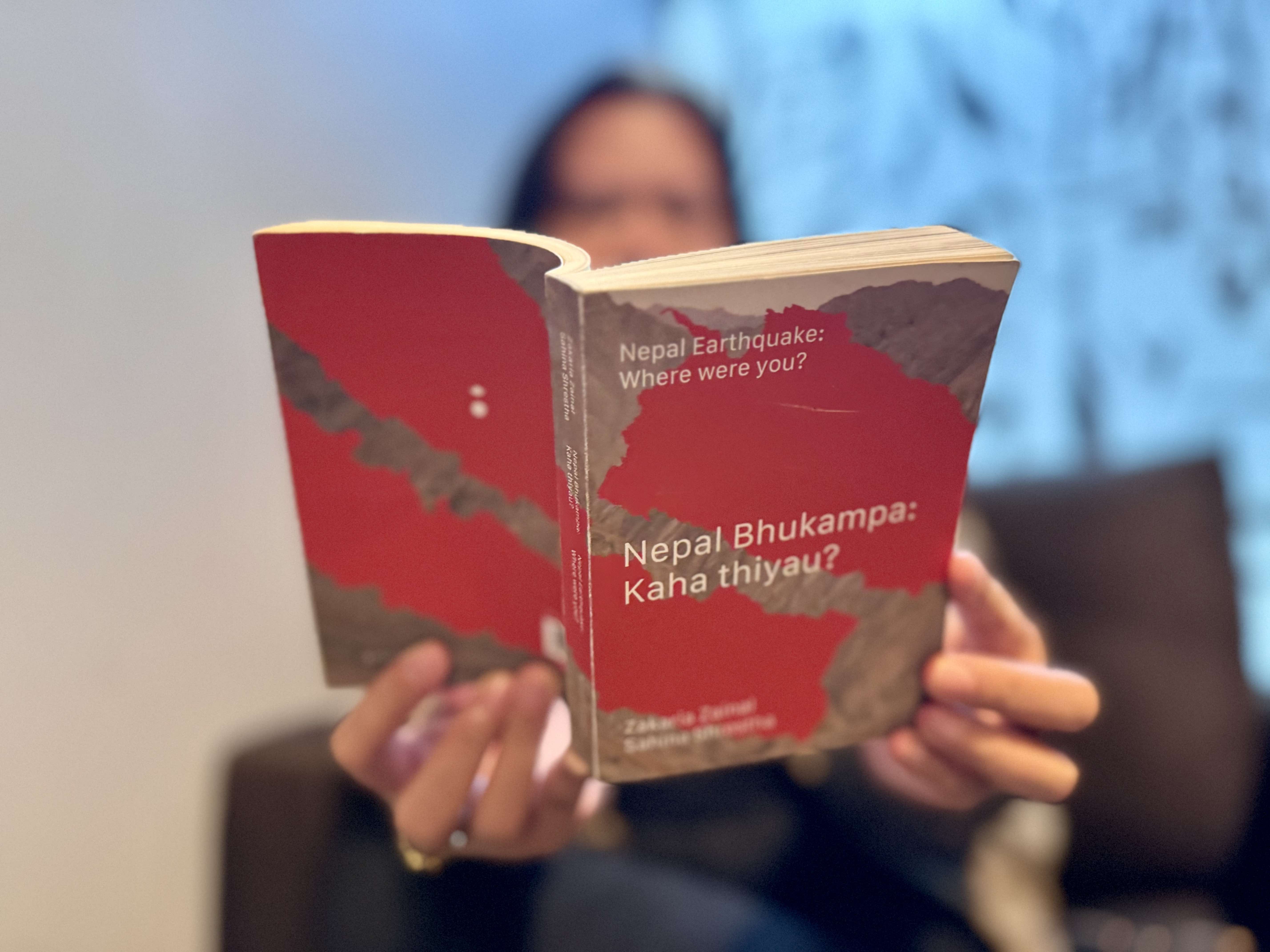
Singaporean author and photographer Zakaria Zainal, or “Zak,” as we call him, co-authored the book "Nepal Bhukampa: Kaha Thiyau" or "Nepal Earthquake: Where Were You?" with Nepali journalist and 2023 AJF fellow Sahina Shrestha.
The premise piqued my interest: The book is something of a tribute for his experience in Nepal when the magnitude 7.8 quake struck a decade ago.
“It is only human to park away a traumatic experience and not wish to remember it. It took me 10 years to face my fears, revisiting the exact location of the 7.8 earthquake, as well as learning from stories of survivors. Imagine, instead of going to therapy, I decided to write a book,” Zak said.
With the recent earthquakes that rocked the Philippines in barely two weeks, the book’s pages are glimpses of what could happen if we continue to be apathetic to the effects of the government’s corruption and lack of disaster-preparedness.
“Memories are tricky”
The book blends the intimate and the immense. When the quake struck, Sahina was a year into her job at Nepali Times. Along with her colleagues, they were up at the hills overlooking Kathmandu Valley when disaster struck.
“We could see red clouds -- dust coming from Bhaktapur,” Sahinda wrotein the book, “the first thought that came to my mind was: Kathmandu is gone… once we are down there, there will be nothing left.”
When she knew her family was safe, she went back to work, writing, editing, and filing stories. “The mind starts to fill in the gaps,” she says in the book. “The way I remembered it may not be the same way someone else remembers it. But it’s so important to keep talking about it. Because that is one way to preserve the memories of those we have lost.”
The survivors’ chapters opened with stories that vary in heartbreak and hope. Ramesh Khatri, a guest house worker lost his legs during the quake but found recognition and meaning after the tragedy. He represented his country in the 2018 Asian Para Games in Jakarta and 2022 Asian Para Games in China, channeling trauma into purpose.
There was Singaporean climber Nur Yusrina Ya’akob whose dream of becoming the first malay-muslim woman to summit Mount Everest was cut short by an avalanche that nearly cost her life.
Painful flashbacks of the trauma at the base camp almost hampered her dream, but two years later, Yusrina finally realized her dream of reaching Mount Everest’s summit.
Another hard read, but the most heart-wrenching for me is the story of 42-year-old Laxman Ranjit, who lost his childhood sweetheart, Nilu at the Kasthamandap, the historic pavilion from which Kathmandu got its name.
In his chapter entitled “The Weight of her Memories," Laxman recalled that fateful day where he went to Kasthamandap with his five-year-old son Aryan to support a blood donation drive of Nilu’s company.
The first quake wave seemed manageable. The second hit harder. Chaos. Darkness. He carried his child, running, until his leg got trapped. He searched for Nilu — but she was gone.
Laxman’s story is a haunting lesson in how love endures even after loss. He’s remarried now, rebuilding his life piece by piece. He still calls his wife “Nilu,” not as a replacement for what was lost, but as a quiet act of remembrance. This time, he’s learning to love differently — with presence, care, and gratitude.
In another chapter, Nepali survivor Tak Ghale opened a hotel in Barpak which displayed framed photographs of destruction in his dining room. According to him, these shards of memory must not vanish. “People need to remember, the next generation needs to know. They need to be aware. We live in a disaster-prone area, if we do not build better, prepare better, we will suffer again,” he said in the book.
Lessons in case of the big one
"Nepal Bhukampa: Kaha thiyau" is more than a memorial. It’s a manual for memory, a call to stay awake, even when we’ve moved on.
A chapter of the book included a Q and A between the two authors, where they pieced together the thought process of building the narrative.
Sahina shared: “In the back of my mind, I was also conscious about the weight of our request. We were, after all, asking them to relive what was most likely one of the most difficult days of their lives. People process and express their experiences differently.”
he language barrier was also one of the challenges for Zak. He is a Singaporean with most of his interviewees Nepalese. But he emphasized, “there is something even more important than being understood, it’s being fully present when someone shares their story.”
That line hit differently, especially in the current era of social media, where facts and disinformation compete for our attention.
While Zak and Sahina’s interpretation of each survivor’s accounts are both ruthless yet personal, their book also has a pocket chapter that explains the legends and superstitions tied to earthquakes.
Eventually, they reel you back to the realities we have to face with practical breathers that explain the science: tectonics, fault lines, and historical data.
The authors also put thought in emphasizing the importance of preserving historical structures and how some survivors lamented at the way the government is slowly going back to its old ways – opting for substandard structures and putting building safety and disaster preparedness on the backburner for profit – a problem which also sounds too familiar for Filipinos.
In the end, they closed with practical advice on how to live, act, and survive in quake-prone zones. These reminders feel painfully relevant as quakes struck Cebu, Davao, La Union, and Zambales in the last two weeks.
In March, PHIVOLCS warned that a major quake or the “Big One” along the West Valley Fault could kill over 50,000 people.
While experts stress these are projections, not predictions, and the recent quakes in different parts of the Philippines are unrelated, the threat remains real.
While writing this piece, Zak messaged me, “No one can predict an earthquake. Even that soothsayer in Japan got the July mega-quake utterly wrong. But you can prepare and be mentally ready. At the individual level, you have agency. You can prepare your emergency kit for your loved ones. You can talk to your local community centre on steps to prepare when an earthquake happens.”
As a parting shot, he also added: “Don’t follow earthquake survival tips blindly. Hiding under tables will not work if your homes are not structurally sound, but you have to live your lives and not let the fear of an earthquake take control of your destiny.” — LA, GMA Integrated News

