The show began with a deceptively simple-looking table puppet, who proved to be anything but basic when he showed his amazing flexibility - and dance prowess. This was followed by a black theater show about life underwater, and what could happen if people continue to abuse the earth’s natural resources. The audience, composed mostly of children, was thoroughly captivated and the performers elicited a steady stream of enthusiastic response to the various types of puppetry featured at the close of the Papet ASEAN 2010 festival last Feb. 26.

Featuring performances from Mascots and Puppets Specialists of Singapore, Roppets Edutainment of the Philippines, and Ony Carcamo (who also played host for the entire duration of the festival), the show capped the three-day festival held at the University of the Philippines in Diliman. Audibly enthralled by the psychedelic show from Roppets Edutainment, the audience expressed empathic sadness with a collective sigh when the consequences of environmental damage were depicted. The low mood was quickly dispelled when Carcamo and his puppet piglet Sampaguita had the kids and adults alike doubling over with laughter, and the Mascots and Puppets Specialists gave an impressive puppet show with education on the side. They presented a wide range of puppets, from basic hand puppets to eighteen-string marionettes. Often, they used recycled materials. "Who knew a toilet tank bowl could be sexy?" quipped the puppet master from Singapore after performing with his belly dancing puppet, whose lower half was originally part of a toilet's flushing mechanism. Apart from being resourceful puppet makers, they were also sweet storytellers. One very short puppet show featuring a flower that had yet to bloom ended with an aww-inspiring line fit for a greeting card: "It's not what you are made of, but what you can become."

Carcamo told GMANews.TV that anyone can be a puppeteer. He himself learned his craft after being inspired by Jun Urbana, popularly known as Mr. Shooli. "Na-inspire kasi ako ni Jun Urbana. Noong nasa advertising ako, madalas ko siyang maging direcor. Naging kaibigan ko siya, tapos na-inspire ako kasi ventriloquist din siya," he shared. It takes a lot of discipline to be a ventriloquist, Carcamo said. "Unang-una siyempre hindi ako nagyoyosi, hindi ako masyadong nagiinom, natutulog ako nang maaga," he added, saying he needs to preserve his voice. Anyone can learn to be a ventriloquist, Carcamo says, but some are more inclined than others. "As with any other craft or, art form, siguro yung iba mas interesado, yung iba, mas hindi." He also says it is difficult to learn ventriloquism in the Philippines, since there is no institution where one can get formal education on the craft. "Wala naman masyadong maraming veterans dito para matuto ka eh. Yung ibang bata kahit gustong matuto ‘di naman nila alam kung paano. Kaya dapat magkaroon ng mga workshop, mga formal training," Carcamo said.
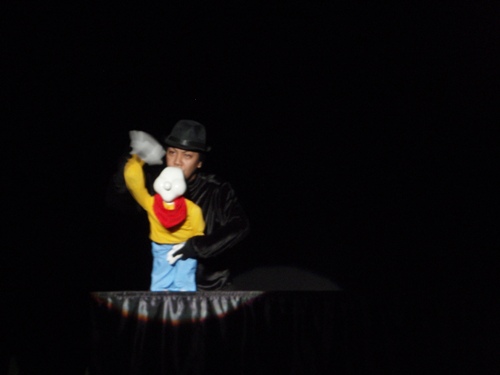
Carcamo previously put up a Grade School Ventriloquism Club that held meetings once a week for one whole year at Miriam College. "Sometimes I hold mini-workshops, pero wala talaga tayong school. In other countries, marami sila, meron silang ventriloquism convention," Carcamo shared.
National Arts Month Puppetry has a long and immensely rich tradition all over the world, and before this year's National Arts Month ends, PAPET ASEAN 2010 engaged people of all ages in the magical world of puppets from Singapore, Indonesia, Malaysia, and the Philippines. The festival opened on Feb. 24 with shows featuring the Philippines' Teatrong Mulat's Sita and Rama and Indonesia's Wayang Sandosa, Malaysia's Pak Yusoff Mamat and the Anino Shadowplay Collective. On Feb. 25, the 3rd ASEAN Puppetry Association Meeting was held, focusing on "How Puppetry Makes a Difference: The ASEAN Experience," a seminar on Puppetry in Education. It takes years to organize this kind of event, Carcamo said, and every year a different country hosts the gathering. "Ang maganda kasi rito, akala mo ikaw lang ang mahilig sa puppetry, pero pag may mga kakilala ka na, especially from other countries na iisa yung hilig niyo, mas maganda, di ba? Yun bang kagustuhan mo na mag-aral lalo, mas gaganahan ka kasi alam mong may ibang katulad mo," he shares. The festival was, like its first time in 2007, a success on its second year. "Laging full house," UP Professor Emeritus and Teatrong Mulat founder Amelia Lapeña-Bonifacio told GMANews.TV. The Samahan ng mga Papetir ng Pilipinas organized the festival with support from various groups including the ASEAN Foundation, ASEAN Puppetry Association, National Commission for Culture and the Arts, UNESCO, Royal Embassy of Cambodia, Embassy of the Republic of Indonesia, Embassy of the Socialist Republic of Vietnam and the University of the Philippines. –
YA, GMANews.TV 

 GMA Brandtalk
 Tracking
 Archives


