THE rainy season had already started when I went to Iligan City towards the end of summer and sat as panelist in the 18th Iligan National Writers Workshop (INWW) this year. I only learned about the trip three days earlier when the workshop director, Christine Godinez-Ortega, called me to cover for my mentor, the Iloilo-based Palanca Hall of Famer Leoncio P. Deriada, who begged off at the last minute for health reasons. A month before the May 23-27 workshop in Iligan, Christine and I were co-panelists at the University of St. La Salle-Bacolod’s Iyas Creative Writing Workshop. I don’t like unplanned trips but I can’t say no to Christine. I also thought I owe it to Dr. Deriada, who has been a regular panelist in Iligan since its beginnings in 1994. Besides, I thought it was high time for me to revisit Iligan, where I was a fellow in poetry in 1995 when I was just a fresh graduate. The Iligan workshop, which is sponsored by the Mindanao State University-Iligan Institute of Technology (MSU-IIT), is the only national workshop I attended as a beginning writer. It is also where I met my second literary father, the great Cirilo F. Bautista. So I packed my bags and headed off to Mindanao to play critic and mentor to young (and not so young) writing fellows. When I sit as panelist in creative writing workshops, I always look forward to finding out what young writers are doing now, learning a thing or two from them, and listening to the wisdom shared by senior panelists. Every time, I always go home a better writer and person.
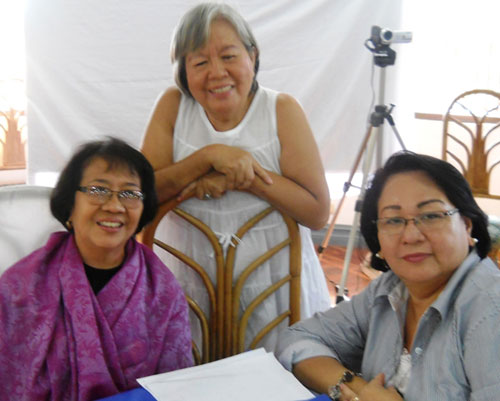
Lady writers and mentors all (L-R): Erlinda Alburo, Merlie Alunan, and Christine Godinez-Ortega
This time around, I listened to my dear Ma’am Merlie Alunan and Ma’am Erlinda Alburo, and also Cagayan de Oro-based novelist Antonio R. Enriquez, discuss literary works. The other panelists were playwright-director Steven Fernandez of IPAG fame; poet and now novelist German V. Gervacio; and of course Christine who heads the Multi-Media Information and Dissemination Unit of MSU-IIT. She is also vice chair of the Committee on Literary Arts of the National Commission for Culture and the Arts (NCCA). Fictionist, essayist, and musician Pearlsha B. Abubakar, INWW writing fellow in 2002, was the keynote lecturer and sat as panelist for the first two days. What’s beautiful about the INWW now is that just like La Salle’s Iyas, it makes a conscious effort to make the selection of fellows geographically representative—five from Luzon, five from Visayas, and five from Mindanao. Manuscripts are not only in English and Filipino but also Kinaray-a, Hiligaynon, and Sebuwano. These factors make the word “national" in the title of the workshop more truthful. The fellows from Mindanao were Mark Anthony Daposala, Rogelio Garcia, Maimona Magayoong, Deo Charis Mostrales, Jonecito Retes Saguban, Allen Samsuya, and Kei Valmoria-Bughaw. From Visayas came Mary Grace Abogado, Gil Montinola, Glenn Tek-ing Muñez, Denver Torres, and Erik Tuban. And from Luzon we had Anne Carly Abad, Vijae Alquisola, Jacob Dominguez, Bonifacio Alfonso Javier III, and Michelle Tan. These young writers are very lucky to have the older generations of writers mentoring them. The poets in the group are the luckiest for the best woman poet in English in the Visayas (and probably in the entire Philippines, in my opinion) was there: Merlie M. Alunan. Every time she talked, I took down notes. I have heard her Alunan speak before in quite a few conferences, but it was my first time to listen to her doing close readings to literary texts in a workshop setting. I was amazed. Now, I don’t only adore her poetry; I also adore her as a teacher. For example, she would define poetry in the simplest and clearest way. “What is poetry? Poetry is human speech. It is grounded primarily on the human. When does a human speak? When something happens."
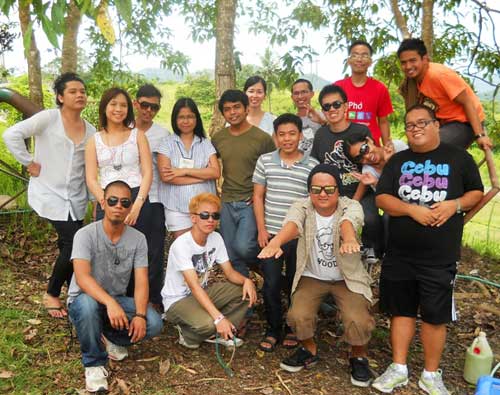
Promising writers all: workshop participants with poet-mentor J.I.E. Teodoro (front, extreme right)
In reading a poem, she would offer a procedure, a design of reading that is both helpful to the reader and the poet: “Design of the poem: First, there must be the speaker, the persona. Second, the speaker is caught in a particular circumstance. And third, there must be an addressee, the one being talked to by the speaker." Alunan reminded the young writers: “Literature is about particulars. The local. Write about a particular place." That is why the poem entitled “Cotabato" by U.P. Mindanao creative writing student Allen Samsuya stood out from the rest. It starts with these lines: “We might not come back home for awhile to Cotabato / because there are more things to do than catch a bus / and travel a tedious deal of 6-7 hours. Imagine the hassle / of having to stop by a terrible total of 10 terminals / and all for what?..." This young writer has a natural ear for poetry. Notice the alliteration of letter “t" in those lines. The tension of this poem lies in the persona’s love-hate relationship with his hometown, Cotabato. The middle of the poem says, “Eventually, we’ll overstay for some ridiculous reason / say in waiting for yet another class reunion, hence / wasting more time and money—hoarding pirated DVDs / at Barter Trade, or pigging put on litson manok at Kitok’s / or worse, overspending on fares on unending jeepney / joyrides--, because you know as well as I do, back there / we have nothing better to do." The tone of this poem, the seemingly effortless kind of poetry, the ordinary but poetic“human speech," reminds me of the beautiful Filipino poems of Rebecca Añonuevo. The most senior among the fellows was Maimona Magayoong, a physician from Marawi City. She just came back to the Philippines after working as a doctor for many years in the Middle East. Her poems in English have the tone of an oratorical piece, but she has one poem entitled “By the Red Sea" which is so sincere and lyrical. It is a beautiful poem in the tradition of the Persian mystic poets:
that night, the moon seemed reachable, touching me with an aura of finality. and sleeping by the beach, the serenity on a winter’s night, calmed my soul like a sedative and brought me slumber fast. during my prayer at dawn, i felt gifted with an ease that I easily communed and gave my thanks to God, implored forgiveness for misgivings, asked for my simple dreams and reasoned out my whys. yes, it was by the red sea when with the rising sun, bursting with its strength that i resolved i cannot question— it is just for me to believe life’s mysteries and God’s wonders for i am but a creature, not even a dot on a globe.
“At the end of the poem, your spirit is lifted," Alunan commented. “You want your poem to ring in the reader’s heart." Indeed, the Iligan workshop is a celebration of the words of the living and the living words. For almost two decades now, the INWW has put the spotlight on Iligan City, an industrial city known for its cement factories in Mindanao, in the literary map of the Philippine archipelago. Christine and her staff are now planning for a grand reunion of writing fellows since 1994 for the workshop’s 20th year in May 2013, something I will not miss for the world. –
YA, GMA News J.I.E. TEODORO is an assistant professor of Filipino and literature at Miriam College. He has won several Palanca awards for his works and a National Book Award for creative nonfiction. He holds an M.F.A. in Creative Writing from De La Salle University-Manila, where he is currently pursuing a Ph.D. in Literature. 

 GMA Brandtalk
 Tracking
 Archives


