

 GMA Brandtalk
 Tracking
 Archives

ADVERTISEMENT
Filtered By: Lifestyle
Lifestyle
Tackling the drama and distress in literature and films
The late Philippine literary matriarch Genoveva Edroza Matute once said that writing is taking from scraps of self, trimmings of others, and bits of one’s surroundings—whether it’s good or bad.
The statement, perhaps, couldn’t be truer for Philippine literature and arts, where drama and distress have always found its value and place—sometimes even in exaggeration.
In an attempt to rediscover this train of thought, three Filipino writers who served as panelists at last month’s Philippine PEN conference delved into the place of drama and distress not only in written works, but in films and in the process of writing itself.
The other 'pornographic' cinema
Steering away from its stereotypical, sexually-charged meaning, author and Ateneo de Manila University professor Gary Devilles defined the word “pornography” by discussing how most Filipino independent films show a problematic Filipino representation “in so far as the First World constructs and chooses to view the Third World.”
Titled “The Pornography of Poverty in ‘Serbis’ and ‘Tribu’,” the paper Devilles presented at the Panel on Literature in Distress and Popular Media last December 2 said these films—by Cannes best director Brillante Mendoza and respected filmmaker Jim Libiran, respectively—elicit questions like “why in particular the theme of poverty become(s) the most often used or abused theme by these independent films.”
Devilles used renowned filmmaker Lino Brocka as the tipping point of his paper, saying that the success of independent Philippine cinema today is part of the phenomenon of the director who he credited for capturing “these themes of oppression in his films successfully.”
He said Brocka, who he referred to as “the most overtly political director ever to emerge in Philippine cinema,” helped shape the formula “by which Filipino commercial melodramatic movies would be patterned.”
“The poverty of Filipinos and the dismal economic condition of the country will be a minefield for writers, directors, and producers. Of course, not everyone would be as successful as Brocka,” said Devilles.
Both “Serbis” and “Tribu”—critically-acclaimed overseas—“can be read as two opposing responses to the country’s depressing condition,” but Devilles said showing these films abroad “becomes problematic” because both of them take after Brocka’s depiction of poverty without addressing the theme, as well as questions such as “To whom are these films talking to?”
This move, Devilles noted, can elicit political indifference, counter-productive guilt, and a sense of disavowal on the part of the audience because we do not know “that we are speaking in our voice and that we are being heard and listened to” when the films board the international film festivals.
“Ultimately, films that do not challenge the viewers’ perspective are no better than pornography, since pornography need not be engaging; they just titillate and seduce viewers and readers,” he said in conclusion.
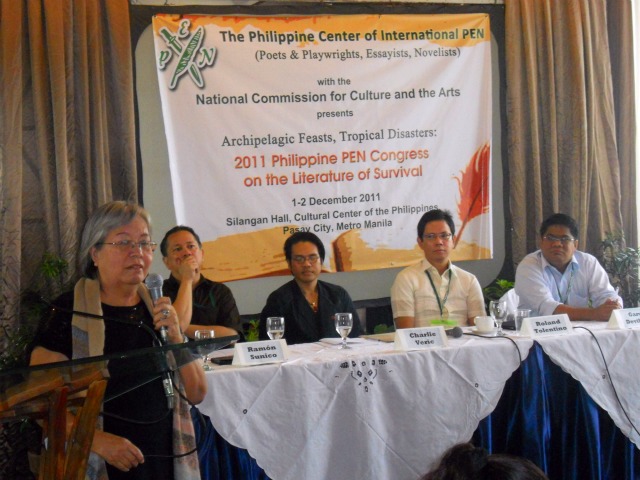
Respected Visayan poet Merlie Alunan, who has produced works driven by disasters, shares her insights during the open forum that followed the panel session.
Nature and literature
For his part, Yale University-educated Charlie Samuya Veric discussed how nature—including its disasters—figures in Philippine literature.
Veric, also a product of UP Diliman, read his paper, “Storms from Paradise: Notes on Philippine Literatures and Disasters,” where he said that literary representations of nature and disasters “compel us to rethink our sense of affinity, as well as our more fundamental sense of politics and history.”
Citing the views of a respected Filipino author, the late National Artist NVM Gonzalez, Veric said: “History, in this sense, is what destroys, and what the literature of disaster represents is our attempt to keep us whole to ourselves and mend what has been torn apart.”
With our “singular intimacy with nature and disasters,” the panelist said our imagination is “green and organic,” a viewpoint that, while helpful for writers, may also come to their disadvantage because it tends “to get lost in plain sight.”
To initiate change, he noted, is for a writer to remind himself that his works should be “eco-centric” rather than “egocentric.” This effect can be achieved by learning more from science to refine the works, he added.
He also proposed three moves through which eco-writing may improve, which included:
- using the environment “as a presence that denotes the co-dependence of human history and natural history”;
- giving equal importance to other dwellers of this planet, or seeing that “an insect’s life is no less valuable than ours”; and
- noting that “environmental time is not human time,” which would help remind writers that “any damage done to the planet acknowledges no color, religion, or creed.”
In closing, Veric read the poem, “Water,” written by author and Ang Ladlad group leader Danton Remoto. The panelist noted that, like water—and the persona’s love that moves like the element—“our new relationship with nature must be ‘queer.’”
“Such relationship must know no boundary as well, be it geographic or taxonomic, because to love is, as the poet suggests, to be non-human, to go from place to place, to be fluid, to be impossible, in a word, to be like water,” Veric said. “Our new relation with nature must be the same: unconventional, supra-human, extra-territorial.”
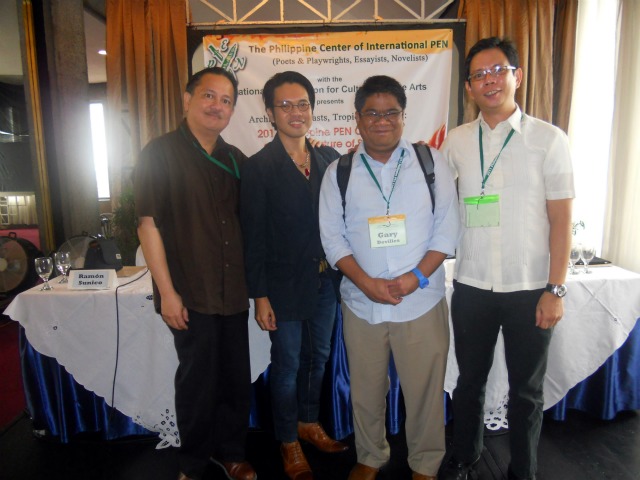
Panelists for the "Literature in Distress and Popular Media" module at the PEN Conference (L-R): moderator Ramon Sunico, Charlie Samuya Veric, Gary Devilles, and Rolando Tolentino
Writers’ crisis
Meanwhile, Filipino writer and University of the Philippines-Diliman professor Rolando Tolentino talked about the crisis that lies within literature’s attempt to give form, weight, and substance to popular experience.
In his paper, “Panitikan ng Kulturang Popular: Popular na Anxiedad at ang Arkipelagong Espasyo,” Tolentino identified three levels of crisis as literature tries to represent the popular in society, namely:
- crisis in literature, or its inability to mirror reality in full;
- crisis in popular culture, where entertainment comes with a price; and
- crisis in society and history, which encompasses the lack of honest and proper governance and “sachet economics.”
He took on these problems through the concept of “archipelagic space,” an image of understanding the condition of a country, its society, history, persona, and literature.
Tolentino noted that moving around this space is a “tragedy” for a writer because it is surrounded with absurdity primarily driven by economic constraints, politics, and celebrity.
He said the main struggle a writer bumps into is how economics affects his craft because literature, after all, is a commodity.
“Dahil limitado ang kapasidad ng mamamayan na bumili ng libro, nagkakaroon ng kumpetisyon para sa maliit na market. Ang formula sa matagumpay na pagsulat ay reproducible, gayon din, ang formula ng pagiging matagumpay sa market ng ilang manunulat na may kapasidad pagsanibin ang kanilang panitikan at ang komersyal na viability nito,” he said, citing popular writers like Bob Ong and Eros Atalia.
But these very same problems comprise the force that drives the writer to do what he does best—write about the ordinary things with a creative, critical, and, at times, fresh perspective.
“Kaya nananatiling nagsusulat ang manunulat hindi sa ligaya dahil walang ligaya ang krisis kundi sa ligayang napagtagumpayan, sa limitadong paraan, ang mabuhay kahit na (in spite) at kahit pa (despite) may krisis,” Tolentino said in closing. –KG, GMA News Photos courtesy of Philippine PEN

