

 GMA Brandtalk
 Tracking
 Archives

ADVERTISEMENT
Filtered By: Lifestyle
Lifestyle
Picasso on strings: Contemplating visual art through music
The act of drawing a bow across a string is, in many ways, like drawing a pen across paper: it is a singular act of determination and creation, an exercise of will upon an otherwise blank yet pliable medium.
A taut string, like a canvas, presents a continuum of creative possibilities. But how does one choose which potential to make real?
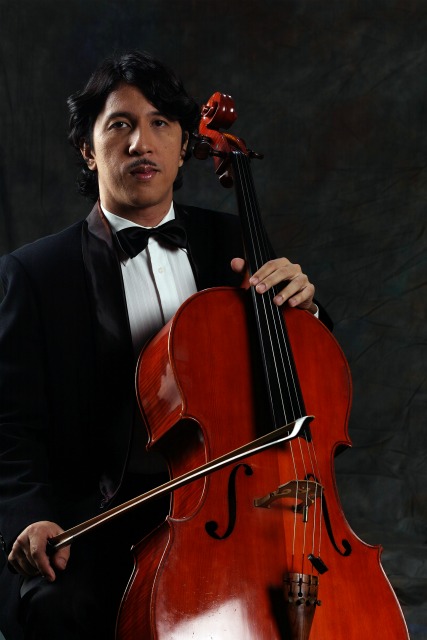
Cellist Renato Lucas put together a range of cello works from Bach to Max Reger for his Picasso tribute. Instituto Cervantes
It's a quandary that all artists face—just as master Filipino cellist Renato Lucas did when he was asked to perform a brief tribute to close the recent exhibit of Pablo Picasso’s “Suite Vollard” prints at the Metropolitan Museum of Manila.
“This task has been in my head for many years. Visual arts have an edge in terms of (public) perception, as the musical arts—especially instrumental music—can be very abstract,” Lucas told us a few days before the event.
Lucas’ brief performance, entitled simply, “Connect and Disconnect: A Musical Homage to Pablo Picasso”, put together a range of cello works that spanned several genres—from the classicism of Johann Sebastian Bach to the modernism of Max Reger.
Lucas started off the program with Bach’s "Suite III in C Major for Unaccompanied Cello (BWV 1009)." Although temporally far removed from each other—Bach lived in the 16th century, whereas Picasso is an icon of the 20th—both artists underwent a period of rigid formalism, their own homage to Grecian classicism.
Just as many of the plates in the “Suite Vollard” showcased Picasso’s steady hand and mastery of classical art, so too did Bach’s compositions—as masterfully executed by Lucas—evoke the clean, almost Pythagorean formalism that was all the rage in post-Renaissance Europe.
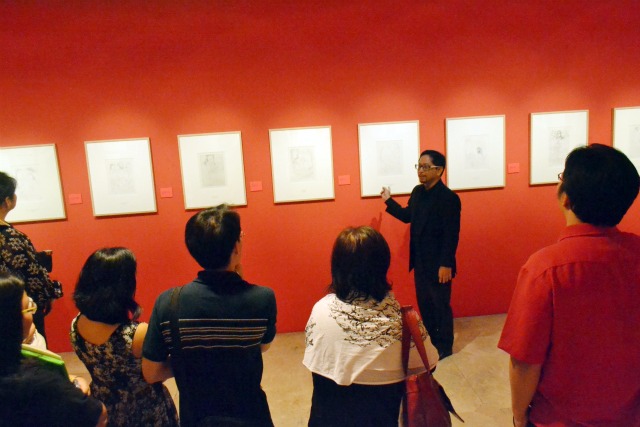
One hundred prints of Pablo Picasso's copper etchings forming the Suite Vollard owned by the Fundacion MAPFRE were exhibited at the Metropolitan Museum of Manila recently. Instituto Cervantes
“There are suggestive parallelisms in the histories of the visual and musical arts, with their constant constructs of order, which echo the various established traditions of Classicism that underscore the balance between Form and Content,” Lucas noted.
But that’s not to say that everything was so rigidly formal: Bach’s "Bourée I and II," from the same Suite, are a lively, jumpy, staccato dance that—not unlike Picasso’s simple, child-like lines—showcased his effortless mastery of his chosen art.
On the other hand, at the other end of the spectrum is Max Reger’s "Suite No. 3," which Lucas singled out for its “reconfiguration of the genre of the instrumental suite as a personal tribute to Bach.”
The dark tones and sweeping passages of Reger’s work reflect the somber mood of the Modernist period through which he and Picasso, who was his contemporary, lived.
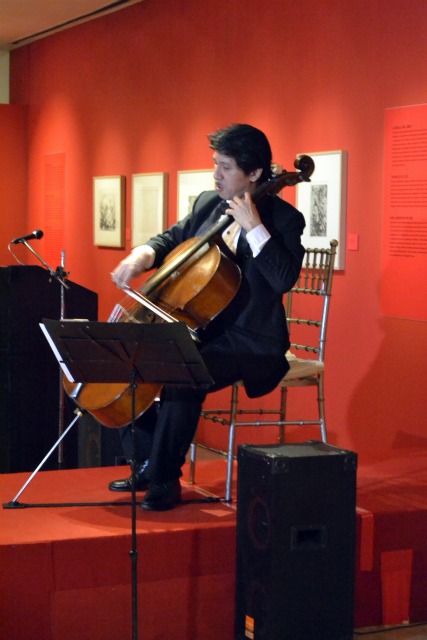
Lucas performs "Song of the Birds" by Pablo Casals to underscore the importance of an artist's connection to his mileu. Instituto Cervantes
But it was Lucas’ inclusion of Pablo Casals’ "Song of the Birds" in the middle of the program that was at once the master cellist’s coup de triomphe and coup de grace: originally a traditional Spanish carol, this piece was taken up by Casals as a protest hymn against the dictatorial Franco regime.
Here, too, there are palpable connections between the audible, the visual, and the visceral: the sad yet defiant notes of Casals’ carol echo the imagery of Picasso’s "Blind Minotaur" prints from the Suite Vollard.
In these prints as much as in his more famous painting, "La Guernica," Picasso uses the mythical man-bull as a metaphor for the plight of his motherland. There is a sense of tragedy, but also a tinge of hope for a better future.
By positioning "Song of the Birds" as the centerpiece of his program for the evening, Lucas underscored the importance of an artist’s connection to his milieu. In the end, Picasso’s art is inextricably woven from and into the events of his day.
“Artists like Casals and Picasso were very vocal in expressing their protests against the Franco regime. But their dissent wasn’t just about Franco. It was also about disgust, in the strongest possible way, towards man’s capacity for inhumanity towards his fellow human beings,” Lucas explained.
And therein lies the strongest tangency between the cellist’s bow and the artist’s pen: each is a means of presenting reality towards forging one’s own future.
“We must synthesize our own experience of our world through the artistic expressions that we encounter,” Lucas concluded.
Picasso might well have concurred. — KG, GMA News

