

 GMA Brandtalk
 Tracking
 Archives

ADVERTISEMENT
Filtered By: Lifestyle
Lifestyle
Movie review: A coming-of-age in reverse in 'Hugo'
+
Make this your preferred source to get more updates from this publisher on Google.
It’s easy to dismiss “Hugo” as a typical coming-of-age children’s adventure movie—after all, it is a film about an 11-year-old orphan boy left to pick up the pieces all by himself after his beloved father’s death, which is not a new story in a world that read Dickens and fell in love with Harry Potter.
Yet with Martin Scorsese in the director’s chair, to dismiss the film at all becomes sheer impossibility, and rightly so, because despite the cheesy movie poster with the typical star-strewn sky, dreamy-eyed innocents, promise of 3D, and movie title printed in whimsical lettering, “Hugo” is not at all a typical coming-of-age children’s adventure movie.
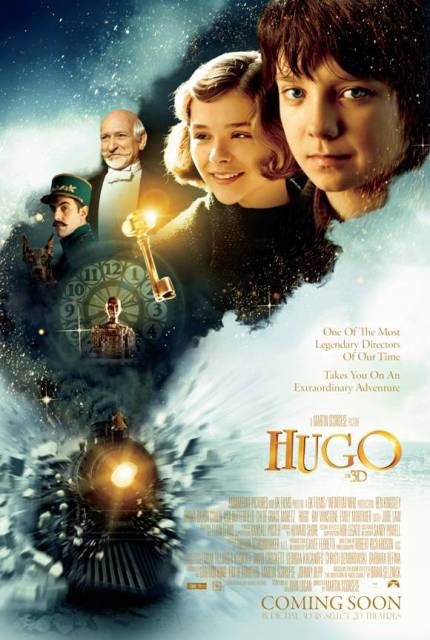 In fact, there comes a point when one realizes that it may not even be a children’s movie at all.
 That’s not to say that young patrons will not appreciate this film. There is enough color and whimsy and dancing and delight and succinct life lessons to keep any kid engrossed and entertained.
But “Hugo” is so much more than that. It’s a heartfelt tale of brokenness and mending that unfolds in beautifully rendered 3D and steampunk aesthetics, against a soundtrack of ticking clocks, clicking movie reels, awestruck sighs, and thumping heartbeats.
It’s also a history lesson as well as a love letter, written in shadow play and masterful mise en scène by Martin Scorsese, addressed to the genre that has loved and served him well—film.
A boy's tale
When young Hugo Cabret’s father dies suddenly in the middle of rebuilding an automaton—a rare robot-like machine—found in an abandoned theater, our hero finds himself in the care (or lack thereof) of his drunkard uncle, who disappears soon enough.
Thus Hugo is left with the responsibility of winding the clocks at Gare Montparnasse station—his delinquent uncle’s job—as well as continuing the project he and his father began, that is, fixing the automaton.
As if that’s not enough for a boy to handle, Hugo also has to feed himself (in true Dickensian fashion, he ends up pinching croissants from passing bakers), and constantly escape the clutches of the station guard, who, in his own strange caring way, sniffs out orphans especially and sends them straight to the orphanage, which, by the way it’s portrayed, feels more like a prison than a foster home.
In the process of building his automaton, Hugo ends up meeting and befriending Isabelle, another orphan who lives with her godparents, Mama Jeanne and Papa Georges, who, incidentally, own the toyshop that Hugo has been stealing parts from for his automaton.
As the automaton slowly gets completed, the more mysterious it becomes so that by the time Hugo completes it and finally puts in the missing piece—a heart-shaped key from Isabelle—it whirs to life and reveals the biggest mystery of all: a drawing of a rocket crashed into the eye of the man on the moon.
Hugo recognizes the drawing from his father’s favorite film, “A Trip to the Moon.”
With the help of Isabelle, he sets out to decode the drawing’s meaning, and in the process the two discover an unlikely connection between Hugo's automaton and Isabelle’s godfather, the grumpy toymaker.
The story takes a most potent and tender turn when it is revealed that Papa Georges is actually one of the great pioneers of cinema, Georges Melies, and Hugo, learning this, sets out to "fix" the broken man.
Realistic
The film is actually based on a book on real life filmmaker Georges Melies, and the movie is decidedly accurate in portraying his story.
In fact, the recreation of 1930s Paris is startlingly realistic, and yet for all its historical accuracy, the film feels every bit a fantasy.
The stunning visuals spare you no time in entering the dream. And unlike most 3D films, in "Hugo," the technology is actually part of the storytelling, and even serves to strengthen the theme such that it serves to mirror the artistic innovation that Melies was famous for.
The 3D technology also serves to complete “Hugo” as a chronicle of film history. As it showed the lovely, painstaking process of making films in the old days—a process which included the tedious task of hand-coloring the negatives—so it showed, by self-reflex, just how far filmmaking technology has come.
Asa Butterfield as Hugo may have been too trying at times, but it was easy to appreciate the young actor’s earnest efforts.
Meanwhile, Chloe Grace Moretz once again proved herself talented beyond her years with her well-balanced and effortless portrayal of Isabelle.
Ben Kingsley was, of course, nothing short of amazing. The evolution of his character from grumpy old man, to fragile and broken artist, to fully restored and celebrated auteur could not have been easy to portray, but he did so seamlessly and gracefully.
Even the actors in the smaller roles shone. Sacha Baron Cohen as the railway guard, for instance, managed in his limited exposure to reveal a painful history and a depth to his character beyond the comic relief that he served.
The film may have verged on melodrama in the first quarter, with a too-tearful Hugo, but the sheer beauty of the visuals were enough to sustain interest and as the story and Hugo's spirit picked up, the initial drag was easy to forget.
By the time Georges Melies's story is woven into the narrative, Scorsese's love for film becomes apparent, and even infectious such that the audience ends up looking at movies and filmmaking with the same wide-eyed amazement as Scorsese clearly does.
Ultimately, that is what “Hugo” is about. It isn't so much a coming-of-age adventure as it is a coming-out-of-age ritual, if that makes any sense.
As in the film, it's not the child that comes out of the journey as a man full grown, it’s the man that sheds his timeworn wounds and relearns to look at and love the world with a sense of childlike wonder. –KG, GMA News
"Hugo" is in the running for Best Picture in this year’s Academy Awards. It is currently showing in cinemas nationwide.

