

 GMA Brandtalk
 Tracking
 Archives

ADVERTISEMENT
Filtered By: Lifestyle
Lifestyle
Art review: No space in Salvatus' 'Territories'
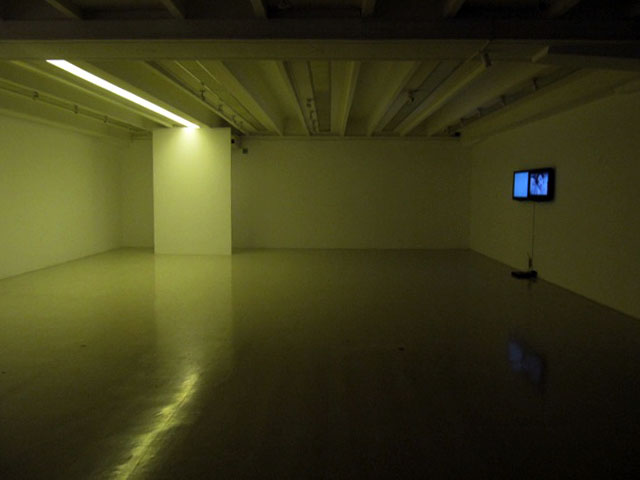
Mostly blank walls in Salvatus’ "Territories".
It is a practically empty gallery that you enter when you go see Mark Salvatus’ “Territories.” The only thing that hits the floor here is a table encased in glass that carries the ephemera that Salvatus has collected in his travels for art, and one white wall installed on the left side of the gallery, one that later you will find carries nothing but a camera.
All the art here are on walls. One of them a video projection. Another a live camera feed. The only work that “hangs” on the wall is two TV screens.
The latter is entitled “Wannabes,” where on one TV screen a six-minute video loop of various YouTube videos of people singing the Spice Girls’ hit song plays; the TV right beside it holds nothing but an empty white screen. The lack of anything else in the space does everything and encourages you to walk in the direction of that installed wall, which then brings that empty screen to life with your own image: participation is obviously the point here. It would be second nature really, between the catchy tune and the fascination with seeing oneself on screen (YouTube and otherwise), the looped craziness of strangers and the involuntary bobbing of one’s head to the music.
The premise obviously is the familiarity with the pop song, but the bigger critique of the enterprise of narcissism that current technology allows is what strikes you too, even as you refuse to be part of the participatory art project. It is silly for sure, and you almost wonder whether your refusal is but part of the project too, is exactly what it depends on too, also because even as you do not fill that empty white TV screen you cannot but have “Wannabe” on LSS (last song syndrome) for a stretch to time. You cannot but know it in your gut that even as you are not captured by this enterprise you are necessarily a part of it because you are in this milieu in which it exists.
You know that those videos are yours in so much as they are free to be accessed online. Here, they are pushed in your face as video art installation, here they demand your participation. There is no escape.
These concepts of escape and capture might also be said of “Model City,” a rotating city of buildings projected against the gallery’s far wall. It is discombobulating, this circular movement of a city that’s obviously one-dimensional, with front structures that hit the camera at an angle being magnified, the ones behind it portrayed to be growing in size even as they are distant. Standing in front of this work, you hear the voice of a woman selling property (and) development above the din of “Wannabe.” You cannot help but follow that voice, which leads you to the small isolated space to the side of the gallery, where this cardboard city stands for real, on a rotating circular table with a camera attached to it.
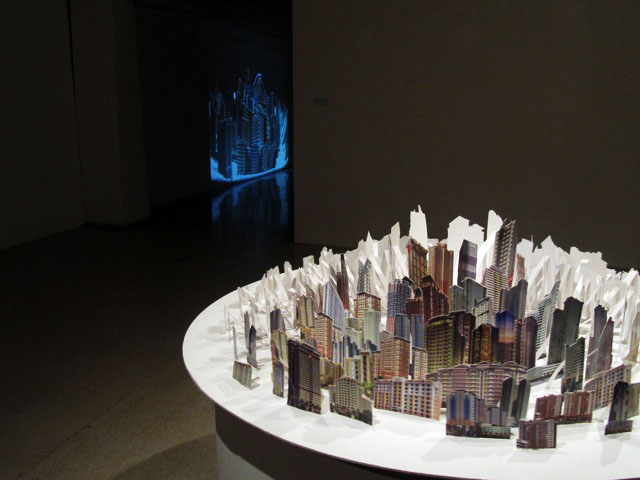
Salvatus' "Model City" as real-life model and projection.
It’s the smallness of this city that strikes you first, and then it’s the one-dimensionality. And then it becomes an eerie portrayal of a space that you know you live in, that you exist within, even as here you’re really only outside looking in, even as here you know it is a fictionalized space. But that voice that’s selling you property is also selling you this truth of the times: development is right here, on that table, with the sheen of beauty that’s in the well-planned structures, which is as well the promise of a planned city.
That it is also this site that creates the promises that the city makes, that this voice of the property (and) development marketer is about a pledge to the truths that this city holds, that you are here in an otherwise empty stark white space listening and looking in, is the promise that you make. You know this, you hold it as truth, even as here you are forced to contend precisely with its falsities: development is about structure, it is about how those structure force upon us and come to represent a one-dimensional kind of living, that is extraneous to the task itself of living as people. The city then is not as it is planned. And we live in this city and become reason for its living, and its failing, too.
Here is where the work “Haiku” finds rhyme, if not rhythm, too. The city is the site of these images of words, appearing four at a time, premised on the randomness of an old school slot machine—the feel and sound of it magnified by the fact that it is a projection, and you have no control over this loop. This lack of control of course is the premise of gambling, and waiting waiting waiting for the cards with which you will be dealt. In the same way that we wait for the words here, and the poetry it becomes is surprise as it is gift as it is necessary failure: it is not haiku, it is just a set of four random words.
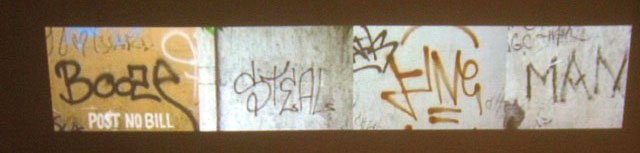
"Haiku" is as random as it is controlled.
Here is this work’s power of course: it is telling us that we inhabit this city but have no control over it, it speaks of the fact that these words will the city into existence, as it is about an unwillingness to let the city be. As you stand in front of “Haiku” and wait for it to repeat itself, it hits you: this loop of words is not just a projection of the city as we fail to see it, as it can also only be a projection of the kind of control that Salvatus takes with his art. It’s the task of having planned a project such as this one, as it is about choosing which words to include, given the spaces and cities these come to represent. It’s the same as the task of making model structures from cardboard and reimagining these into a projected city, larger than life, but also puny and unstable and questionable.
Which is what’s being said about space here, about the parts of it we think we own, and the collective experience of the city as it has changed and has become in recent years. Here is where Salvatus speaks of territories and tells us that we’ve lost all right to space: the city is the time we spend on the Internet, the city is in the words that we write on public walls, the city is as imagined in one-dimensional of buildings. We have no control, we do nothing but place our bets on the possibilities of ownership, we are extraneous to the city’s survival.
Working only with occupying walls via projections and (un-)controlled images, “Territories” can also only necessarily be an experience of this gallery floor’s breadth and scope, its coldness and whiteness, empty of disturbance, freed yet in process of erasure. By noise, by image, by the task of repetition in the works here. But also you know that it is play, as it is reminder: look at this space in the gallery, it is not yours, it does not exist. Here is the illusion of territory. –KG, GMA News
Mark Salvatus’ “Territories” runs until April 30, 2012 at the Ateneo Art Gallery. Katrina Stuart Santiago writes the essay in its various permutations, from pop culture criticism to art reviews, scholarly papers to creative non-fiction, all always and necessarily bound by Third World Philippines, its tragedies and successes, even more so its silences. She blogs at http://www.radikalchick.com. The views expressed in this article are solely her own.

