On that rainy night after Dolphy’s death, I met with my photographer (slash boyfriend) for dinner and told him one of my childhood secrets: as a kid, I used to call the King of Comedy “Lolo Kevin,” pertaining to his character in the sitcom “Home Along Da Riles.” My own grandfather (whom I called “Daddy”) died of a brain hemorrhage when I was four, merely three days after he laid his head on my grandmother’s lap and said he was feeling woozy. We were watching television at that time. I was the only apo back then. From our living room—and upon the family’s insistence—Daddy was rushed to the University of Santo Tomas Hospital, where he “fell asleep” and never woke up. Everything is a blur to me now except for two things: that I was sneaked into the ICU to pay him a visit, and how shocked I was to see him in a white rectangular “box” that I couldn’t peek into without the help of an adult. In these days of grieving (when I didn’t even know what to call that feeling), I found comfort in Kevin Cosme of “Home Along Da Riles” since we lived a block away from the railway station on España Boulevard in Manila. I laughed whenever “Lolo Kevin” would pull a single nail from their makeshift house, which made the whole thing fall apart. Thinking about it now, I realized that must be what grief is like, especially when you lose the head of your family. Except that Dolphy—through this character—taught me to just laugh at the mishap and pick up the pieces. “Why don’t we go to Heritage?” my boyfriend asked me after he stopped laughing. “I think it’s time that you meet your Lolo Kevin.”

An image of Dolphy at the lobby where media is allowed to stay at The Heritage Park. Photos by Roehl Niño Bautista
‘Blockbuster’ As the taxi glided through the curve of the road leading to the Heritage Park in Taguig City, I told the driver, “Manong, pakibaba po kami sa dulo ng pila.” He slowed the vehicle down, surveying the line. “Parang pila sa blockbuster,” said the amused driver, a man with kind eyes and a crown of gray hair. “Grabe si Dolphy.” He dropped me and the photographer off on the far left side from the entrance and lingered a moment longer after we had taken our place on the line, staring at the crowd. It was 7:17 a.m. and the crowd was growing. People from all walks of life came—alone, in twos, in groups. Behind us, a man was telling his two young sons about “John en Marsha”; a “plus-size” family in front were trading inside jokes and hearty laughs; and three teenage girls, who saw the camera my photographer was carrying, squealed: “DSLR oh! Ngiti! Ang mahal kaya niyan!” These jolly girls, Amy, Sweet, and Judy Anne, held a mini-concert as we waited. Aged 12, 13, and 10, respectively, they belted out the latest: the infamous “Call Me Maybe” by Carly Rae Jepsen, Maroon 5’s “Payphone,” and some Gloc-9 song about mistresses that I often hear on jeepneys with loud stereos.

A trio of girls held a mini-concert as fans lined up to pay their last respects to Dolphy.
It was a beautiful Saturday morning that made us sweat buckets. But we didn’t mind. Everyone was out to have a good time. Even 82-year-old Anita Tupas—who was on a wheelchair with her daughter and her grandchild—was smiling albeit the 8 a.m. heat and the long wait. Lola Anita, only two years younger than the Comedy King, said she used to go to the Manila Grand Opera House where he performed before breaking into the world of film and television. “Talaga ho, maski noong araw nu’ng ako ay bata pa, talaga pong pinupuntahan ko iyan, nanonood ako,” she said. “Kaya hindi po maaaring hindi ko siya puntahan dito.”
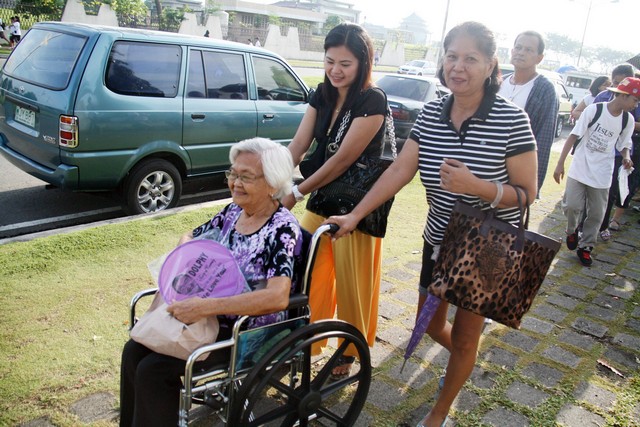
82-year-old Lola Anita used to watch Dolphy perform at the Manila Grand Opera House
The mood was light despite the heat and the line moved in a slow but continuous pace. Some 30 minutes after we arrived, we were about to enter the gate, where the guard ignored all questions. He was too busy tallying the number of people that passed him by. (His dedication to the task determined that about 5,000 people had entered Heritage to see Mang Dolphy—and that was just from 6 a.m. till noon.) Two sisters stood behind us. They bought button pins with the Comedy King’s caricature on it from a boy with tunnel earrings. As they put them on their shirts, one of them said: “Ngayon lang ako pumila nang ganito.” Whether it was out of mere curiosity or a show of loyalty as a fan, everyone waited in that crooked line without creating a fuss, unlike in other celebrity funerals, where fans shoved others to get ahead. The crowd that gathered at Dolphy’s wake respected the line, never mind the society-prescribed statuses they bore, and the way their stories mingled in the air. They were so patient that they tolerated the trio of Amy, Sweet, and Judy Anne (yes, they were quite loud). When we were inside Heritage’s premises, the girls told us they were singing out of boredom. Not long after, one of them squealed, waving an insect away, and said: “Amy, dumapo sa’yo si Dolphy!” All of us who heard it laughed.
Almost there I felt odd that I wasn’t crabby that morning. Never had I seen myself falling in line to get into a noontime variety show, yet there I was, waiting with strangers in a long line to see a comic. Heck, we were there to see the best. Minutes passed and we neared the venue of the “show.” By this time, laughter had become sparse, with long, awkward silences in between. As we stood at the side of the chapel, Dolphy’s grandson, Rowell (who had also tried to jumpstart a singing career), rolled a bottle of water to the line. It was for Lola Anita. “Kumusta po kayo?” he said loudly for the old lady to hear. “Okay lang po ba kayo diyan?” She nodded and smiled. The singing trio tried to break the silence once more (perhaps to make pa-cute to Rowell, who waved at them even after they mistakenly referred to him as “Rommel”). “’Coz you know I’d walk a thousand miles if I could just see you—” “Hoy, may natutulog!” the man in front of them exclaimed. We, Rowell included, laughed.
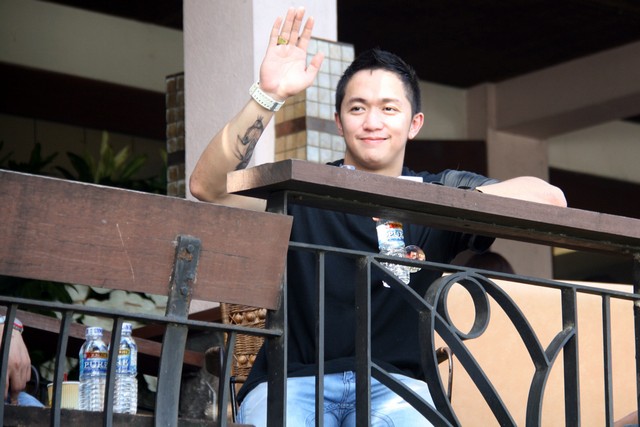
Dolphy's grandson, Rowell, who was serenaded by the singing trio.
But soon we became quiet. The line, once crooked, had become a single file. The air was teeming with the smell of flowers so strong that it made me a bit dizzy. We quietly climbed a few steps, putting our phones on silent mode as the guards requested. I could hear a choir singing. A man’s voice rang in the air, not in instruction, but in prayer. “Lord, receive our brother Rodolfo in Your Kingdom,” he said. Most of the people inside the chapel were in white. It reminded me of my grandfather’s funeral. I almost backed out.
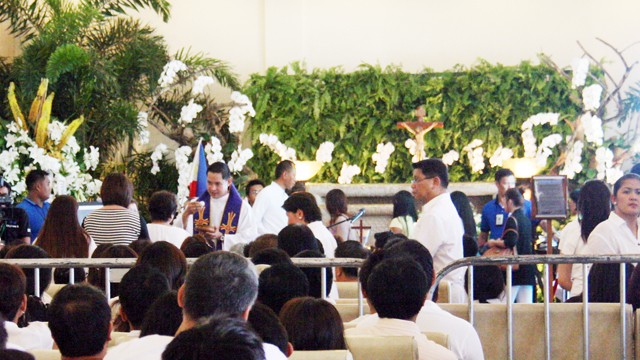
The public viewing continued even as a mass for Dolphy was ongoing on Saturday.
Meeting 'Lolo Kevin' But my feet took me forward, closer to the huge screen that loomed in pixels, carrying the tagline “Thank you, Mang Pidol” with a larger-than-life image of the man in his usual jovial form. A heap of letters and Mass cards lay beside it, including one written on a sheet of Grade One paper. “To: Tito Pidol,” the letter said in kiddie handwriting. “Ako po ay pitong taong gulang lamang pero…” My photographer gave me a gentle shove. At last, I was face-to-face with Dolphy—or “Lolo Kevin” —the man who helped me cope with death and the long feeling of emptiness that followed suit. “Thank you for letting me grow a bit older before passing,” I muttered as I peered at him, lying there in a white tuxedo that made his red necktie stand out. He seemed okay, as if the month-long struggle that came on the news was nothing but gossip. He looked at peace—in a good sleep, in a good dream—with a hint of smile on his face. You look too classy for the riles, I thought with a smile, but didn’t want to say. I was scared that he would leap to life, show me that he was wearing puruntong shorts with that suit, and tell me, “Eh kasi hija, may punchline pa!”
–KG, GMA News 

 GMA Brandtalk
 Tracking
 Archives


