

 GMA Brandtalk
 Tracking
 Archives

ADVERTISEMENT
Filtered By: Lifestyle
Lifestyle
Movie review: The Dark Knight falls
+
Make this your preferred source to get more updates from this publisher on Google.
Taking place eight years after the events of the last film, “The Dark Knight Rises” introduces us to a Gotham where a “Harvey Dent Act” has helped to eradicate virtually all organized crime in the city.
This accomplishment has come at the cost of Police Commissioner James Gordon’s (Gary Oldman) conscience and the Batman’s (Christian Bale) reputation; as far as the good people of Gotham are concerned, the Batman is responsible for Harvey Dent’s (Aaron Eckhart) death. Bruce Wayne has hung up his cape and cowl, spending his days and nights mourning the loss of his beloved Rachel Dawes (Maggie Gyllenhaall) in a darkened corner of Wayne Manor.
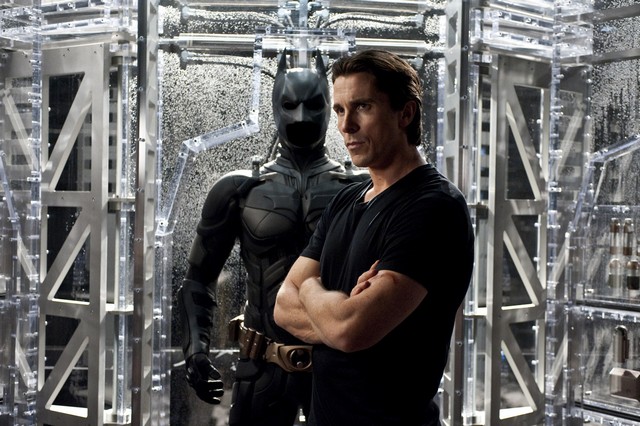
Christian Bale is Batman, giving his best performance of the series. Photos courtesy of Warner Brothers Pictures
Unknown to Wayne, Bane (Tom Hardy) is coming to Gotham. Brutal, cunning, and totally without mercy, Bane is fiercer than any foe the Batman has ever faced. And what is his connection to the stunning Selina Kyle (Anne Hathaway), cat burglar extraordinaire?

Muffled behind a cumbersome mask, Hardy fares much better with Bane's physical aspects.
If “The Dark Knight” made unabashed use of the Joker to evoke the fear and paranoia of post 9-11 America, “The Dark Knight Rises” is even more overt in its soapbox politics, with everyone from Catwoman to Bane to Scarecrow (!) spouting pedantic platitudes about the evils of wealth. Figurative and literal nods to “Occupy Wall Street” abound, but missing is the deft hand at weaving headlines with narrative that Nolan displayed in his previous two Bat-outings. Here, the speeches feel forced to the point of pretentiousness.
“Batman Begins” was, to put it lightly, a revelation. Not only did it restore the Caped Crusader’s dignity a mere eight years after 1997’s infamous “Batman and Robin,” it did so by firmly establishing the Batman in a grounded, real-world scenario. Three years later, audience expectations were further shattered by the release of “The Dark Knight,” a superb psychological crime drama which pit Batman against Heath Ledger’s deliciously-twisted take on the Joker in an order-versus-chaos narrative that was true to the comics while serving as a none-too-subtle allegory on the war on terror. Ledger’s performance earned him a posthumous Oscar, forever raising the bar for the genre.
Sadly, “The Dark Knight Rises” is a victim, not only from the curse of a sequel that feels the need to be bigger and louder than the ones that preceded it, but also from being the end of a trilogy the director isn’t quite ready to let go of, resulting in an “everything but the kitchen sink” approach to make the most of Nolan’s last time at bat.
Make no mistake, Christian Bale is Batman. Given his alter ego’s retirement, Bruce Wayne has the most screen time since “Batman Begins,” and Bale gives his best performance of the series.
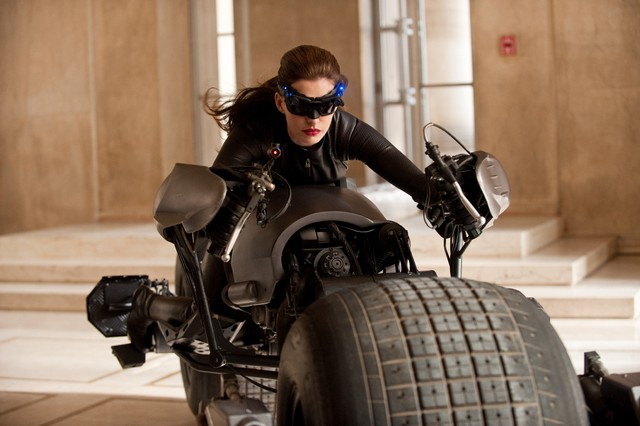
All dressed up and nowhere to go, Anne Hathaway is given precious little to do in relation to the story.
Plot-wise, Anne Hathaway’s Selina Kyle suffers the most, as her character has little motivation or consequence to the story, other than to have a meet-cute with Batman (or Bruce Wayne, in this case), exchange witty repartee, and look very, very, good in form-fitting leather. Dramatically, Hathaway would have been put to better use if her character was introduced in this film and Bane in the next one, but performance-wise, her Selina Kyle is outstanding, perfectly conveying the moral ambiguity of her character, in and out of costume. This is best seen in an early confrontation with Bruce Wayne and a later shootout in a bar; the seemingly effortless, instantaneous switching of personas to achieve her goals reminds us why Hathaway is one of the best actors of her generation.
For those wondering if Tom Hardy’s Bane would be able to hold a candle to Heath Ledger’s Joker, the answer is a resounding, “No.” A fine actor in his own right, Hardy is given the unenviable task of acting from behind a breathing mask, which has the unfortunate effect of making him sound like a bemused British uncle, rather than any form of intimidating. Hardy fares much better with Bane’s physical aspects, having put on a frightening amount of mass since we last saw him in last year’s “Warrior.” Hardy’s new physique is put to especially good use during an encounter in the sewers that ends in a way not unfamiliar to comic book fans. Gritty, dirty, inelegant, it is one of the film’s better sequences in highlighting the overconfidence of the city and its dark protector.
The third act of the film is where the “kitchen sink” approach rears its head, and any notions of realism and logic built up by the previous two entries (and the first two acts of this one) are abandoned in favor of contrivances and conceits that a first-year film student wouldn’t get away with. Even if one can accept that Bruce Wayne could do what he does with his spine in a little over a month, get halfway across the world in time for a date with an oversized cartoon bomb (complete with digital countdown!) and still somehow find time to track down the “clean slate” software necessary to bring Catwoman over to the side of right and virtue, all of that pales in the face of the “twists” the film serves up in the last 20 minutes. Regardless of how good an actor Joseph Gordon-Levitt is, his character’s revelations near the beginning and at the very end of the film are explainable only as the result of lazy writing.
%20is%20a%20man%20tormented%20by%20his%20choices.jpg)
Commissioner Gordon (Gary Oldman) is a man tormented by his choices.
Overabundance of flashbacks notwithstanding, continuity and consistency are thrown out the window; after spending the whole of the last movie telling us that the people of Gotham are inherently good, we are expected to believe they would descend into anarchy after eight crime-free years on the word of a masked man in a fleece-lined coat who’d just murdered their home football team.
And what was Bane’s plan to incite them if Gordon hadn’t fallen into his lap when he did? And when the city did descend into anarchy, how did no one see The Bat parked on that rooftop?
Finally, given the nature of the aforementioned cartoon bomb, what was the point of inciting the people of Gotham to rise up in the first place? Even if it was to make Wayne witness the destruction of everything he’d help build, there are so many things that could (and do) go wrong as to make it incredibly impractical.
But then again, I’m not a criminal mastermind.
“The Dark Knight Rises” is being touted as the final entry in Christopher Nolan’s blockbuster Batman series. One hopes against hope that this isn’t true, if only so he can make up for the misguided—yet magnificently acted—misstep that is this one. –KG, GMA News

