

 GMA Brandtalk
 Tracking
 Archives

ADVERTISEMENT
Filtered By: Lifestyle
Lifestyle
In:Transit bridges Manila and Toronto with poetry
Spoken word is that strain of poetry that casts itself onto a stage, is meant to be read aloud, performed to an audience and is often done to musical accompaniment.
When done well, as in the recorded work of Leonard Cohen, Penny Arcade, Henry Rollins, William Shatner (yes, him), or Saul Williams, this rare animal contains the strength of two mediums: the power of the written word and the transporting ambience of music.
In:Transit / Bigkas Pilipinas 2: Manila X Toronto is a collection of spoken word tracks by performance poets based in Manila and Toronto (by Canadians of Pinoy descent, many of them second generation children of émigrés). Released in early July, the album is filled with themes of longing; “for love, for a place in the world, for an answer to the question `Who am I?’.”
Heading the Philippine poets is the quirky and spirited Kooky Tuason, a well-established spoken word artist known for organizing the Romancing Venus events and the two studio albums bearing the same title. Through her Bigkas Pilipinas show on Jam 88.3, she has continued to champion Pinoy poetry. Meanwhile, the Canadian team is headed by Fil-Canadian performer Leonard Cervantes, a playwright who also hosts the Canadian TV program FLIP!, and a member of the first Carlos Bulosan Theatre Collective.
.jpg)
In:Transit's Canadian team is headed by Fil-Canadian Leonard Cervantes, a playwright who also hosts the Canadian TV program Flip!, and is a member of the Carlos Bulosan Theatre Collective.
It was in December 2010 that Cervantes (who was in the country for the annual PEN Conference) asked to meet up with Tuason and, together, came up with the idea of a collaboration between Manila and Toronto. After choosing the poets they wanted to work with, they started recording and eventually finished with a 12-track album. One half of it is produced in Manila and the other half in Toronto; the music and recording of the Toronto tracks were overseen by Olivier Fersancourt, a musician based in France
Part of the album sales, they unanimously decided, would go to the non-profit organization called Artists For Change (AFC) who co-funded the CD. They in turn will send 52 percent of the overall proceeds to the Children’s Rehabilitation Center in Manila, as part of their Meaningful Publicity campaign.
On the album itself, the standout tracks belong to the poetry collective’s leaders Tuason and Cervantes. The latter’s “Coloured Contact” is especially affecting as it discourses on alluding to and sometimes faking exotic ethnicity or vice-versa by using colored lenses as central metaphor.
Other standout tracks include Marty Tengco’s “Salvation,” where personal suffering translates to a greater yearning for identity, and PSL Collective’s “Balak” where commonality becomes an agenda for treasuring life in eight minutes of call and response narrative in Bisaya, English, and Tagalog, without being too obtuse about it.
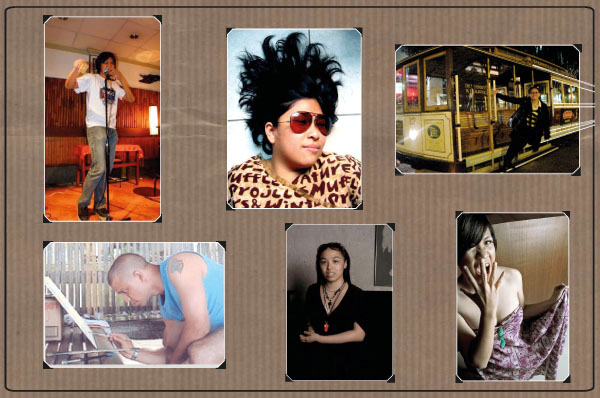
Manlia's poets are led by Kooky Tuason, a well-established spoken word artist known for organizing the Romancing Venus events and the two studio albums bearing the same title.
The best though is Raul Roco Jr.’s “Traffic” as an exposition on gridlock and vehicular journeys as a way to meditate, to realize how urban life can become energy. The great backing track interlaces well with Roco Jr.’s mellifluous and clear enunciation in a low timbre, his timing impeccable and well executed.
We sent a few questions to the leaders of both teams to find out how they came up with this landmark collaboration project.
Looks like this project was meant to happen according to how events led to your meeting.
LEONARD CERVANTES: I stopped in Manila for a few days after the [PEN] conference and having heard about the movement to unify Filipino writers across the regions, I thought we could take it a step further and unify performance poets across oceans and time zones. It was as easy enough as Googling “Spoken Word Poetry” and “Manila” and there she was. I basically Facebook-stalked her and convinced her to meet me for a quick coffee, and a few hours later, this project was born. From there, we traded emails and chatted over Facebook frequently.
Even with Skype and current communications technology, I’m sure it was hard to work out the details and the minutiae of this collaboration from 13,000 kilometers apart.
LEONARD CERVANTES: The ideas flowed pretty quickly at the start of things, but once the recording, producing, not to mention raising the capital to finance the project, here is where things began to take their sweet time. We're very proud of this project. It’s one thing to say that we should have solidarity among writers of Filipino descent no matter where in the world we live, but we've actually delivered on it. We've proven that this can be done with the tools and technology we have today.
As per the loose diaspora and identity theme, was there any "new" plan of attack for this album, especially for Kooky, who’s produced spoken word albums before?
KOOKY TUASON: The artists were regulars of our open mic events. After giving them the theme, they wrote about it and I instantly liked what they came up with. Bigkas Pilipinas is a traveling troupe in itself. It's a radio show, a team of performance poets, an album which will soon be in the map. It is evolving.
How was the selection of music made to fit the poetry?
LEONARD CERVANTES: Actually, the [Toronto-based] poets were recorded performing their work with no guide track at all, no background music. It was important to do it this way because if you've ever gone to a Spoken Word show, you know that there is enough power in the rhythm, the cadence, the intonation of the poem that music isn't actually needed to conjure up an emotion in the audience. In doing this the way that we did, we've preserved the power of the word while adding a lush musical layer on top. It's a killer combination.
KOOKY TUASON: I hired different producers to arrange music for the Manila-based artists. We first listened to the tracks to see if it'll fit the words.
Not many poets are good at spoken word performance and vice-versa, and I’m sure many poems are not meant to be performed aloud at all. How does a poem become a spoken word piece and how did you wrestle with this dilemma to make the album better?
KOOKY TUASON: It's all in the projection: vocal delivery, hand gesture, facial expression.
LEONARD CERVANTES: We “performance poets” have an interesting relationship with 'page poets' (as we call them, sometimes they don't consider us poets at all). One school of thought is that a spoken word poem is just that, meant to be spoken, read aloud. But not just that. A spoken word poet has many tools that a page poet does not: volume, gesture, rhythm, facial expression, etc. With that said, we always remind those we are mentoring that even a spoken word poem has to possess solid mechanics. You still have to grasp metaphor, simile, alliteration–all the poetic devices we learned in school.
Your thoughts on the current state of poetry vis-à-vis spoken word?
LEONARD CERVANTES: One thing that we see over here and think, "Wow, that is so cool!", are the FlipTop Battles that you can find on YouTube. Sure, these are MCs rather than spoken word poets but, really, what's the difference–other than maybe more profanity? Our Filipino roots point back to the balagtasan, which was basically the same thing; two poets duelling in verse and then the crowd decides the winner. This is the same as the modern Poetry Slam.
What can newbie spoken word artists in both countries take away from your experience producing this album?
KOOKY TUASON: Write, write, write. Pour out your soul on the page. Summon enough courage to expose yourself in public. Go up on stage. Oh, and consider attending performance poetry workshops. Margaret Atwood said "A word after a word after a word is power." Keep words spoken! — DVM/KG, GMA News
The album is available at: http://artistsforchange.ca/manila-x-toronto Photos courtesy of the In:Transit producers

