

 GMA Brandtalk
 Tracking
 Archives

ADVERTISEMENT
Filtered By: Lifestyle
Lifestyle
Art review: 'Recollection 1081': Lost in history
What "Recollection 1081: Clear and Present Danger (Visual Dissent On Martial Rule)" told me after an afternoon spent in the CCP Gallery (which I haven’t entered since the Kulo debacle), is this: what a waste. And this is not to say there’s bad art here, or irrelevant art, as it is to say these works are wasted on the lack of a curatorial vision, the kind that would elevate the discussion about Martial Law and make it important for a growing generation that doesn’t care much for it, will not know to discuss it any deeper than what’s offered in textbooks.
This would’ve been a fantastic opportunity to talk about Martial Law and its contingent artistic and creative oppressions, and the kind of artmaking that it produced given what it allowed. It would’ve been great to have a sense of how exactly these artworks existed in that context, where were they exhibited? how much were they sold? who got into trouble for art, who got away with it? how did this all fit into the true, good, beautiful that self-proclaimed and imagined cultural attaché Imelda Marcos espoused?
We are not told by this exhibit, and you can’t help but think: what a waste. Because here are works that are kept in private collections, ones kept by the artists themselves, ones that travel nation, but which rarely come together in one space. This is the value of this exhibit, and yet at this point in time, 40 years since Martial Law, it just isn’t enough to throw all of them together and tie them together with a fancy title.
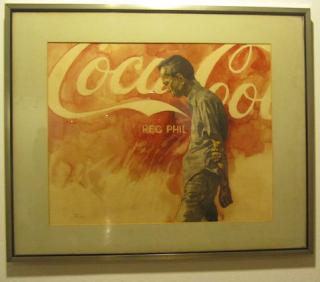
Antipas Delotavo's "Itak sa Puso ni Mang Juan"
Here was a chance at engaging a younger generation in a discussion about art as historical representation of, say, how nothing has changed, given BenCab’s two versions of the same image in "21st Century Proclamation" (1975) and “1081” (2012), and Jose Tence Ruiz’s “Revolution Evolution Pixelation,” a well-conceptualized conversation between the past of Martial Law and its icons, and the present dis-engagement from it. These would’ve been wonderful ways to begin a real – and new – discussion about Martial Law and artmaking.
But no. Instead what we are treated to here is a hodgepodge of works thrown together, sometimes thematically, sometimes chronologically, which could only leave the spectator half-confused, half-tired from having to go through so much art with nary a sense of its rationale. I mean of course they are tied to Martial Law, and there are dates to tell us when these works were made, and in some sections artists and art theorists are allowed to speak about those times. But none of that helps in the face of art that is not just diverse, but which carries the weight of a past of repression.
An exhibit such as this demands trailing a critical gaze on these works, the better to elevate the discussion about, contextual art better in, the Martial Law years. Maybe then we could have had a sense of why Bencab’s “Ang Tao” (1971) and Antipas Delotavo’s “Itak sa Puso ni Mang Juan” (1987) use the same downtrodden image of the every man, with back hunched, eyes on feet, walking in sadness.
The mother and child image is also here in all its diversity. A curatorial take on this might have allowed for a differentiation if not a lesson in sameness, given the historical milieu in Aster Tecson’s "Kare't Krus" (1980), Manuel Panares' "Untitled" (1983), Papo de Asis’ “Untitled (Mother and Child)", (1973), and Pablo Baen Santos' "Panangis ni Ina" (1973). Layer this with the symbol of mother for nation in Imelda Cajipe-Endaya's "Inay, Inang, Kalayaan Ay Inyo Rin" (1983) and Pablo Baen Santos' "Malumbay si Ina" (1983) and a grand section on politics and mother(ing) in the age of Martial Law is easy to imagine.
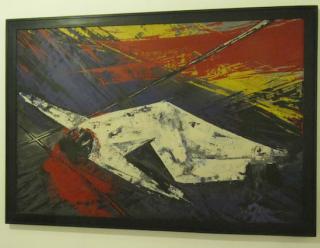
Phyllis Zaballero's "August 21"
An easier curatorial decision would’ve been to organize works in terms of periods, i.e., early 1970s, late 1970s, post-Ninoy-Aquino assassination. This seems particularly important for the latter, as the years from 1983 onwards seemed to have diverse content and form, from Heber Bartolome's imagination of nation in motion and in pain, forming a flag in "Ang Bayan" (1983) to Phyllis Zaballero's abstract rendering of Ninoy’s dead body in "August 21" (1983). There was Ang Kiukok’s two versions of “Scream” here, done in 1980 and 1983, which could’ve been placed in the context of these works from the early 80s to Ninoy’s death.
Another possibility would’ve been to work in the fact of violence as theme, which cuts across much of the work here, from Brenda Fajardo's rarely seen abstract work "Buka Ngunit Tikom" (1974) to Anna Fer's heavy realist hand in "Favali at Iba Pang Biktima" (1987), from Jaime de Guzman's rendering of death and skulls in "Sabbath of the Witches" (1970) to Virgilio Aviado's symbol of the times in "Molotov Cocktail" (1970).
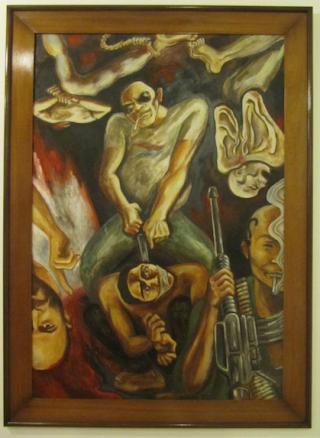
Anna Fer's "Favali at Iba Pang Biktima"
The more difficult curatorial stance would’ve been to talk about media and genres here, where there is an obvious disparity between the works of activists, the grim and determined, the ones who did their time braving the streets and the underground, versus those who had time at detailed more introspective works, those who were “safe” from the heavy hand of oppression that Martial Law used to control culture.
Both dated 1984, Charlie Co's "Political Prostitute" is necessarily pitted against Jose Valerio's "Pait at Luha.” That the former is vintage Co that plays with metaphors of clowns and masks to talk about the state of politics of those times, can only be counterpoint to the latter that is a still life of a crumpled tabloid with the headline on Ninoy’s assassination, some onions, and some bitter gourd. The aesthetic of Left activist art such as Valerio’s of course is in many of the works here, which could’ve been pitted against, for example, Edicio dela Torre’s “Notes for a Theology of Struggle” (1980) that worked around the downtrodden image of the UP Oblation and the student movement, and “Sumbat” (1984) which powerfully depicts pain and suffering as handed down to the next generation.
The diverse media in which these artists worked could’ve been a worthy curatorial task as well, where Santiago Bose’s "The Great Liberation" (1987) and "UNTITLED" (1981) were rare works of etching and mixed media respectively, across the rest of the works on exhibit. The works of Ofelia Gelvezon-Tequi' were all in what’s called color viscosity etching, in the same way that Benjie Torrado Cabrera's works were all in intaglio. That these were created in the early 1980s is infinitely interesting, if not telling maybe of the different spaces these artists and works inhabited in the context of the changing Martial Law milieu.
But of course all these possibilities would’ve required more work, demanded much more of an exhibit that seems to have been set on just showing these works, some maybe for the first time, like a showcase of creativity for those years of repression. That goal, while easy, doesn’t do much for discussing Martial Law anew; more importantly, it doesn’t do justice to these works that were borne of a time that was at its core about the suspension of the right to freedom of expression. That these works happened then, and that these are hung in the Cultural Center of the Philippines’ walls without a clear assessment of those times given artmaking and creativity, makes it an almost free-for-all, where history can be rewritten by anyone who dares, extraneous to those oppressive years.
In that sense, in fact, “Recollection 1081” is not just a waste of this body of work from our artists. It also, even if inadvertently, offers a dangerous proposition. –KG, GMA News
“Recollection 1081: Clear and Present Danger” is organized by the Center for Art, New Ventures and Sustainable Development (CANVAS) and Liongoren Gallery with the Cultural Center of the Philippines.
Katrina Stuart Santiago writes the essay in its various permutations, from pop culture criticism to art reviews, scholarly papers to creative non-fiction, all always and necessarily bound by Third World Philippines, its tragedies and successes, even more so its silences. She blogs at http://www.radikalchick.com. The views expressed in this article are solely her own.

