

 GMA Brandtalk
 Tracking
 Archives

ADVERTISEMENT
Filtered By: Lifestyle
Lifestyle
Theater review: The 'Bona' bandwagon
+
Make this your preferred source to get more updates from this publisher on Google.
The bandwagon is extraordinary on these shores, and even more awesome is how it will silence.
And so what you must know is that I looked forward to watching “Bona.” Yes, because of Eugene Domingo, but also and more importantly because this was a PETA production. I tend to imagine being floored when I go see PETA plays, and no I don’t mean “Caredivas.”
But “Bona” was far far from being fantastic, and I mean that even when I was laughing out loud the whole time I was there, even as I clapped for Domingo and the rest of that cast. If laughter was the goal, then yes, this staging of “Bona” delivered the goods, which should be no surprise. But if being transported into the world and being introduced to the psyche of the fan was the goal, then there is nothing here that will do that for you.
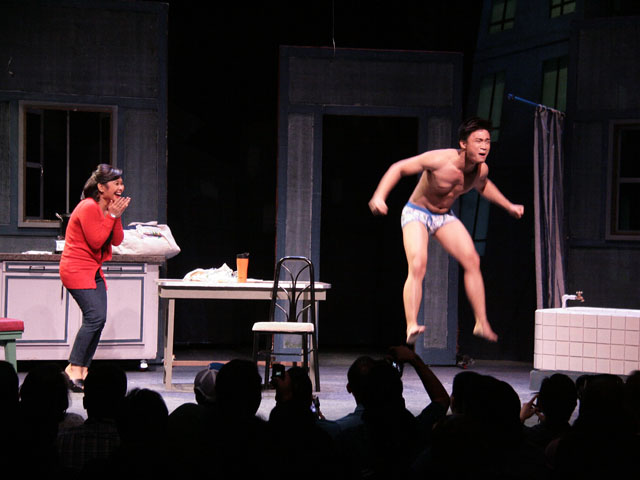
Eugene Domingo plays Bona, an avid fan of struggling actor Gino (played by Edgar Allan de Guzman). Photos by Roehl Niño Bautista
There is the fact that this is a contemporary version of Bona, where she is older – far older – than the object of affection Gino (Allan de Guzman). In the movie there was a rationale for the kind of love that Bona (Nora Aunor) had for Gino (Philip Salvador), not just because well, the artista is hot, but even more so because Bona had no place to go. That layer of choicelessness is not in this telling of Bona, though that just seems secondary to the other major difference between the more familiar film and this staging.
Bona’s old here. And I mean that literally, where Domingo is old enough to be de Guzman’s mother, and the fan-artista dynamic could only require much fine-tuning. It doesn’t help that in the beginning of the play, the present is established to be about Bona’s call center agent career, her online raket, and her being the sole breadwinner of family – a sister in particular who keeps falling in love, and getting pregnant. Overall, a good head on her shoulders is what this Bona’s got, and even her engagement with religion is one that’s not about blaming the Nazareno for her woes, as it is about working hard still, and praying for love still, regardless.
That it begins this way is what makes it difficult to imagine how Bona at any point will fall for the poverty porn that’s in the reality show that Gino joins. It’s strange that she would fall into the trap of fandom, this particular trap not just about spending some money on tarpaulins and t-shirts and food, but ultimately about giving up life as she knew it, to help out this poor embattled soul that wanted to be artista.
None of it makes sense because there is nothing here that would attract Gino to Bona, and nothing that allows us to imagine it either. The sexual tension isn’t here, and that is a matter beyond these two actors, as it is a matter of having chosen this age gap at all. 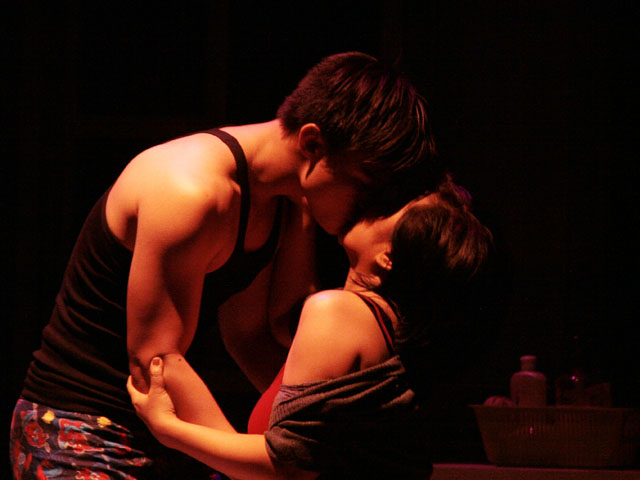
In fact you know this age gap is problematic because without Domingo’s brand of comedy, this story would not survive. Without her shifting to some good ol’ Kimmy innocence and kilig, the audience wouldn’t be brought to fits of laughter, which masks the lack of sense in this relationship. It also masks the sudden absence of Bona’s sense of self, which was whole and complete in the beginning of the story. She fell in love with a young boy she barely knows? How is that even possible? Who is Bona exactly? What are the intricacies in her personality that allow her to move from sensible woman to infatuated sugar mommy?
Well, you won’t be told. In this production she is actually and just ultimately Domingo, and no one else. You do not sit through this play and think: wow that is Bona. You sit through it and realize it’s like watching a Eugene Domingo retrospective, like she’s reliving her roles in films, from Kimmy and Dora, even some Precy from “Wedding Tayo Wedding Hindi!” (2011). Half the time though, and especially in the beginning, all you see is Domingo as herself, doing banter with her gay best friend like they were hosting a stand-up comedy gig, where kabaklaan goes on overdrive, to the audience’s enjoyment.
All of that would be fantastic were it consistent. But it isn’t. By the time Bona decides to move houses to care for Gino, none of who she was in the beginning exists – not the gay lingo, not the smarts, not the love for a nephew she practically treated like a son, not even the technology. In fact there is no sense at all to the notion that this was about a fan wanting her idol to trend on Twitter; technology was not part of the equation after the first 20 minutes of this play.
Letting go of all those things would’ve been fine were there an indication of the reason for Bona’s infatuation, a sense of why she loved this boy who could barely clothe himself, was talentless, and thankless half the time. I mean yes, the most intelligent of women can fall in love and forget themselves. But here the age difference and the characterization of Gino do not allow for Bona’s character to make sense. That Domingo is playing it just makes it seem more like her show, and not the text’s.
Thankfully there is de Guzman, whose performance is believable from beginning to end, as the trying-hard ungrateful probinsyano with dreams of the city via becoming artista in his head. That his character is familiar from the days of “That’s Entertainment,” and remains believable to the present, is a testament to how nothing has changed. If at all technology and the reality show have just made things more absurd, more unbelievable, where it involves the enterprise of celebrity like it hasn’t existed before. That this is the kind of celebrity system that this Bona falls for, when she began by being a smart woman, is the failing of this production.
But probably its most basic failure is that it seems to have chosen Domingo for the role of Bona first, and had the original narrative re-written around that. Now I do not doubt for a second Layeta Bucoy’s writing skills, and in truth I could only hear her voice in those instances when Bona was talking to the Nazareno, and in the few instances when the conversations were regular and normal, and not over-the-top Domingo.
As such one does wonder who wrote this version of Bona. And how much of this re-writing was about having Domingo in that lead role, how much of it was about her just playing herself onstage. That the latter is precisely why the bandwagon has come to celebrate this production just rocks my world. We wanted to see Domingo onstage and expected her to make us laugh? Well, that’s all we’ve got here.
You want to imagine Bona in all her complexity? We’ve always had, and will continue to imagine, the Bona done by Ate Guy. –KG, GMA News
"Bona" is a PETA production directed by Soxie Topacio.
Katrina Stuart Santiago writes the essay in its various permutations, from pop culture criticism to art reviews, scholarly papers to creative non-fiction, all always and necessarily bound by Third World Philippines, its tragedies and successes, even more so its silences. She blogs at http://www.radikalchick.com. The views expressed in this article are solely her own.

