

 GMA Brandtalk
 Tracking
 Archives

ADVERTISEMENT
Filtered By: Lifestyle
Lifestyle
Movie review: 'Argo': CIA's 'best bad idea' is Ben Affleck's best film
“Argo” begins in November 1979, when activists, outraged over the US’s granting of asylum to the recently-deposed Shah of Iran, stormed and captured the US embassy in Tehran, eventually holding 52 Americans hostage for 444 days. The story centers on the extraordinary true story of six American consular employees who were able to flee the compound, and the efforts of CIA exfiltration specialist Tony Mendez (an excellent, if ethnically-questionable, Affleck) to get them out of the country.
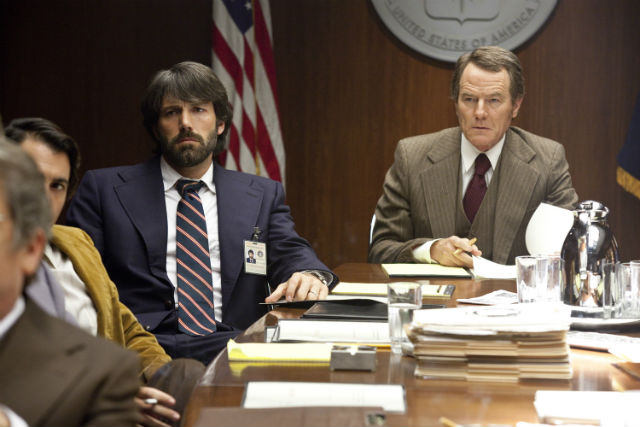
The CIA decide to go with their best bad idea to rescue the six diplomats.
With time running short and the White House looking to avoid further international embarrassment, a plan is approved that is ludicrous in its audacity: Armed with a cover story cooked up by (real life) Academy Award-winning make-up artist John Chambers (the always-reliable John Goodman) and Hollywood producer Lester Siegel (Alan Arkin, playing an historical composite in top cantankerous form) and carrying storyboards by legendary comic book artist Jack Kirby for a fake script consulted on by Ray Bradbury, Mendez will fly to Iran posing as a Canadian film producer scouting locations and exit the country with the six embassy workers posing as his equally-Canadian crew.
As the kind of rescue that could only be made in Hollywood, it’s certainly fitting that “Argo” is the kind of story that could only be told by Hollywood. Fortunately, Ben Affleck is a hell of a storyteller; from the opening frame utilizing the classic, era-appropriate WB logo, Affleck allows his narrative to unfold onscreen with a maturity and restraint unexpected from someone directing his third feature.
Unlike many directors of his generation, Affleck is unafraid to let his audience think, and though the film does employ tried-and-tested methods to keep the audience on tenterhooks, “Argo” never panders. This, in fact, may be the director’s best trick: Taking a complex script filled with complex situations and complex dialogue and presenting it in a way that is exciting and technically proficient without having it appear dumbed down, rushed or showy.
A perfect example is the chaotic embassy siege that opens the film; in establishing an overarching sense of tension that permeates until the very end, the sequence is effective, even without a working knowledge of the politics involved. Nowhere to be found is the jingoistic flag-waving or, conversely, outright condemnation of US action currently popular with most modern films depicting US-Middle East relations.
Aside from the aforementioned stars, several familiar character actors appear in secondary roles, including Bryan Cranston (TV’s “Breaking Bad”) as CIA supervisor Jack O'Donnell, Kyle Chandler (TV’s “Friday Night Lights”) as White House Chief of Staff Hamilton Jordan, and Victor Garber (“Titanic”, TV’s “Alias) as the Canadian ambassador who bravely housed the Americans and coordinated with the CIA.
The cast is almost uniformly excellent, delivering self-important bureaucratic doubletalk, dead seriousness and gallows humor with naturalist aplomb that would make Robert Altman proud. Standouts are Goodman and Arkin, whose Hollywood insider characters provide a merciless skewering of studio culture that one wouldn’t normally expect to see in a film of this type.
%20coaches%20the%20six%20diplomats%20on%20their%20new%20identities.jpg)
Tony Mendez (Affleck standing) coaches the six diplomats on their new identities.
The obvious effort that went into creating a fully-realized version of the period is also worthy of attention for just how little attention it draws to itself. Clothes, hairstyles, technology and even landmarks of the era (watch out for a neglected Hollywood sign, before Alice Cooper and, later, Hugh Hefner, spearheaded restoration and conservation efforts) are presented here in meticulous detail, with nary a trace of irony or nostalgic whitewashing. Adding to the “authentic” feel are actual vintage news broadcasts intercut throughout the film.
Of course, considering Affleck’s previously-mentioned status as a storyteller and not an historian, audiences should know going in that, for all the hype that has been generated about “Argo” being based on a true story, a fair amount of dramatic license has been applied here. Moments have been added, such as the visit to the market and the breakneck chase at the airport, while others have been altered or omitted, such as the Canadians’ greatly-reduced role in the rescue. While this writer does wonder what the overall experience would have been had the film stuck strictly to the facts, what is on display here is such a brilliant exercise in suspense filmmaking, it’s hard to complain.
On its own, “Argo” is an excellent entry in the ranks of historical events recreated for the celluloid stage, staying no more true to its factual origins than “Braveheart,” “A Beautiful Mind,” or “JFK” before it. As the latest in actor/director Ben Affleck’s remarkable transition (evolution) from Oscar-winning screenwriter (for “Good Will Hunting”) to mediocre leading man (“Daredevil,” “Gigli”) to directorial powerhouse (“The Town,” “Gone Baby Gone”), however, “Argo” is an unmitigated triumph.
While his first two films served us notice that Affleck is a director capable of greatness, with “Argo,” he’s gone out and actually achieved it. –KG, GMA News Photos courtesy of Warner Bros. Pictures

