

 GMA Brandtalk
 Tracking
 Archives

ADVERTISEMENT
Filtered By: Lifestyle
Lifestyle
Sakai's 'winged' washi parchments: not your ordinary stationery

The Haguruma headquarters in Sakai, Japan. Photo by Mark Merueñas
SAKAI CITY, Japan – Nestled at the heart of Japan's ancient city of Sakai is a century-old company famous for producing what could be the envy of every kid or kid-at-heart: colorful crafty parchments made of traditional Japanese paper—that same paper used for those lovely flower or swan origami.
And Japanese businessman Masaki Sugiura was more than happy to accommodate several Southeast Asian news outlets including GMA News Online for a tour of his family's 94-year-old paper company in this city in the Osaka Prefecture.
Throughout the course of the one-hour tour of his factory, Sugiura—speaking in his vernacular—ran us through the daily operations at the Haguruma (Winged Wheel) Envelope Co Ltd, as an English interpreter translated every word he was saying.
At one point, our translator was nowhere in sight—apparently attending to some of the other journalists—but I wanted to ask Sugiura some more questions about their family business. I approached the businessman, introduced myself as a Filipino journalist, and tried speaking to him in English, ever so slowly and hoping against hope that he'd at least pick up context clues to understand what I wanted to inquirer about.
Sugiura obviously wanted to reply in Japanese but was aware I wouldn't understand a word. And so, to my surprise, he suddenly spoke in straight English, obviously searching for a few words but speaking the language adequately.
It turned out Sugiura knew how to speak English after all. He just opted to address us in his vernacular because he was still learning the foreign language.
But what I didn't know was that I was in for a bigger surprise. Sugiura came closer to me and whispered: "I'll let you in on a secret. A Filipino actually taught me how to speak English."
Yes, Haguruma's head and chief executive officer owes it to that same industry that continues to drive thousands of foreigners, most evidently Koreans, to visit the Philippines to learn the English language.
Sugiura told me that around eight months ago, he decided to learn English and browsed the Internet for tutorial sites. He came upon a Filipino-run language tutorial site and enlisted the help of one of its Filipino tutors.
For eight months, twice a week, an hour a day, Sugiura goes through the rigors of learning English online. He said until now, he continues with his English lessons with his Filipino tutor.
Sugiura wanted so hard to learn English because he believed that while it was important to embrace his native tongue, he should also be open to learning a foreign language like English in order to keep up with an ever-changing and diverse market.
And Sugiura applies that same philosophy to his paper company.
'Winged Wheel'
There was a time when my female classmates back in primary school would gush about their newly acquired "stationery"—those prettier-than-pink scented and sometimes glittery parchments that girls either collected or used in their love letters.
But just like regular mail or snail mail, stationery seemed to have gone out of fashion these days, especially in the age of digital communication through text messaging, the Internet, and the world wide web.
Girls no longer seem to bother making handwritten notes on stationery sealed with a kiss. Instead, lovers shifted to using animated electronic greeting cards and started exchanging mushy messages over Twitter, Facebook, and Skype, using their touchscreen phones or tablets.
Sugiura admitted that while digital communication was an inevitable phase of technology, people should never lose touch of "analog communication" with the help of the good ol' pen and paper.

Some of Haguruma's best-loved creations are these gift cards with embossed "3D" images printed on them. Photo by Mark Merueñas
"I believe that people can only be moved by analog communication because through e-mail, we won't get that impressed very much," Sugiura said.
"I think both are necessary. You can't keep eating fast food for life. Yes, sometimes you need time to eat and have a good time, but we need to have both digital and analog," he added.
That is why the company prides itself in giving new meaning to the use of washi, a traditional Japanese paper made from paper mullberry, gampi tree, or mitsumata shrub.
Washi is commonly used for origami (Japanese paper folding), shodo (Japanese calligraphy), and ukiyo-e (Japanese painting). But instead of sticking to these traditional uses of washi, Haguruma incorporated this type of paper for modern-day products like greeting cards, business cards, envelopes, stationery, and even dust jackets (book sleeves).
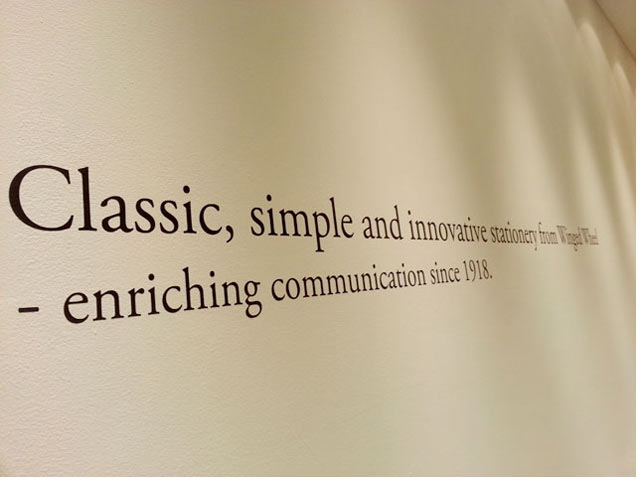
From the two million paper products that their 50 machines churn out in a day, one can easily make out the company vision of Haguruma Envelope. And that is best encapsulated in their company slogan: "Classic, simple and innovative stationery from Winged Wheel—enriching communication since 1918."
The company slogan printed on one of its walls. Photo by Mark Merueñas
Inside their factories, workers, including elderly ones, diligently run the machines, meticulously cut reams of paper, and meticulously apply the tastefully designed artworks on the paper.

One of the gift cards features an embossed image of a monkey that resembles the Philippine tarsier. Mark D. Merueñas
One of their more interesting paper products are greeting cards with embossed and colorfully painted images of flowers, fruits, and animals like penguins, clown fish, iguana, and even a hippopotamus. One of them even had an embossed monkey figure that resembled our own Philippine tarsier. And they all come with bright-hued envelopes.
Literally, every paper product is an artwork in itself.
"I don't think communication could be fulfilled any better than with the use of paper. And that's why my ancestors decided to put up this company in the first place," Sugiura concluded.
Haguruma has stores in Tokyo and Osaka, and exports their paper products all the way to the US and Europe. Unfortunately, Haguruma Envelope hasn't reached the shores of their Asian neighbors yet, including the Philippines. "We haven't studied that option yet. But we will see, we will see," said Sugiura in English, and gave me his reassuring smile.
And of course, I understood him clearly, simply because Mr. Sigiura puts a premium on effective communication no matter what language you use. –KG, GMA News

