

 GMA Brandtalk
 Tracking
 Archives

ADVERTISEMENT
Filtered By: Lifestyle
Lifestyle
Movie review: The anatomy of cruelty in 'Bully'

Alex Libby, 12 years old and one of the subjects of Lee Hirsch's documentary, "Bully".
"Bully" official trailer Do you have kids? I don’t, but here’s the thing: you don’t have to have them in order to appreciate what this documentary is all about. The use of abuse on a weaker person through emotional, verbal, or physical means paints what bullying is all about in broad strokes. See, everyone’s been bullied. At some time or another, you’ve very likely bullied someone (though it falls under the broad definition, yes, scrawling your teacher’s name on the bathroom door is passive-aggressive bullying). “Not everyone’s made of sugar,” my grandmother used to remind me in Tagalog, then she’d grin and hold up a fist to illustrate to me how “for everything else there’s always blunt force trauma.” It’s how evolution shapes us, man. Which is why my lola, raising nine kids post-War to be survivors, was as tough as nails. Technically, someone weaker or without leverage can’t bully someone stronger. It’s the way the world works, the same harsh reality that subjects predator to prey, the stronger to the weak, ad infinitum. The impulse of the schoolyard tough is war and crime simply writ small. Having said all that, that doesn’t mean the events recorded on “Bully” are any less important. Nor are the issues they raise any less complicated. For example: we cannot condone bullying when it has become tolerated in schools, the administrators turning a blind eye to kid-on-kid violence that it’s already routine. And it’s apparently been happening in the US like as epidemic. Take Tyler Long and Ty Smalley. Dead by their own hands in the late 2000s, victims of bullying who felt that the daily brutality was all too much and decided to end it all instead of go back to school. Directed by Emmy-award winning Lee Hirsch (“Amandla! A Revolution in Four-Part Harmony”), this full-length documentary opens with Tyler and Ty's parents in high grief. A tone of overwhelming pathos is established at the get-go and retained like a keening treble note throughout. We go with the Longs to Tyler’s grave, so fresh that it doesn’t even have a tombstone or cross yet. We are shown haunting footage of Ty Smalley’s funeral and the distraught Mrs. Smalley unable to take even the smallest step unless assisted by her husband. 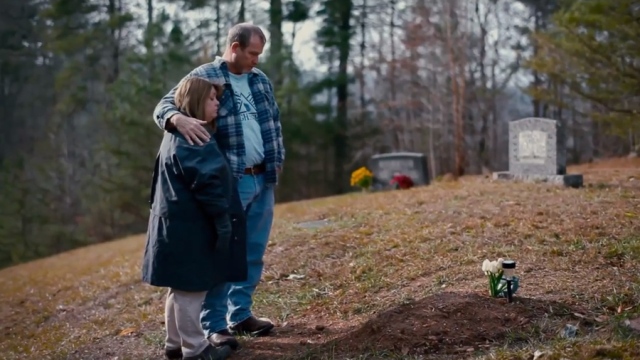
Photos from the Weinstein Company David and Tina Long mourn at the grave of their son, Tyler.
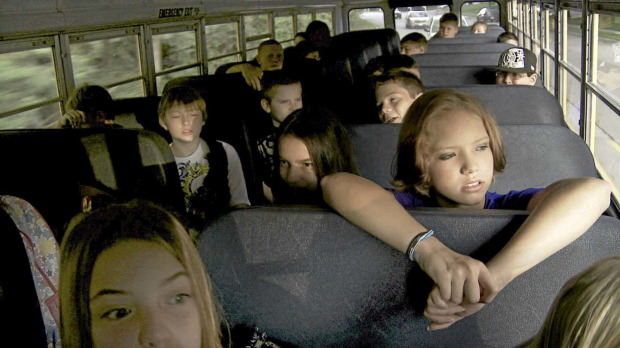
We shift to the present day and follow around the three major characters: students from high schools in Iowa, Mississippi and Oklahoma during the 2009 to 2010 school year. The narrative gets diffuse as we jump from character to character. There’s 12-year-old Alex from Sioux City whose unusually large nose, weirdly-shaped face, thin physique, and nerdy glasses make him an easy target. His daily tribulations start on the school bus where he’s subject to pencil pokes, chokes, slurs, curses and threats. 14-year-old Ja’Meya is black and smart and sweet. But she was picked on every morning and afternoon of the hour-long bus ride between home and school. One day, she’d had enough and packed her mother’s pistol to scare off the bullies. The rest of the children took her down and the parents of the bullies did the rest, pressing charges against her for multiple felony counts. The movie takes us to the Mississippi juvenile detention facility, where she’s currently imprisoned. 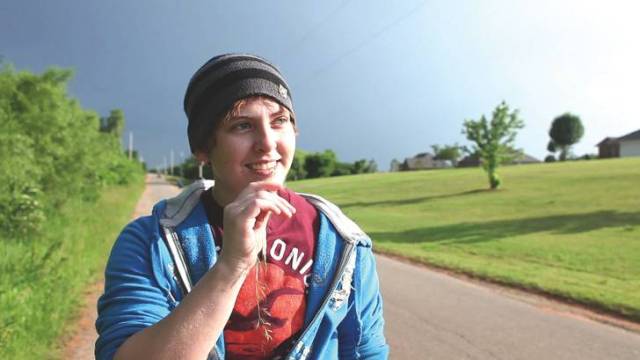 If you think you’ve had it tough, try being 16-year-old Kelby Johnson. Not even her all-star athlete credentials could save her from the onslaught of hate and vitriol from her Bible-belt classmates for being a lesbian. When we follow her around, we find that she’s more fortunate than the previous two because she does have friends (and a girlfriend!). But she’s had to leave her sports teams because of the attacks and is hanging in there, refusing her parents’ offer to pack up and relocate. Your heart will likely go out the most to Alex. He’s got a perennial good guy disposition (and even defends his bullies by telling his parents they’re “just messing around”) and he wants what every new kid in school wants: to fit in. But the cruelty escalates, and soon even the filmmakers are unsure whether Alex is indeed safe in the bus or in school. They deliberate whether they need to intervene. Of course you want the underdog to fight back at some point, but the docu maintains its middle ground that violence is not the answer—further illustrating how, in great detail, the average American school kid cannot defend himself against oppression or cruelty. It becomes clear that “Bully’s” mission is to bombard us so full of pathos that it overflows the brim, and our own emotions spill down to wet our shoes. It has an exhausting insistence. Aside from talking to the principal, none of the families take steps to arm their children with the means to strike back—except for Ja’meya, who threatened to do a “Falling Down.” “I was bullied throughout middle school and much of my childhood,” said director Lee Hirsch. “Bullying was a subject I wanted very much to explore in a film...But it stayed an abstraction for a long time—I was too scared to start developing the idea in earnest because it would mean confronting my own demons, and revisiting a painful period of my life.”
  I guess that answers my question: where is the point of view of the bullies? Why not follow them around, question them about their motivations (since there are talking heads aplenty here) for hurting Alex or Kelby or Ja’meya, to shed more light on the situation? Hirsch aimed his sights (and its most frustrating parts) squarely at educators and school authorities. He shows their passitivity, their incompetence and their unbelievable idiocy in the face of abuse. He states how dismissing an issue simply isn’t enough anymore. Not when students are hanging themselves from closets because of intolerance. One of the most mind-blowing scenes is when Alex is called into the principal’s office and asked to report about the daily abuse he receives. (Am paraphrasing here, mind.) “‘Did you report the things they did to you before? You’ve got to tell us and trust that we’ll do something about it,” said the principal. “I did. He lifted my seat on the bus and sat on my head, and you did nothing about it,” responded Alex. After a long pause: “How do you know I didn’t do anything about it? Did he sit on your head again after you told me?” “No,” shrugged Alex. “But he did other things after that.” It all works, though. Never mind the pell-mell narrative, and how it veers smack into propaganda. My friend (a single woman), was in a crying jag by the time Ja’meya is released from juvenile prison. And we weren’t even halfway through. It’s a complex and thorny issue, no doubt. And one that doesn’t owe its woes to environmental factors. For my part, I assume it must have been a directorial decision not to film a student who attends a public school in the inner city. Say, the black and Latino communities of Detroit or LA? Those are tough neighborhoods replete with gangs and organized crime. Hirsch must have clocked that the context would deflate his theme too much. I respect that, but some context would have provided clarity. Still, you won’t be prepared for the violence visited upon the characters—especially Alex (thanks to the small Canon 5D Mark II that Hirsch filmed with). No one holds back from hitting and cursing, no one speaks up when a teen the size of a safe chokes him, and the bus driver looks at her rearview mirror at all the ruckus. . .and continues to drive. — BM, GMA News “Bully” is rated PG-13 and is now screening at all major theaters. Proceeds from the movie will be used to provide free screenings in public schools across the Philippines through the “Not in Our School” anti-bullying campaign.
Kelby Johnson, 16, is bullied for being a lesbian.
The daily bus ride for Alex Libby.

