

 GMA Brandtalk
 Tracking
 Archives

ADVERTISEMENT
Filtered By: Lifestyle
Lifestyle
Lit aloud: Why perform poetry?
Reading works of literature is generally thought of as a solitary activity, silent and contemplative. Whether one reads curled up in a sofa, while on board a jeepney, by the seashore, or inside a good ole library, reading is essentially understood as a quiet pursuit.
Then there are those not quite content with this, and would rather see words come to life. And like the diversity of the topics of literature, their reasons for performing vary.
Practitioners of the craft shared their thoughts on the matter during the talk “Exposed: Literature as Public Performance” at the Read Lit District, the Philippine International Literary Festival, conducted from November 14 to 16.
Bobis and bodies
Multi-awarded writer, performer and academic Merlinda Bobis was there at the talk, having flown in from Australia to launch a book here. Her talk centered around performing as a result of her leaving the Philippines to go down under.
Bobis recounted the times when, still new in Australia--where she started living in starting in 1991--she would dance the nights away just to stave off loneliness. She shared that it was in this activity that some of her movements during poetry performances were created.
“I always write with the body, if you have read my work, there is always the body and body parts” Bobis said, who grew up in Albay before she moved to Australia, where she currently teaches creative writing at the University of Wollongong.
“Why am I writing (about) body fragments all the time? And I realized this has something to do with migration...it’s a consequence of migration,” she explained.
One of the pieces Bobis performed was “Covenant”, a poem about war and destruction through a child inviting a man who bombed the child’s town to fly kites, which are the body fragments of the child’s mother, father and sister.
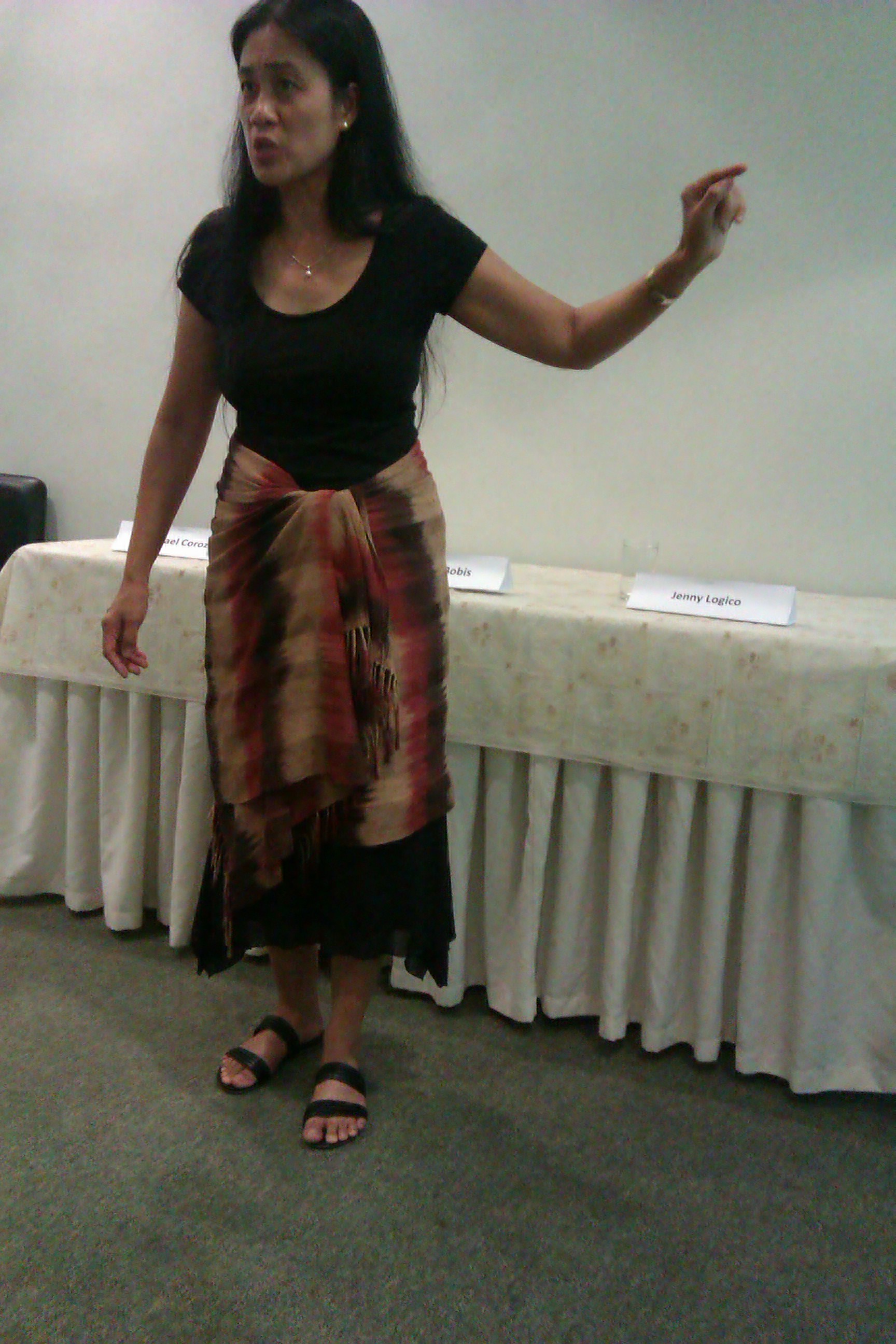
Merlinda Bobis at the PILF. Performance helps her "reclaim the wholeness that is splintered by migration."
Lines from the aforementioned poem are excerpted below:
“now hurl it upwards, mister / and fish that missing / arm-kite of my mother / leg-kite of my father / head-kite of my sister / perhaps, they’ll ripple / the blue above your head / perhaps, they’ll bite just right / to grace your board and bed”
Bobis is no stranger to performing her written works. Aside from “Covenant,” numerous samples of Bobis’ other dramatic works can also be found on her website.
She shared that because of her transnational identity, some outputs of her creative process have as a result also become transnational, and that the themes of some of her pieces have to do with migration and the self affected by it.
“When you leave what you love, you lose a limb, you lose limbs,” Bobis said. “And the only thing you can do in the new home is to [tell a] story and sing.”
“You try to sing the lost limb back, but you can never get that lost limb back as it was before, you can only sing about remains,” she also said.
Bobis also said that through the process of performing, she is somewhat able to gather the self that was affected by her departure from her original homeland.
“It’s a very personal thing that I’m doing for myself. In the process of performance, you reclaim the wholeness that is splintered by migration,” she said.
'Poetry is song'
Poet and teacher Michael Coroza, meanwhile, associated poetry as being song, thus his comfort and familiarity with performing literature in public.
“Well I believe that poetry is song...Whenever I write poetry I really have that intention to perform the poem,” said Coroza, who is an Associate Professor of Philippine Literature, Creative Writing and Literary Translation at the School of Humanities of the Ateneo de Manila University.
“But there really are poems that are good to perform, and there are poems that are really better read than heard,” Coroza said, adding that he would always write poetry than can be performed. “And I want it that way, because as I said I am coming from an oral tradition of Tagalog poetry,” said Coroza, who performs the balagtasan.
He then proceeded to introduce himself in that form:“Michael M. Coroza, ako po ay makata / Mayamang-mayaman sa tula at taba / Bagaman ang ama’t ina ko ay mula sa Laguna ako ay taong Maynila / kaya po ang aking pananalinghaga hinubog ng trapik, basura at baha.”
Coroza said his challenge as a performer is to craft material that will reconcile “old” styles of poetry with modern ones, “para hindi naman ako si Jose Corazon de Jesus lang,” referencing the late and acclaimed poet who was also known for his takes on the balagtasan.
“Iyon po ang laging problema ko kapagka ako’y tumutula,” he said. “Kung paano mapagtatagpo ang moderno at luma,”
Bringing words into a space
The third speaker, Jenny Logico, describes herself as a performer by profession. She writes pieces that can be used for performances, and the one she performed was entitled a “Series of Air.”
It was a confessional piece which describes Logico’s love affair with a transgender Latin-American, bipolar man in Harlem in the early 2000s. For her performance, Logico donned a suit and dressed as a man, because of the identity of her past lover. Her husband was also accompannied her piece by playing steel bongos.
“I’ve always been a performer. there’s really something about bringing [those words into a space],” Logico said. “What pushes me to perform is to just. . .it’s so cliché. As a performer it’s just being able to exorcise the words through your body and just let go afterwards,” she also said.
There are works of literature better read silently and were written for that purpose, and then there are those destined to be performed. And, after contemplating and summoning nerve and daring, when the time comes for the performer to act out his or her piece should he or she decide to do so, there’s nothing left to do but to pour one’s self in one’s performance.
“Ang prinsipyo kasi, yung performance ay pakikipag-isa sa audience, so how do you become with them if you don’t let yourself out?” Coroza said.
“You have to become one with the audience, you have to pour out yourself, you have to do it that way or else wala ka lang diyan, as in wala lang,” he summed up.--KDM, GMA News

