

 GMA Brandtalk
 Tracking
 Archives

ADVERTISEMENT
Filtered By: Lifestyle
Lifestyle
Movie review: The word is made flesh and lives on in 'Baybayin'
Many moons ago, during a discussion about a proposal to build a cement plant in his ancestral homeland, Pala’wan elder Tito Mata stood up and calmly told the audience of technocrats that he could not have signed the consent form the proponents were claiming as proof of his indigenous community’s approval of the project. Why, he was asked.
Simple, he replied. He does not sign his name with the cursive script most Filipinos use, but in the traditional inaborlan writing.
This little piece of history, published in the community newspaper “Bandillo ng Palawan,” is one of the nuggets that inspired the latest film of multi-awarded director Auraeus Solito.
Introspective for the most part and crass when necessary, "Baybayin" speaks to the audience about truths that can sometimes seem stereotypical, but which, for the people of Palawan who grapple with these realities on a daily basis, is simply a reflection of what is happening in the province today.
There’s the Pala’wan, an artistic community found mainly in southern Palawan that still performs shamanic rituals often seen as primitive in the eyes of outsiders. There’s the do-gooder anthropologist, absorbed in documenting the vanishing practices that might one day help colonized people understand those who have resisted foreign influences. There’s the gang of government soldiers that guards private business interests instead of safeguarding the public.
Their stories are woven into the central tale about two sisters who fall in love with the same man, with the baybayin as the ephemeral link that binds them. Written in the sand, on a bamboo stalk, and most often, on their semi-naked bodies, the indigenous alphabet spells out their views about the world. It is the living expression of their natural environment as well as their feelings, often in very eloquent terms even if only one word is written down.
This is where the power of this film lies--the ability to communicate simple messages that have been lost in the din of modern gadgets and the pursuit of money. The majestic view of El Nido’s limestone cliffs and Snake Island plays a major role in depicting life’s forgotten joys, and it helps that the magic of high-definition cameras and the Digital Cinema Package gives justice to the film crew’s hard work; the visuals leap out as if one were watching mainstream cinema instead of a digital indie film.
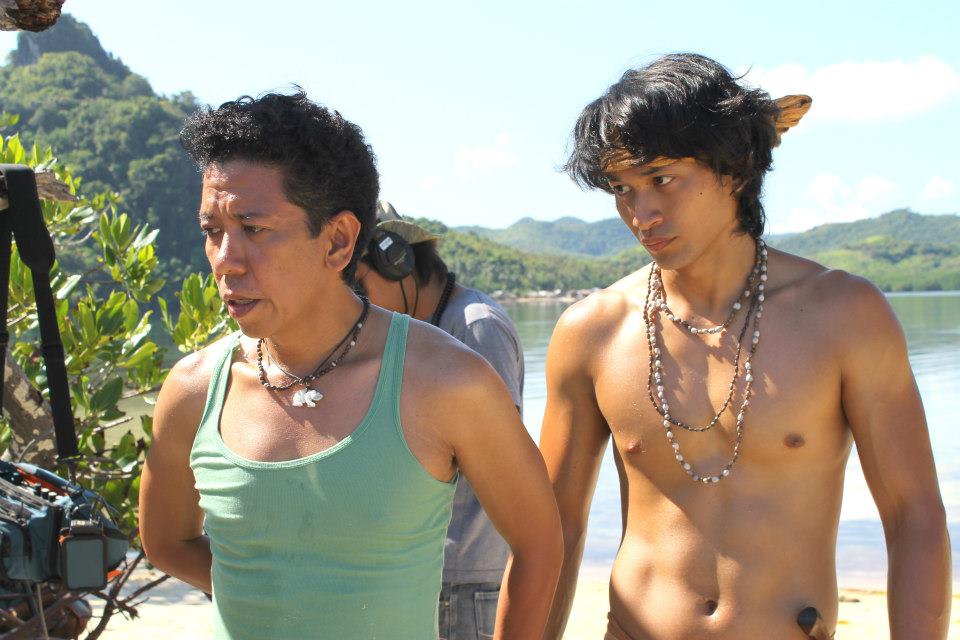
Director Auraeus Solito (left) and actor Adrian Sebastian on the set of "Baybayin."
However, anyone who thinks it’s all about breasts and butts will be missing the point dearly. There may be shades of “Pillow Book” in this film, but the eroticism is not the kind that merely tickles the imagination. Instead, it invites exploration into our views about relationships that may seem unorthodox, but are plausible even if these are unacceptable to people who would rather stick to safe and conventional Christian norms. Most of all, “Baybayin” deals with the sense of loss, not only of people who matter in our lives, but the intangible things we once valued and have neglected to nurture in our adult existence.
That’s why it’s worth the effort to sit through the few dragging parts, the occasional shaky-camera-following-a-walking-character moments that seem inevitable in indie films, and a misplaced artifact that only prayerful Catholics will notice. These minor inconveniences are overshadowed by the major strengths of the film, which truly define the value of cinema.
There's the perfect casting and superb acting of sisters Assunta and Alessandra de Rossi, along with those of veteran thespians and new finds in Palawan. The musical scoring captures the essence of Pala'wan culture, as well as the melancholy spirit of the island that has captivated many wandering souls. The cinematography brings to life not only gorgeous scenery, but also the human drama unfolding in less charted paths of the province. The film’s surprising restraint also shows how far the director has come in his journey to introduce Filipinos, and the rest of the world, to his indigenous heritage. “Baybayin” is the second in Solito’s planned trilogy about Palawan-–the first one was the internationally acclaimed “Busong” – and we eagerly await the coming of “Sumbang” next year. -–KDM/HS, GMA News
Baybayin will be screened on the following dates at the Cinema One Festival:
Shang Cinema
12:30 PM Dec. 1, Saturday
Robinson’s Galleria
8:30 PM Dec. 3, Monday
2:30 PM Dec. 6, Thursday
5:00 PM Dec. 8, Saturday All photos from Auraeus Solito's Facebook page.

