We use cookies to ensure you get the best browsing experience. By continued use, you agree to our privacy policy and accept our use of such cookies. For further information, click FIND OUT MORE.
Make this your preferred source to get more updates from this publisher on Google.
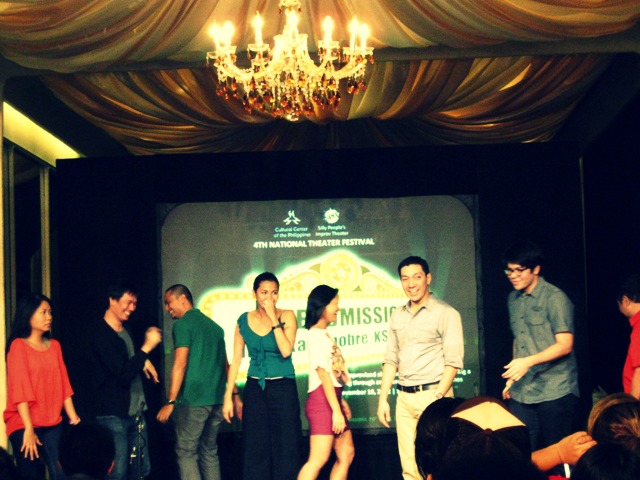
The actors of SPIT receive well-deserved applause at curtain call
Improvisational theater is the kind of performance that seems perfect for television (hence the popularity of shows like “Whose Line Is It Anyway?”), in bars, cafés, or on makeshift stages that are as slapdash as the pieces that unfold upon them. The Cultural Center of the Philippines (CCP) seems a rather unlikely place for an improv show. With its giant stages and chandelier-lit halls, it is intimidating whereas improv is inviting; scrupulous where improv is spontaneous. In fact it seems almost an affront to the high-end venue to basically wing it for an entire performance. And yet that is exactly what the actors of the Silly People’s Improv Theater (SPIT) did at the National Theater Festival (NTF) last November 16 for their show “Hindi Kami Pobre, KSP Lang.” Admission was free to this unscripted, unrehearsed performance about "the struggles of making a living through art in contemporary Philippines."
The Silly People's Improv Theater. Photo courtesy of spitmanila.com
The formal and fancy halls of CCP's Silangan Hall served as the perfect counterpoint for what turned out to be a freewheeling exploration of the life of today's starving Filipino artist. As it turns out, unscripted and unrehearsed hardly means unprepared—at least not for the actors of SPIT, who appear to have been getting ready their entire lives for this performance. Which is to say that the actors’ blade-sharp wit, biting sarcasm, and lightning-quick creativity could not have developed overnight. These served as fuel for the show, so that even with heavy audience involvement, the applause still belonged exclusively to the actors and no one else. Led by comedian Gabe Mercado of “OK ka ba tiyan?” TVC fame, the actors began with a long-form improvisation under the theme “copycat,” which was suggested by an audience member. For a group whose posters read “seriously funny,” the comedy came on subtly—a pat on the back, than a punch in the face. But as each scene ran on, it soon became apparent that SPIT’s objective was actually not to make the audience laugh, but to talk about their message—that is, the struggles, financial and otherwise, of Filipino artists. They did tremendously well, even as a few jokes fell flat and some dialogues were repetitive and drawn out. Individual monologues kicked off the show, after which they paired up for scenes. Mercado played a skeptical older brother to Kenneth Keng, who turned out to be a young playwright whose grades were compromised by theater. Following them were Happy Feraren and Chal Chang-Lontoc, whose excellent energy and chemistry as a pair of fine arts majors doing their thesis brought the audience to giggle-fits.
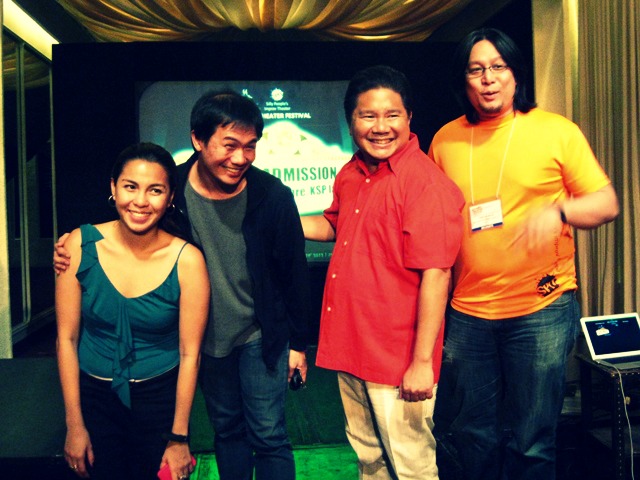
SPIT's Chal Chang-Lontoc, Akong Bongcaras, Gabe Mercado, and Pepe Manikan after the show
The final pair was Dingdong Rosales and Teresa Barrozo who, despite the unestablished relationship of their characters to each other, arguably elicited the most emotion—both laughter and tears—from the captivated audience. In the end, events took a turn from the comedic to the dramatic, with conclusions that were not only touching, but insightful. The scene by Rosales and Barrozo, in particular, came with the realization that, as challenging as conditions are to survive in, and despite so many forces pitteed against them, ultimately, theater and art are worthy pursuits. After the intermission, SPIT proceeded with a line-up of short-form improvisations, which they promised to keep doing as long as people were still having fun. It was here that the show's theme became secondary to the comedy as it became decidedly more upbeat and the humor more profuse. Audience involvement grew in the second half as well. SPIT members Chester Cruz, Bibay Cordero, Monica Cordero-Cruz, and Akong Bongcaras joined the cast for this, and each of them played with a different style of humor to keep the laughter going. The show ended as unceremoniously as it began, to the tune of a collective, unrehearsed “awwww” from an audience who was certainly not prepared for the show to end, and who clearly had not yet had enough. — KDM/BM, GMA News


 GMA Brandtalk
 Tracking
 Archives