

 GMA Brandtalk
 Tracking
 Archives

ADVERTISEMENT
Filtered By: Lifestyle
Lifestyle
'No getting away from being gay' for Pinoy LGBT writers
+
Make this your preferred source to get more updates from this publisher on Google.
To be openly LGBT (lesbian, gay, bisexual, or transgender) in this predominantly Catholic, conservative country is not an easy thing. Many still believe that homosexuality is a sin, and something to be solved or cured instead of simply accepted.
Poet Nerisa del Carmen Guevara, speaking at the third Philippine International Literary Festival (PILF) last November, put it succintly: “in a Catholic country, these letters [LGBT], these words have broken many a human being.”
“These words are also stellar rebellions [that] the youth so explosively use to fluster parents and friends. And when youth has waxed and waned, these stars fade into a straight domesticity, this state of being that a Christian society feels needs to be dealt with, this label on me, over my shoulders like a yoke or fancy blinged pendant between my breasts,” she continued, denoting both the power and difficulty of being an LGBT writer in the Philippines.
At one of the forums at the recently concluded Philippine International Literary Festival (PILF), four Filipino writers came together to discuss how the label affects their work. As moderator J. Neil Garcia pointed out, all four writers seemed to agree that LGBT category was at once liberating and limiting.
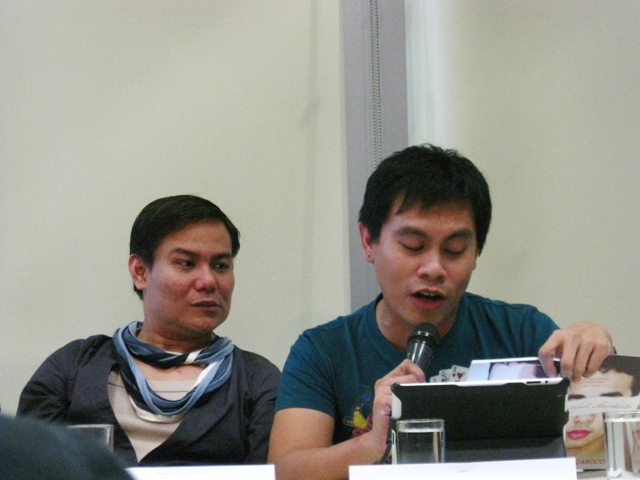
Ralph Semino Galan and Ian Casocot at the Phil Int'l Literary Festival.
“Attached permanently to my work with no possiblity of disavowal whether private or public, the LGBT label had been paradoxically both liberating and limiting,” said poet Ralph Semino Galan.
Galan explained that the label was liberating because it allowed him to talk about once-taboo topics “out in the open and not inside the closet.”
He also said that the commercial success of LGBT literature such as the “Ladlad” anthology series of Philippine gay writings, show that they do have a market and an audience.
The downside to the label, Galan said, is that it tends to stereotype writers as it does anyone who identifies with the LGBT community.
“For instance, the assumption by some heterosexual writers and scholars that some Filipino gay writers are only preoccupied with sexual matters, which is furthest from the truth,” Galan shared.
Another limitation of the label, he said, is that everything he writes will always inevitably be seen or read from the gay perspective, even if the writer doesn't intend for the work to have a gay theme.
As writer Jhoanna Lynn Cruz put it, “the writing I do today is more than 'lesbian' and yet is always 'lesbian,' even when it is only reaching out to a memory or perhaps wish fulfillment.”

Jhoanna Lynn Cruz with a copy of her book, "Women Loving"
“On the one hand, I wanted to fully inhabit the lesbian niche which at that time wasn't occupied by anyone. On the other hand, my personal life was going through so many changes swinging towards 'the other side,' normalizing, and I was beginning to struggle with the label 'lesbian,'” she said.
Fictionist Ian Rosales Casocot himself admitted that there was a time when he felt too “boxed in” by the gay label. He then started writing fantasy stories, horror, and science fiction as an effort to break free from the LGBT tag.
The writers also said that another limitation of the LGBT label especially for a writer is that it can take its toll on personal relationships.
As Guevara said, “being a writer, whether gay or straight, it’s hard to have a relationship unless it’s [with] another writer, an artist.”
“Usually, nahihirapan sila because they're afraid to be written about, that that [gay] birthmark is going to end up somewhere in the text and, wala, alam na ng lahat. But I think it's even harder when you're lesbian because it is a small community and a birthmark can be identified,” Guevara explained.
Ultimately though, the label is empowering.
As Cruz said, “I'd like to begin with what Adrienne Rich said many years ago...she said 'the word 'lesbian' must be affirmed because to discard it is to collaborate with silence.'”
Casocot put it in even simpler terms. After relating his struggle to break free from the LGBT label by writing genre fiction, the writer concluded that even if he tried, there will always be a shade of LGBT in his works.
He said, “I guess there really is no getting away from being gay.”--KDM, GMA News

