

 GMA Brandtalk
 Tracking
 Archives

ADVERTISEMENT
Filtered By: Lifestyle
Lifestyle
Comics superheroes educate voters in 'The C.H.A.M.P.S.'
+
Make this your preferred source to get more updates from this publisher on Google.
“They're young! And they're after the bad guys,” screams the cover of the first issue of “The C.H.A.M.P.S,” a superhero team created to entice the youth to vote responsibly this coming local and mid-term elections.
C.H.A.M.P.S stands for “clean, honest, accurate, meaningful and peaceful elections,” the long-time mantra of the election watchdog Parish Pastoral Council for Responsible Voting (PPCRV). With help from the Communication Foundation for Asia (CFA), they produced the comics, which is inspired by a recent superhero movie.
“Ambassador Henrietta de Villa, PPCRV's national chairperson was so enthralled by the Avengers where each superhero had a special power to defeat something bad,” said the organization's voters education co-director Ginny Rodriguez.
The heroes

"The C.H.A.M.P.S." can be downloaded from the Communication Foundation for Asia (CFA) website.
C.H.A.M.P.S consists of Jessa, a college paper editor who sees a glimpse of one of the country's alternate futures; Cyberoid, a wheel-chair bound gadget inventor; Nemesis, skipper of the varsity taekwondo team; and Lexa, a law student with a network of contacts from different government agencies.
“Superheroes are attractive to the youth,” she added. “We had so much fun doing this.”
CFA tapped Christina Mercurio and Noel de Leon as co-editors and writers, and Boogie Policarpio as artist. This is the second time PPCRV collaborated with CFA to produce a comic book for voters education – the first one being “The Rise of the Machines,” a story demystifying the automation of the 2010 National Elections. CFA also made the comics available for download on their site.
“They have a wide variety of comics and activity magazines for all ages – very talented people,” Rodriguez said. “We had many brainstorming sessions which we all enjoyed.”
But did the comic book creators achieve this goal without being too preachy or too campy?
The story
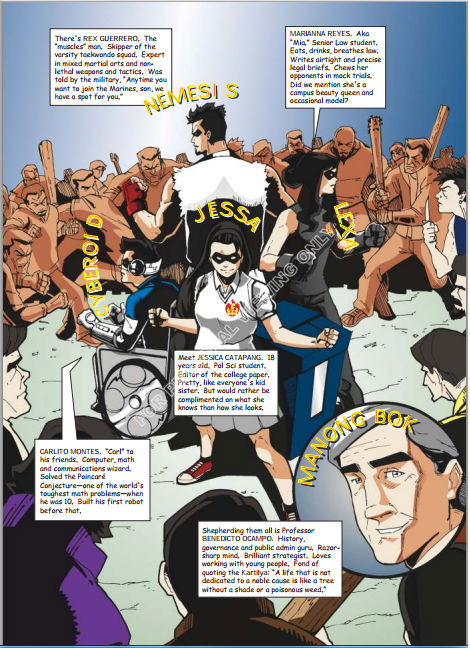
C.H.A.M.P.S consists of Jessa, a college paper editor who sees a glimpse of one of the country's alternate futures; Cyberoid, a wheel-chair bound gadget inventor; Nemesis, skipper of the varsity taekwondo team; and Lexa, a law student with a network of contacts from different government agencies.
The plot revolves around Jessa discovering that their corrupt governor has risen to power and become the country's president in 2033. She learns that the taekwondo varsity player and the law student she looks up to have become lackeys of the President, who is determined to lock up political leader, Mang Bok, her current History professor.
Some important parts of the story were left unexplained: the characters suddenly deciding to put on masks to change their futures but still wear their school uniforms and taekwondo outfit came a bit strange. The authors may have perhaps opted for the “compressed” style of storytelling, but this could leave their readers scratching their heads.
The code names Jessa and Nemesis picked also appear too campy or non-related to the character's power set, which may also alienate their discerning target readers.
What I like about “C.H.A.M.P.S” is that the subplot presented in the beginning of the story is resolved. The story also does not come across as preachy, but subtly inculcates ideals by entertaining the reader as the tale progresses. It does not directly tell us to vote responsibly but rather shows the effects of having a rotten government official elected, prompting readers to think twice about what to write on their ballots.
“The C.H.A.M.P.S” is written in English, a language that may not be accessible to all. “A Tagalog version is in progress,” Rodriguez assures us.
The visuals
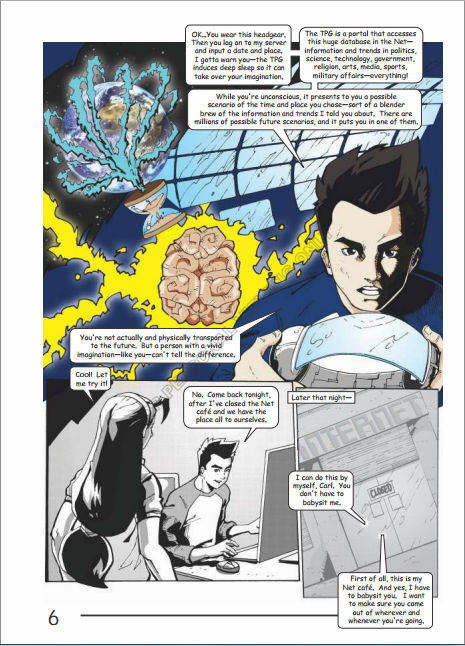
C.H.A.M.P.S. features some panels in black and white, and some in color.
You'd think at first glance the black and white panels are part of a storytelling technique, but they aren't. If budget constraints forced the producers to print some panels without any color, they could have printed the pages set in the future in black and white to differentiate the setting while enhancing the story. It is confusing for a reader to see one scene colored then it's black and white on the next panel.
Boogie Policarpio's art matches the current taste of the young voting public. He was not able to draw some characters in-panel though, resulting in some dialogue appearing as text with the character's name at the bottom of the panels.
The use of round square balloons may also be a turn-off. It looks like the balloons, the tails and other shapes used for the captions and dialogues were acquired from the available clip art of MS Word. Comic book creators who self-publish their works now use Adobe Photoshop and read online tutorials to create visual effects that look like they were done by professionals.
Social change through comics
Despite these flaws, the comic book will give a “Funny Komiks” feel that may be nostalgic to those who grew up in the '90s. This also shows that you can come up with a good story even if the production quality has lagged behind those produced by Marvel and DC Comics.
There's an untapped potential in using the superhero genre in comic book format to spread awareness of social issues locally. The fact that PPCRV sees the power of the comics to promote change is a welcome development in the use of the medium. This can also inspire would-be creators outside of the comic convention-going crowd to come up with stories, our own superheroes tired of “trapos” beating up the villains in Barong. — KDM, GMA News
Jerald Uy wrote a comic book story in 2011 introducing Segovia Solutions, a call center that supports Filipino superheroes targeting particular social ills in the country—particularly the killings of journalists in the first issue. For updates, visit his site or the comics' Facebook page. All photos courtesy of the Parish Pastoral Council for Responsible Voting (PPCRV)

