

 GMA Brandtalk
 Tracking
 Archives

ADVERTISEMENT
Filtered By: Lifestyle
Lifestyle
Theater review: 'Boeing Boeing' is far from farce
It was frustrating watching Repertory Philippines’ “Boeing Boeing,” and for most of the show at press night, I couldn’t quite put my finger on it. Until Baby Barredo, Repertory’s Director and the play’s maid Bertha, responded to questions about this comedy they had just finished performing. She called it a farce. 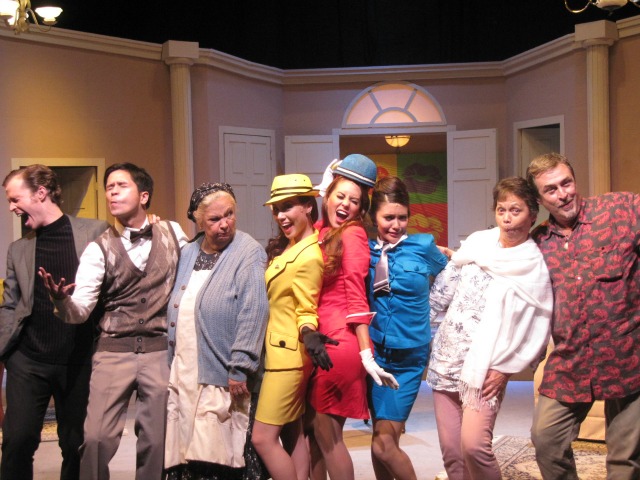
The cast of 'Boeing Boeing' with Bertha alternate Joy Virata and director Miguel Faustmann
But I’ve seen farce, and I’ve seen Repertory do it well (“Shakespeare in Hollywood,” “Leading Ladies”). This one that kicks off their theater season is far far from the farce Rep has proven it can do.
To say that this was unsuccessful is an understatement. “Boeing Boeing,” set in 1960s Paris, depended on over-the-top comedy, the kind that’s almost absurd, that one that we know to be unreal. Characters didn’t need to be larger-than-life, as they needed to be an extreme, to the point of being unbelievable. Farce is only successful when it is obviously so, and laughter is borne of its situational impossibility.
It’s too easy to blame the material—elsewhere in the world it is said that the disconnect with the contemporary audience is because of its datedness. In this staging though, datedness was the least of its problems.
Because it barely established 1960s Paris, not through its set, not given the conversations that were being had by the, uh, Parisians. Were we supposed to see it through those stewardess uniforms? Those men’s outfits? In the age of vintage, all of those are possible. And no, those pretend-Andy Warhols hanging on walls didn’t help any.
Missed characterizations
It also didn’t help that most those actors on stage failed at being believable as the extreme versions of the characters they were playing. It is not an easy question of acting, as it seems it might have been a failed task of characterization. 
Topper Fabregas
David Bianco (Bernard) and Topper Fabregas (Robert) are tried and tested Repertory actors, and yet in “Boeing Boeing” they both seemed like they were going through the motions of being their characters, disallowing for a sense of who they might be as real people, if not what their motivations are. Fabregas’ Robert in particular, was way too effeminate when all the brief says is that he was innocent provincial boy. Here though, Fabregas gets on that stage and for a good stretch of time seems … gay.
That would’ve been fine were that the point. But the story unfolds and reveals him only to be inexperienced with women, thus he would be overwhelmed by the mere idea of having one girl, not to mention three. Which is at the center of this play, where Bernard has found that the only to true love is to have three of it: that is, three stewardesses, one who is with him in Paris, and two others who are always in two different parts of the world at any given point.
The plan works because all three girls work at different airlines, and the airline system ascertains that they will be at different places, landing in Paris at different times, if not on different days. Bernard’s polygamy was all planned out with the aviation system: what could go wrong? Well, delayed flights and faster airplanes, yes. But that was the least of this staging’s problems.
There was Bianco’s lack of swagger, which he needed in the beginning so that his freaked out version would be a worthy extreme. The two girls who played the stewardesses—Giannina Ocampo (Gabriella), Carla Dunareanu (Gretchen) and Jennifer Blair-Bianco (Gloria)—might collectively be the worst I have heard accents done on the Rep stage in the past three years. Where the Italian would shift to Spanish, the German at certain points sounded Chinese, and well, the American accent was lost in the missing Parisian accents of both Bianco and Fabregas in the lead roles. 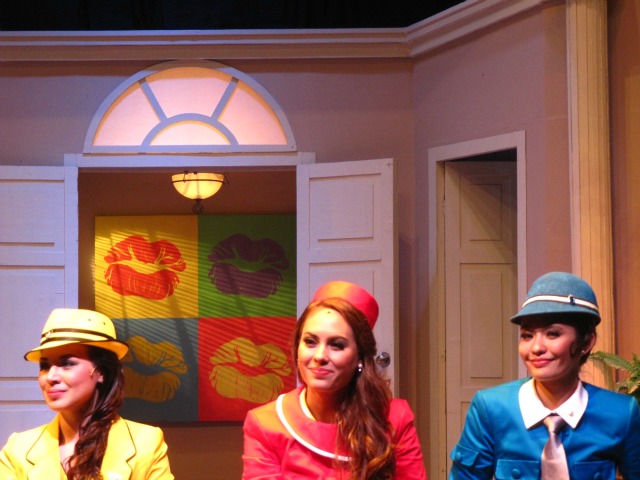
The stewardesses in 'Boeing Boeing'
Acting-wise, it would be Blair-Bianco who had the American Gloria down pat, not just because she looks the part but sounds it, too. She would out-swagger everyone on that stage in fact, and I mean that in every good way. Dunareanu was the most consistent in terms of being the German Gloria, extremely uncompromising on one hand, but falling into the trap of romance on the other. These shifts were something she did flawlessly, and something that was fodder for some farcical laughter. Ocampo’s portrayal of Italian Gabriella was the most difficult to believe, as there was not enough romance in her, much less a farcical extreme of that.
Tested, but tired
That this cast lacked collective swagger was nothing but a surprise to me. Repertory after all, is tried and tested when it comes to this genre, and the past two seasons yielded pretty fantastic staged farces. On that stage, that cast looked tired. They weren’t walking swiftly enough, not speaking quickly enough, not working with the premise of physical theater enough. In their hands there was a tendency to imagine this nothing but a realistic story.
Nothing else would weigh as heavy on this play. Barredo was difficult to forget as Bertha, and this is not because she was fantastic. On the contrary, in the first 20 minutes or so of “Boeing Boeing,” the quick-witted repartee required of her versus Bernard and Robert, would leave her visibly breathless. At some point she can barely get through her lines, much less through the motions of being servant.
It would seem Bertha could’ve been that central character that is perfectly misplaced in this ideally farcical “Boeing Boeing.” Given Barredo’s version of though, we cannot know that for sure.
Which might be said of this play as a whole. Without a sense of how it is farce, all we’ve got is a cast that seems to be going through the motions of performing, if not through the motions of a funny play. Because it does remain funny, even as you imagine that it can be funnier.
No, it should’ve been funnier. But in the end “Boeing Boeing” was really just the farthest from farce I’ve seen Repertory churn out in a while. —KG, GMA News
"Boeing Boeing" is a Repertory Philippines production directed by Miguel Faustmann, written by Marc Camoletti and translated by Beverly Cross and Frances Evans. It runs until February 17, 2013.
Katrina Stuart Santiago writes the essay in its various permutations, from pop culture criticism to art reviews, scholarly papers to creative non-fiction, all always and necessarily bound by Third World Philippines, its tragedies and successes, even more so its silences. She blogs at http://www.radikalchick.com. The views expressed in this article are solely her own.

