

 GMA Brandtalk
 Tracking
 Archives

ADVERTISEMENT
Filtered By: Lifestyle
Lifestyle
My big, fat Chinoy New Year
What do you get when you combine a Bulakeña with roots in Catholic Pampanga and a second-generation Chinese man whose parents were immigrants from Canton?
You’d get a smattering of Cantonese, an affinity for food, a strong dislike for incense of any kind, and more traditions than you can count.
In a word you get, well, me.
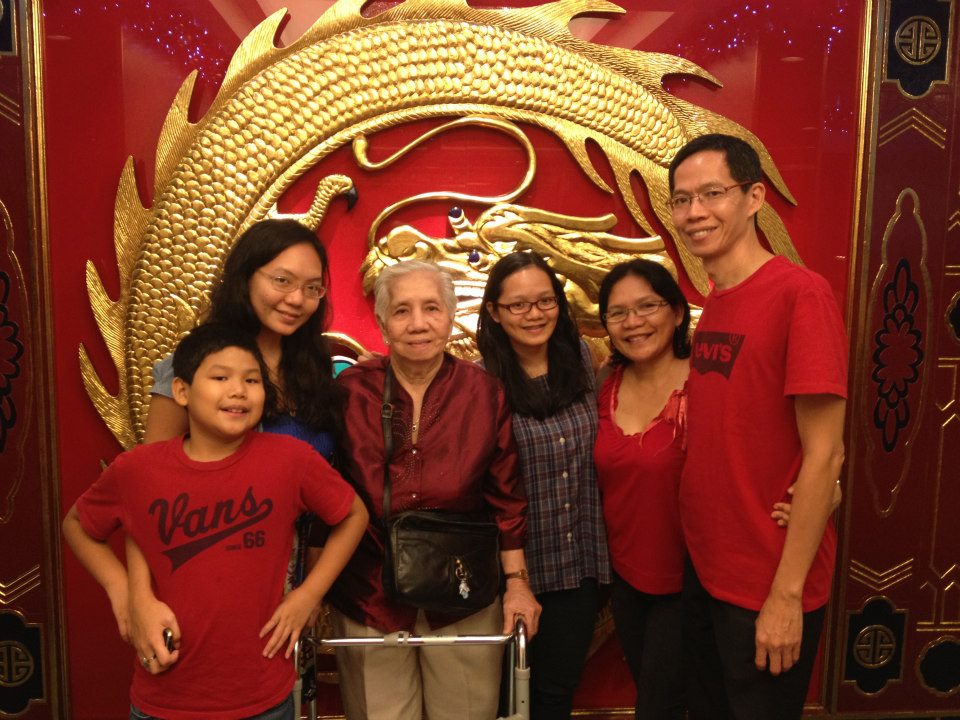
GMA News Online's Patti Chiu, second from left, with her lola and family.
While I’d be first to admit I’m more Filipino than Chinese, growing up in the mixed environment of the two strong cultures has taught me several things about tradition – specifically doing away with some, preserving others, and creating new ones along the way.
Best of both worlds
Despite what may seem like a confused childhood, nearly 23 years after the fact, I can truly say I have the best of both worlds.
Growing up, there were few things that were as sacrosanct as Chinese New Year. Or, more importantly, the Chinese New Year’s meal. Back when all the sons and daughters and cousins who were still in the Philippines lived in one compound, it was easy to organize.
Lola (we never did get used to the Chinese honorifics) would phone us from the ancestral house two doors down to reserve our time for dinner on Chinese New Year. Unlike the usual New Year celebrated when the clock strikes 12, Chinese New Year for my family is more relaxed. There are no fireworks, or waiting for midnight, or lion dances.
Instead, we’d troop to the old house in our best red clothes, to be handed small red envelopes – ang paos – with a little bit of cash inside. Traditionally given by all the married women to single girls, in our family, it’s only lola who gives out money.
But this year’s celebration will be a little different. My uncle and his family have moved out of the compound, and my two aunts have been abroad for a while. So instead of dinner on Chinese New Year, which in 2013 falls on a Sunday, Lola’s scheduled the traditional meal for lunch the day before.
Plenty of “good luck” food
Yet if there’s one thing we can count on never changing, it’s all the good food.
We’d get Fat Choy soup, black hair-like algae that resembles long filaments and served with scallops or mushrooms or chicken. I will always remember the widening of eyes the first time Lola served the “good luck soup.”
“Drink it all,” she said, refusing to clear bowls until the last drop was drunk, and we obliged, first resentfully, and then with more gusto upon realizing the soup, in fact, tasted brilliant. It’s probably the most Chinese part of the meal.
I’ve never really figured out what sort of luck the soup was supposed to give me, but when your Lola says it cost quite a dime to make the soup, you feel lucky she cares at all.
And it wasn’t just the “strange hair soup,” as my sister once called it. We’d also get Birthday Noodles, served side by side with patatim, stewed pig knuckles in a thick brown sauce and quail eggs. We’d get sweet and sour pork, and oyster sauce chicken, and steamed fish, essential if we want prosperity to “jump into our new year,” according to my grandmother.
But there are distinctly Filipino elements to our celebration as well, notably the presence of ice cream after dinner, and maybe fruit salad, if we’re feeling festive (and have a lot of Christmas leftovers.) Plus, the prayer before meals is said with the sign of the cross.
Tikoy, how to say "happy new year!" and more tikoy
A few days after Chinese New Year, my very Filipino mother will be scrambling for ways to serve tikoy creatively. There is only so much fried sticky rice a family of five can eat, after all.
The big winner, we’ve found, is tikoy wrapped in lumpia wrappers and drizzled with a little sugar, cooked a la turon. The year mom served the fusion merienda, the boxes of glutinous rice cakes disappeared much much faster than the years before. It has been the go-to recipe ever since.
Then there’s the matter of the greeting. Being Cantonese, I was taught to say “Kung Hei Fat Choi” at a young age, instead of “Gong Xi Fa Cai,” the traditional Hokkien greeting. I found it confusing, being educated in a school that taught Mandarin, but whose teachers spoke Hokkien and telling me my greeting was wrong.
Funnily enough, I was never offended by that, despite the strong feelings of distinction my Chinoy friends seem to harbor. When half your family doesn’t celebrate the holiday, words are not quite as important, especially if they essentially mean the same thing.
Over the years, I’ve learned to accept that there were many kinds of Chinoys, and when someone greets me, no matter the language, the best thing to do is smile and say thanks.
Culinary and linguistic adventures aside, sometimes it surprises me how easily the two cultures have gelled for us to be able to celebrate the Lunar New Year in our own way.
But then again, perhaps that’s the thing about coming from two cultures. When you put in enough effort to make the everyday work, pulling off grand(er) celebrations is easier. After all, we’re all used to compromise. – KDM/HS, GMA News

