

 GMA Brandtalk
 Tracking
 Archives

ADVERTISEMENT
Filtered By: Lifestyle
Lifestyle
Movie review: Anthony Hopkins and Helen Mirren deliver a Hitchcockian treat
A dilapidated house sits forebodingly in the middle of a weed-strewn yard. Up front, a duo of dubious moral fiber makes small talk while working on a half-dug hole. Without warning, their conversation is interrupted by the swing of a shovel, quickly punctuated by the sickening crunch of metal on bone. As the digger-turned-corpse crumples to the freshly turned earth, a familiar, jaunty, funeral tune starts up. The camera pans to reveal a corpulent figure of distinctive profile nonchalantly observing the scene. The figure turns away from the homicide he has just witnessed and addresses the audience with a protracted, slightly ominous, “Good evening.”
Thrown into the deep end, right off the tongue-in-cheek bat, fans of Alfred Hitchcock, the Master of Suspense, know they’re in for an in-joke-laden treat, with Anthony Hopkins in the title role. Also staring is a superlative Helen Mirren as Alma Reville, the very picture of stoic dignity next to the mercurial perfectionist.
Following the prologue and opening titles, director Sacha Gervasi (“Anvil! The Story of Anvil”) launches us into the narrative proper, beginning in 1959, at the premiere of “North by Northwest.” At the time, the Cary Grant-starrer is hailed as Hitch’s greatest achievement, never to be topped. Advancing in age and creatively exhausted from making the sorts of films he has become known for, Hitchcock decides that the only way out of his funk is to seek out a project no one in his right mind would associate with him. His search leads him to option the rights to a trashy slasher novel currently setting the bestseller lists on fire, the appropriately named “Psycho.”
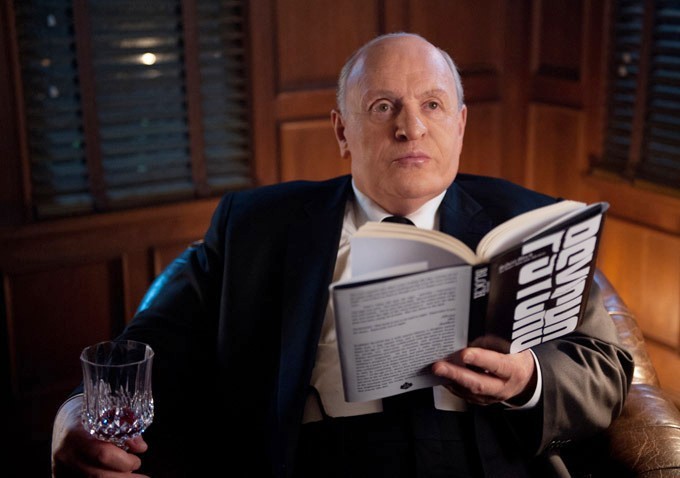
Anthony Hopkins in the title role, seen here in character with a copy of Robert Bloch's "Psycho"
While Paramount wants Hitchcock’s next project to be something safe, Hitch wants to re-experience the thrill of the unknown that marked his early forays into filmmaking. What follows is an engaging mixture of Hollywood politics and backstage intrigue as Hitch battles studio execs and prudish mindsets (represented by “Robocop” and TV’s “That 70’s Show’s” Kurtwood Smith as a by-the-book censor) to get “Psycho” made.
On the human-interest front, Hitch is faced with the very real possibility of his wife’s infidelity, due to the charming presence of his “Strangers on a Train” collaborator, screenwriter Whitfield Cook (Danny Huston, “Children of Men”). Complicating matters is Hitch’s own tendency to obsess, not just on his current projects, but on his (preferably blonde) leading ladies, including Janet Leigh (“Lost in Translation” and “The Avengers’” Scarlett Johansson, in fine form) and former apple of his eye, Vera Miles (Jessica Biel, “Totall Recall,” TV’s “Seventh Heaven”).
Serving as the personification of Hitch’s growing insecurities via dream and imagination sequences is Ed Gein (Michael Wincott, “The Diving Bell and the Butterfly”), the real life serial killer whose crimes inspired both “Psycho” and “The Texas Chainsaw Massacre.” While likening Hitch’s growing neuroses to Gein’s personal history may seem like an intriguing proposition on paper, the film never quite knows what to do with it, relegating Gein to a handful of non-sequitur scenes that come across as missed opportunities, as opposed to any real exploration into what made one of cinema’s greatest minds tick.
As Hitch, Hopkins never falls into the trap of attempting an impersonation, his makeup enhanced silhouette being as far as straight-up imitation goes. Hopkins’ portrayal is more about our collective idea of the famed director—his personality here presented as a capricious cross between acerbic and petulant—a man well aware that, while his so-called “best days” may be behind him, he’ll be damned if he goes off into the proverbial sunset quietly.
As easy as it would have been for the film to paint its subject as a workaholic whose films and leading ladies were his only concerns, it is a credit to Hopkins that we are nevertheless able to empathize with Hitch when he realizes he has been taking his marriage for granted. His anger with Alma is not that borne of a scorned husband’s misdirected sense of self-righteousness, but of a man terrified to lose the only person he truly cares for (whether he admits it or not).
For being the woman behind the great man, top marks must be awarded to Helen Mirren’s Alma Reville. Matching Hopkins beat for beat, Mirren exudes the confidence, intelligence and wounded pride necessary to make you believe that this, indeed, was someone that Hitch would be staunchly devoted to (whether he showed it or not).
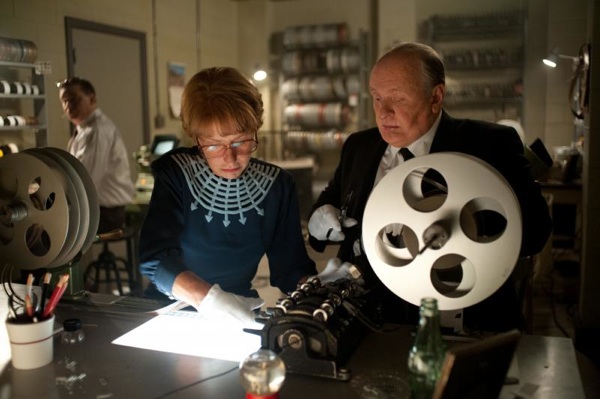
Power Couple - Hitchcock (Anthony Hopkins) and Alma Reville (Helen Mirren) turn 'Psycho' from a promising concept into a Hollywood classic.
Jessica Biel’s emaciated lack of resemblance to Vera Miles notwithstanding, much of the film’s success comes from the care taken in its casting of even the smaller roles, be it former “Karate Kid” Ralph Macchio’s blink-and-you’ll-miss-it appearance as Joseph Stefan, a screenwriter with mommy issues, or James D’Arcy as an eerily spot-on Anthony Perkins (“Psycho’s” Norman Bates).
While not quite the definitive biopic on Alfred Joseph Hitchcock, Gervasi's film delivers here an entertaining look at the man and myth that, if nothing else, should engender in casual viewers an interest to seek out more about this giant of cinema and his place in Hollywood history. For fans of Hitch who know all the backstories and real-life drama that went on behind the scenes, however, this is an affectionate, fanciful tribute well worth spending a couple of hours on. —KG, GMA News
Hitchcock is currently screening in Ayala Malls Cinemas nationwide. Mikhail Lecaros is a professional magazine editor and freelance writer. The views expressed in this article are solely his own.

